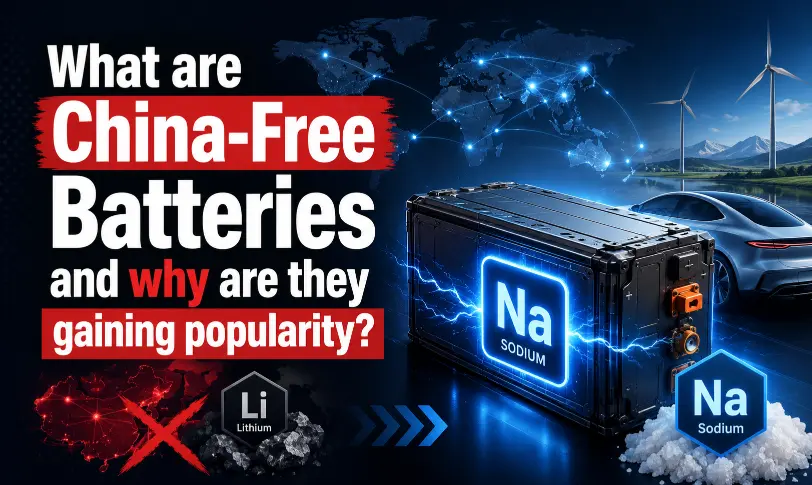

Batteries are the power engine that drives the electric vehicle industry. Today, almost all EV batteries sold are lithium-ion. That dependence is turning into a strategic issue. The world has few lithium reserves, and nearly all of the refining facilities are in a few countries. The processing side is completely under the control of China.
Sodium-ion batteries are listed on MIT’s Technology Review as the breakthrough technology of 2026. So where the sodium is in the batteries is the determining factor; that’s why some people call them China-free batteries.
What Makes Batteries China-Free?
The label does not indicate the origin of manufacturing of the battery. It describes the contents within it.
- Lithium is geographically concentrated. China’s lithium processing capacity is much more than any other country in the world, and the country has a tight grip on the global EV supply chain. Countries desiring to construct EVs must cross that hurdle.
- Sodium is different. It dominates the Earth’s crust, forming approximately 2.3%. It occurs in seawater, salt flats, and mineral deposits in almost all countries of the world. Alkaline battery of sodium based (Na) does not require Chinese Lithium Processing. The China-free label is all about this.
How Does Sodium-Ion Technology Work?
The sodium-ion battery has a similar working principle to the lithium-ion battery. The ions transfer from the positive cathode to the negative anode when the device is charging and discharging with the electrolyte. What ions are those that differentiate the two? Sodium replaces lithium.
The only benefit in their favor is the raw material. Sodium is widely available, inexpensive, and can be obtained from all over the world. Does not need complex mining and lithium refining. The battery may be cobalt-free and/or nickel-free as the materials are toxic and supply-limited in many chemistries employed in lithium-ion batteries.
Why Are Sodium-Ion Batteries Relevant Now?
The change from research to production of sodium-ion happened for several reasons around 2025 and 2026.
In April 2025, CATL, the largest battery company in the world, rolled out its sodium-ion brand Naxtra. According to CATL, sodium-ion therefore has the potential to eventually replace 30 to 40% of the lithium-ion market.
In January of 2024, BYD took up the project of building the first sodium-ion battery factory. On Monday, Changan Automobile introduced a sodium-ion passenger car slated for release in mid-2026. The IEA has estimated 2026 as a key year for scaling up the technology.
On the other side of the world, as it were, companies such as Inlyte Energy in the U.S. and Peak Energy are doing their best to avoid the pitfalls of relying on lithium for sodium-ion production. Peak Energy CEO Landon Mossburg put it plainly: the risk is not being out-innovated on the science. The only alternative is to be out-scaled, and China can turn research into industrial production at a rate faster than others can catch up.
What Are the Benefits of Sodium-Ion Batteries?
- Cost: Sodium will cost much less than lithium. Just as production ramps up, sodium-ion batteries will become significantly more cost-competitive than Lithium-ion batteries of similar capacity. That difference does matter for entry-level EVs and electric 2-wheelers where cost is the main obstacle.
- Cold weather performance: CATL’s sodium-ion cells retain over 90% capacity at minus 40° C. Cold temperatures cause Lithium-ion batteries to lose a lot of their capacity. This is important for EV markets in cold climates.
- Safety: Many lithium-ion battery chemistries are prone to thermal instability, whereas sodium-ion batteries are not. Thermal runaway is a battery failure mode that is less likely to occur, contributing to the worst vehicle perimeter fires.
- Supply chain independence: If a country or a company decides to make sodium-ion batteries, it has nothing to do with the processing of lithium by China. It’s a form of independence, and for Tumblr, it’s an economic and geopolitical asset.
What Are the Limitations of Sodium-Ion Batteries?
Sodium-ion products are not ready for widespread substitution for lithium-ion.
- Lower energy density: A sodium-ion pack requires more space and weight to store the same amount of energy as a modern lithium-ion pack. This is a significant limitation in passenger EVs if range were a key factor. For stationary applications where weight is not a priority or grid storage, it is not.
- Today’s production is still very small. In 2025, sodium-ion production accounted for less than 1% of global lithium-ion production. The shipping of real products is in process, but the maturity of the supply chain is nowhere near lithium-ion yet.
- Lithium prices have also come just over a dramatic decline since hitting a high in 2022. At current lithium prices, the cost of making the switch is less compared to two years ago.
What Could These Batteries Mean for Pakistan?
The EV market in Pakistan is dominated almost 100% by Chinese manufacturers. Lithium-ion vehicles are currently sold by BYD, Changan, and others. However, these batteries could become more relevant to Pakistan as sodium-ion production expands.
However, the direction must be correct. When China has scaled up its sodium-ion EV production in the entry-level segment, the vehicles can be expected to enter Pakistan through the same channels. A budget EV with a sodium battery would alter the equation and make it much more economically feasible for Pakistani customers.
Conclusion
China-free batteries translate to a chemistry that reduces dependency on a handful of countries in the lithium supply chain. Sodium-ion batteries utilize the most plentiful material on the globe, are less expensive to manufacture, operate more effectively in cold environments, and have a low risk of catching fire. Presently, they are not the alternatives to lithium-ion batteries for use in high-performance EVs. For budget cars, grid storage, and nations that are seeking to cut dependence on critical resources from China, they are the biggest battery innovation of 2026 to date.