
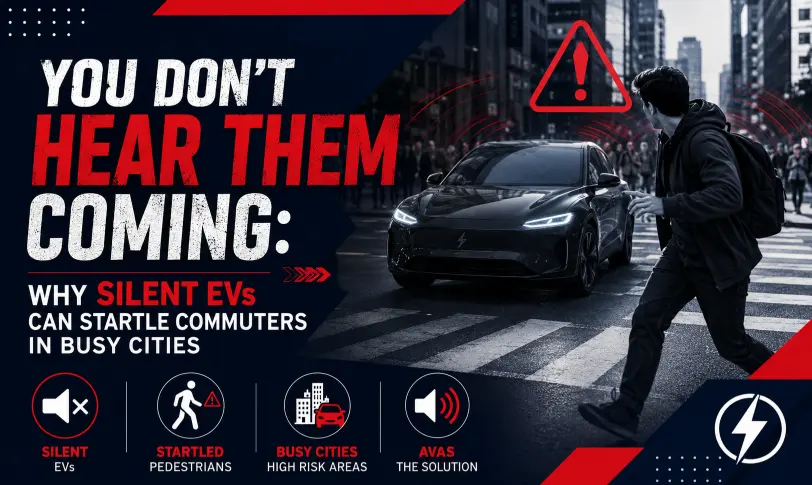

When someone is crossing a busy street and suddenly notices an approaching car, the experience can be surprisingly alarming. These occurrences are increasingly becoming the norm for electric vehicles. EVs can glide through cities with very little noise, sometimes leaving pedestrians and cyclists unaware of their approach until they are nearby.
Why Are EVs So Quiet?
A petrol or diesel engine emits constant sounds: gears shifting, an exhaust note, vibration of the engine; sounds that pedestrians have gotten used to over decades. Electric motors don’t operate like that. When driving slowly, an EV emits only tyre friction, and in the background, an almost quiet noise.
It’s not a problem with the technology itself. It’s a natural consequence of eliminating the gas engine.
Where Are EVs Most Dangerous?
The safety of silent EVs varies from place to place. The threat focuses in a few scenarios:
- Parking lots and driveways where cars are parked, and pedestrians don’t look straight ahead on the driveway.
- Narrow streets and market areas where people cross the footpath without looking left or right for vehicles.
- Reversing situations in which a silent EV retrieves from a parking space without any audible signal.
- Pedestrians with visual impairments who use engine noise as a primary tool for distance and speed assessment.
How Regulators Are Responding?
In response, governments have taken steps to rectify this through a technology known as an Acoustic Vehicle Alerting System (AVAS). The technology does this by creating an electronic noise on external speakers when the car moves at a speed below a threshold. It provides an audible signal that would alert others.
- Under European Union regulation UNR138, which has been in effect since 2019, AVAS has been required for all new EV vehicles.
- Australia implements AVAS incrementally: All newly approved EVs must have AVAS from November 2025; all new EVs manufactured will have AVAS from November 2026.
- India has suggested rolling out AVAS for new models from October 2026 and for existing models from October 2027 onwards.
- The United States has a similar standard in FMVSS 141, which calls for alert sounds up to about 31 km/h, compared to most of the rest of the world.
- It is China that uses its own version via the national GB/T 37153 standard for electric and hybrid vehicles.
- The basic idea is the same in all countries: provide sufficient time for pedestrians to see a vehicle coming before they are in its line of sight.
What Do Quiet EVs Mean for Everyday Commuters?
The adoption of AVAS by EVs, for drivers, reduces the risk of pedestrians failing to hear the approaching vehicle. Many EVs on the road today, however, don’t have this capability, and most regulations do not mandate retrofitting, leaving a significant portion of EVs already on the streets today silent by default.
However, the pedestrian safety precaution is to avoid going by sound when EV drivers are present. Double-checking your approach to a street, driveway, or parking lot is always a good practice, but it is even more important these days when all EVs operate quietly.
Conclusion
Electric vehicles address many issues created by petrol vehicles, such as tailpipe emissions, fuel costs and noise pollution. However, the quietness opens up a new layer of danger that was not present from a 10-year view. And one that cities, regulators and drivers need to catch up with. Of course, AVAS is catching up, but as long as not all EVs are equipped with them, this is something that pedestrians and drivers must know.