
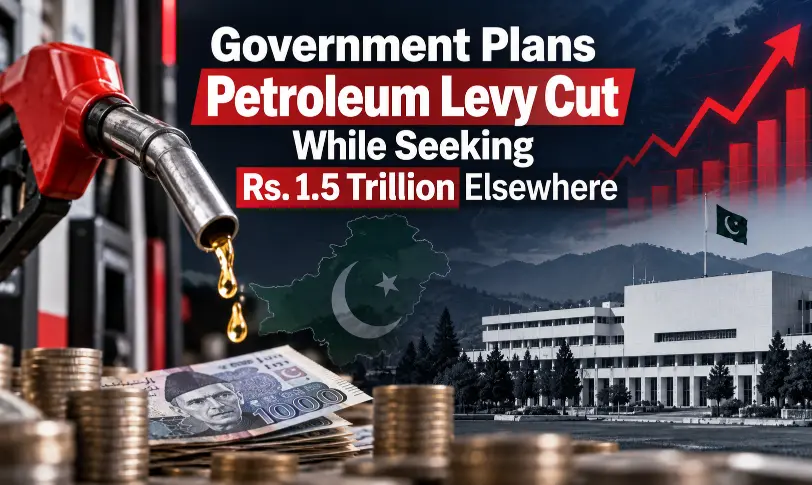

At first glance, this appears to be good news for Pakistan’s petrol prices. However, if the petroleum levy is cut, the government will need to recover the lost revenue elsewhere.
Petroleum Levy Cut Proposal: What’s Actually Being Proposed?
The government is considering a plan to reduce the Petroleum Levy to Rs. 5 to Rs. 10 per litre. Jamaat-e-Islami proposed the plan, and the Ministry of Planning circulated it to the Finance Ministry, FBR, and the State Bank of Pakistan. The proposal includes new taxes, stricter enforcement, spending cuts, and the elimination of exemptions.
A considerable number of figures are involved. The government collected Rs. 1.557 trillion through the Petroleum Levy in FY2025-26, exceeding the target of Rs. 1.468 trillion. The target for FY26-27 is even higher at Rs. 1.576 trillion. As a result, reducing the levy to Rs. 5-10 per litre would leave only around Rs. 96 to 180 billion in annual receipts, creating a revenue gap of roughly Rs. 1.45 to 1.50 trillion.
Where the Replacement Money Would Come From?
The plan calls for luxury consumption, the wealthy, large corporations, property, agriculture, and retail as new revenue sources. Way forward ideas consist of increasing Federal Excise duty and regulatory duty on luxury imports, luxury cars, high-class consumption, and also a levy on first-class and business-class air travel.
However, these luxury-related measures could generate an estimated Rs. 200 billion to Rs. 280 billion once fully implemented. Therefore, they would still fall short of covering the entire revenue gap, still well short of covering the full gap on their own.
Why the Petroleum Levy Cut Isn’t a Simple Swap
The government considers petroleum levy income as non-tax revenue, going directly to the Federal government. The NFC Award formula shares the majority of FBR taxes with the provinces.
This implies that the government can’t just take Rs. 1.5 trillion in new FBR taxes and expect to recover the same amount for federal use. The government might need gross FBR collections around 2.3 times higher than the actual deficit, if the government does not implement any of the other arrangements, such as using a surcharge or a different plan with the provinces for NFC.
The IMF Factor
However, the government will need IMF approval before implementing this cut, considering the high importance of the petroleum levy in Pakistan’s current fiscal terms. The government will need to negotiate before making any changes to make, with Provincial co-ordination as another level.
Why the Government Is Even Considering This?
With the spiraling fuel prices, there is real pressure on the fuel market. Brent prices have reached nearly $108 a barrel, which means petrol is already dear and has risen sharply this year. Islamabad relies on the levy as one of its most reliable revenue sources exactly because it doesn’t have to be negotiated around like taxes broadly, but this benefit has come at a real cost to consumers.
Conclusion
Reducing the petroleum levy in Pakistan appears like good news on paper, but replacing it gives rise to fresh issues. Ironically, 1.5 trillion in federal revenues is actually complex. Before drivers see any real change, this proposal has a long road ahead, including IMF approval, provincial rules of the game for revenue-sharing, and the sheer scope of new taxation needed.