
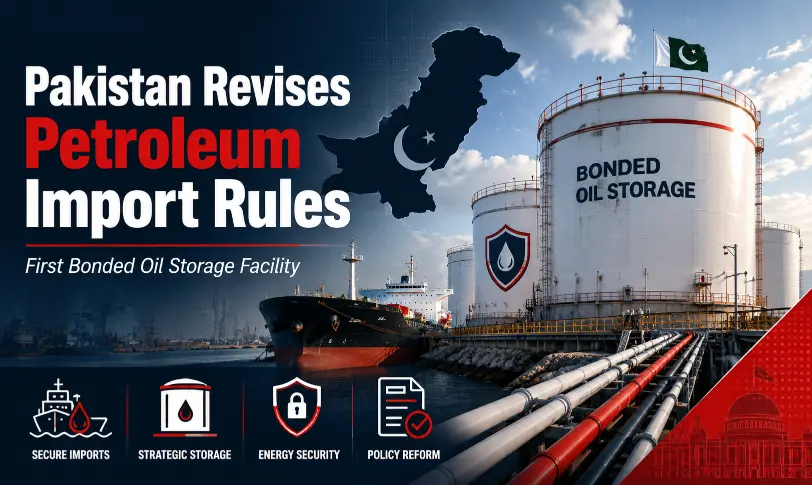

Pakistan is taking steps towards establishing its first commercial bonded oil storage facility to strengthen energy security and manage petroleum supply risks. The policy to make it happen has been submitted to the Economic Coordination Committee for approval. According to Petroleum Minister Ali Pervaiz Malik, the scheme had been prepared with the assistance of Saudi Aramco and other major companies on the 24th of August 2026.
The push is based on a hard lesson. The Iran-US conflict this year saw the Strait of Hormuz blocked, and Pakistan did not have any strategic buffer to back it up. This strait provides access to as much as 90% of the country’s imports of crude oil and LNG.
Why the 2023 Policy Failed?
This isn’t Pakistan’s first attempt. ECC approved the original bonded Storage Policy in June 2023. Rules and procedures were adhered to. However, three years later, no foreign supplier had erected any bonded storage facility as part of it.
These were structural reasons. The policy was not user-friendly towards suppliers. It limited their free re-exportation of stocks. It also imposed duties at the wrong stage in the supply chain, which resulted in an unappealing commercial deal. At the beginning of 2026, Malik set up a committee to rectify this issue, which led to a revised draft policy being sent to the ECC.
How the Bonded Oil Storage Facility Will Work
The main change is straightforward: However, petroleum cargo is now released on a foreign supplier’s account without immediate compliance with domestic duties. A supplier may have a local liaison, branch, and/or incorporated company. Either they can create their own storage, or they can use existing licensed stores.
After they enter the bonded system, the products may be transported between approved sites in Pakistan via the pipeline system without paying duty. Duties only come into existence on the removal of the product for domestic consumption. Any supplier who cannot sell locally can re-export.
It makes Pakistan’s role totally different. This policy applies to crude oil, motor spirit, high-speed diesel, jet fuel, fuel oil, LPG and LNG. Sanctioned products are not included. The proposed port storage sites consist of Port Qasim, KPT, Kemari, Hub, Gwadar, Mahmood Kot and Machike Sheikhupura, which have been subject to the normal safety and licensing assessments.
Implementing a backup plan in Pakistan
The most crucial clause, from Pakistan’s perspective, is the emergency access right. In an emergency, the government has the right of first refusal on bond stock. If their stock has decreased to the end of the last 10%, then they shall notify Pakistan. Next, the government has 24 – 48 hours to decide if it wants to purchase the remaining stock. If it doesn’t, the supplier is free to sell or export it.
This will provide Pakistan sufficient buffer without taking a significant risk of funding its own strategic reserve. There would be a separate proposal to redirect some of the existing petroleum levy into a separate fund to build bonds, in addition to the bonded storage system.
Who’s Interested So Far
Kuwait was the first country to formally show interest. The framework has also been extended to Saudi Aramco, Abu Dhabi National Oil Company, Kuwait Petroleum Corporation, QatarEnergy, PetroChina and trading companies Vitol and Trafigura.
On its own, Pakistan has continued its diversification of crude sources. The country’s largest refiner Cnergyico has continued to purchase USWTI oil from Vitol, which is part of a trend it started in 2025 away from the almost exclusive reliance on Middle Eastern supplies.
Where Pakistan Stands Regionally?
There are currently no strategic petroleum reserves in Pakistan. India was using the assistance from the UAE to enhance its reserves. Saudi Arabia, Kuwait and the UAE all hold significant amounts of their own reserves.
The revisited bonded storage structure (assuming approval and indeed this is the case this time round) fills that gap without forcing the government to lead the charge alone.
Conclusion
Pakistan’s proposed bonded oil storage facility could become a major step toward improving energy security and building a more resilient fuel supply chain. The cost of no reserves was a reality, not a speculation, because of the Hormuz disaster. The updated policy addresses the business issues, and now Kuwait has shown interest. Let us hope for the best with these updated policy Rules for Oil Storage Bonded Facility.