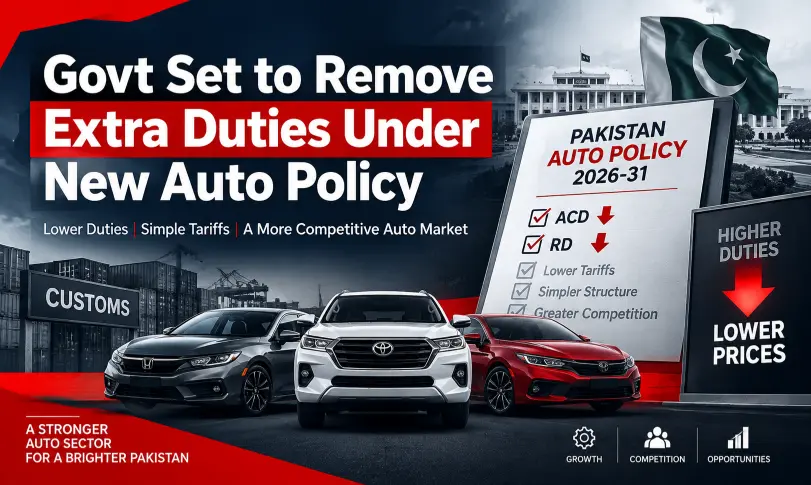

The import composition of vehicles in Pakistan is changing dramatically. Under the Pakistan auto policy 2026-31, the government plans to remove two duty categories that have increased vehicle prices for years.
What Will the Pakistan Auto Policy Remove?
The policy applies to Additional Customs Duty and Regulatory Duty. These duties have been added to standard customs duty for many years. The draft states that the implementation of regulatory duties and other customs duties will be discontinued completely by FY31.
This is not a fast process. The government will gradually phase out these duties under the National Tariff Policy 2025-30. The goal is to reduce the auto industry’s weighted average tariff from 10.6% to under 6% by 2030.
How Does the Pakistan Auto Policy Relate to Tariff Issues?
The policy aims to expand exemptions from imposing customs duty on all vehicles, except ACD and RD being capped at 15% till FY2030-31. For CKD imports, non-localised components will be imported at 10%, whilst localised parts will be reduced to 15%. Duties on raw material are completely removed.
The duty for hybrid CBUs will change to 15%, with a new duty for new energy vehicles of the same level in effect. The current, more complicated tariff structure will be replaced by a simpler five-tier plan consisting of 0%, 5%, 10%, and 15% rates.
Why Is the Government Doing This?
The complete transformation can be attributed to the IMF programme commitments of the country of Pakistan. The IMF has particularly recommended a gradual phase-out of protection on the auto industry, including abolishment of further customs and regulatory restrictions, in addition to a significant car customs rate reduction.
The Fiscal Math Behind the Policy
The government projects this policy could generate a net fiscal benefit of around Rs. 288 billion, plus over Rs. 1.764 trillion in additional economic benefits over its five-year rollout. Estimates suggest that the number of people killed is approximately Rs. 485 billion in additional Federal Excise Duty revenue, against about Rs. 196 billion in reform-related expenditure.
What Does the Pakistan Auto Policy Mean for Buyers?
As ACD and RD are eliminated, both locally-made vehicles and imported vehicles prices will move closer towards competition. Reducing tariffs also usually leads to greater competition from imports, driving deflationary pressures on current manufacturers.
This is still a multi-year rollout, though, and significant price adjustment and not a 20%-off discount. It is still to be reviewed by the IMF, endorsed by EC C, signed by the cabinet and enacted into law by Parliament before it can be fully put into effect. While prices likely won’t change in an instant, the trend seems to be toward a less protected car market.
Conclusion
The Pakistan auto policy could significantly change vehicle import taxes. The gradual removal of Additional Customs Duty and Regulatory Duty could bring long-term changes for buyers. It also supports Pakistan’s broader tariff reform commitments.