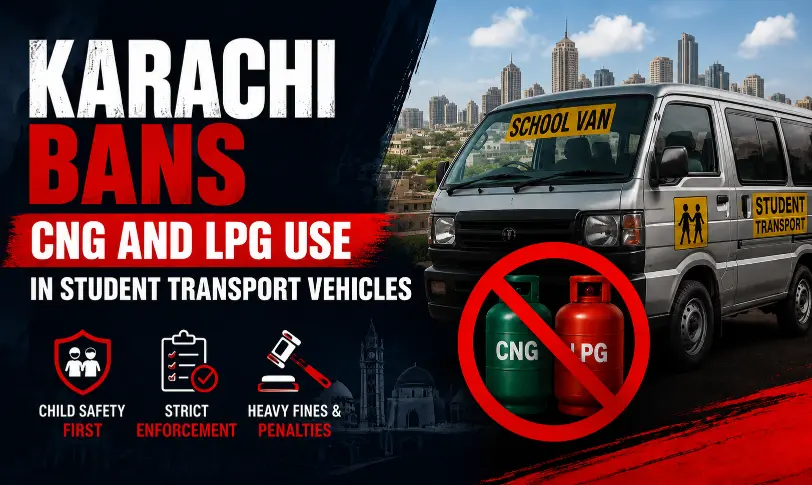

The Karachi CNG and LPG ban prohibits the use of CNG and LPG in school transport vehicles affiliated with the Board of Secondary Education Karachi (BSEK). All schools and institutes must ensure that vehicles used for student pick-up and drop-off comply with the new directive.
What the Karachi CNG and LPG Ban Says
The notification was issued by Naveed Ahmed, Secretary of BSEK, on August 6th, 2026. It tells schools to ensure that the student transport vehicles discontinue the use of CNG and LPG. This is also true during vacations, which means that operators cannot change fuel types after classes end.
Schools are also required to conduct regular checks on transport vehicles. The idea is to prevent collisions from happening because they aren’t going to happen.
What Happens If a School Ignores It
The sentences are genuine and serious.
- Vehicles caught using CNG or LPG won’t be allowed to run as school transport.
- Violators will face fines.
- Impounding of vehicles is possible.
- Schools should monitor compliance, not rely on police to catch violations.
This directly affects school administrations, rather than just van owners. A school that ignores such things today runs a real risk as well.
Why the Karachi CNG and LPG Ban Was Introduced
BSEK’s notification also forms part of its reasoning, citing the Gujarat school van case. It is using that precedent as a reason for why its enforcement is important.
This isn’t the first time in which Karachi has had this ban. This same order was issued in 2015 for school vans to remove gas cylinders. Strict enforcement of the regulations declined, and van owners went on strike. Cylinders once again were sneaked into numerous vehicles quietly.
Since then, the core threat is the same. The study identified a CNG cylinder as one of the actual risks in vehicles in Karachi. This has been witnessed in past incidents in Pakistan. Children have been killed and injured in gas cylinder-related fire accidents in vans over the years, such as in Kashmore and Muzaffargarh.
Why CNG and LPG Became the Default in the First Place?
CNG has been available in Pakistan since the 1990s, when there appeared to be ample supplies of natural gas. It was cheaper than petrol or diesel, and widely used as an environmental-friendly fuel. It was enthusiastically taken up by van operators who were stretched for profit, such as those transporting children. One of the reasons CNG has remained in school transport, despite these previous phases of the ban, is the lower cost than petrol.
It’s not just a Karachi issue
The transport department said that the government should also take action against school vans and inter-district public transport vehicles in the province. BSEK’s directive is implemented in conjunction with the broader push, not instead of it.
That’s important because previous bans failed in part because of difficulties in enforcing them. A notification at the city level clearly dies down soon; now this problem requires a provincial-level notice.
What Schools Are Being Asked to Do Beyond Enforcement?
BSEK also wishes to raise awareness among parents, students, and transporters. The way we want to do it is more of an explanation of the risk, not a handing out of a rule. This time, it will be awareness plus enforcement.
A positive transition from 2015. There was little reason cited for the ban in those days, and it was resisted strenuously, partly because CNG and LPG were cheaper to run. This cost disparity and the apparent lack of clarity about why the safety was necessary were sure to be met with resistance.
What the CNG and LPG School Transport Ban Means for Parents
So far, the responsibility lies primarily with schools and transport operators. However, parents have a part to play as well. It’s not too much to ask if a school tells you whether their transport means meet the new directive. Unlike the 2015 ban, quiet compliance cannot be taken for granted, given how cylinders were sneaking back in since then. There is no cost for a brief conversation with the school administration or van driver.
Conclusion
The Karachi CNG and LPG ban represents a renewed attempt to improve student transport safety through stricter enforcement, institutional responsibility, and public awareness. This time it is a joint effort from BSEK and the transport department of Sindh, and penal consequences come with a warning campaign. If it actually makes it through will rely on the ability to enforce. So the schools, the transporters, and the parents are all given a clear direction to follow. Removing CNG use from student transport will be a great initiative for the safety of children.