
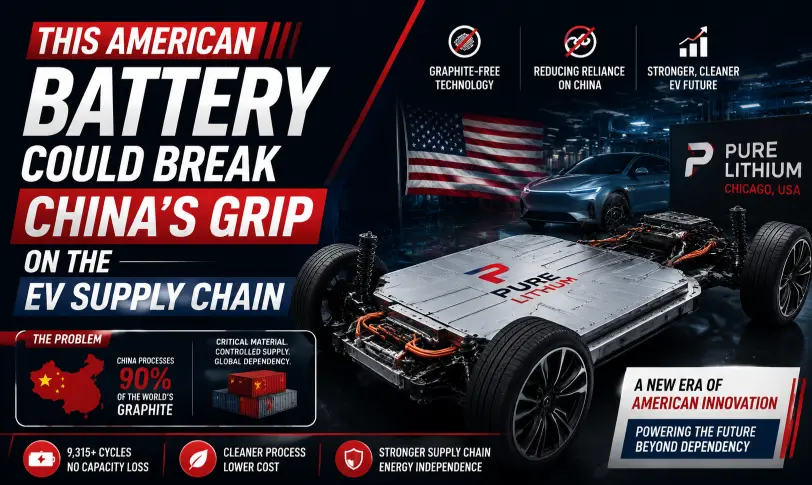

The majority of electric vehicle batteries currently rely on a supply chain connected to China. A Chicago-based company believes it has developed a solution: a graphite-free battery technology that could reshape the future of electric vehicle production.
Meet Pure Lithium’s Electric Vehicle Battery Technology
Pure Lithium is an American startup developing a lithium iron phosphate (LFP) battery. It removes the use of graphite in the manufacturing of electric batteries. Mostly, China processes 90% of the world’s graphite, and America wants to reduce the dependency on China by making graphite-free batteries.
A Breakthrough in Cycle Life
Lithium metal batteries have long faced challenges with cycle life, losing their effectiveness over time as they are recharged.
Pure Lithium says it has cracked this. In a statement, the company said that the cell had endured nearly 9,315 charge and discharge cycles without a loss in capacity, compared with a typical lithium-ion battery, which lasts about three cycles.
Notable: This outcome is the result of Pure Lithium’s own laboratory testing. It is not verified by a third party yet, and the tested cell energy density has not been published.
The impact of this for the Supply Chain
Pure Lithium’s battery eliminates the need for such materials, which are costly, dirty, and restricted to Chinese supply chains.
The company makes its lithium anode by electrodeposition, a single manufacturing process, which reduces costs and eliminates dirtier sourcing methods.
The same goes at the policy level. China’s battery output and processing capacity is dominant. Across the board, this concentration is perceived as a growing threat to the development of independent EV markets for countries.
Pure Lithium Isn’t Alone
Other U.S. startups such as Factorial, Solid Power and QuantumScape are pursuing the same objectives. LionVolt is also working on lithium metal anodes in Europe.
There are no mass production projects of these. STP’s outcome is not a product, but a laboratory milestone. The transition to any new chemistry in a factory is typically a multi-year process.
What This Electric Vehicle Battery Could Mean for the Future?
If the technology can survive outside the lab, it could provide a genuine alternative to graphite-powered batteries, and a relief from China’s export policy and pricing. Readers interested in the latest automotive developments can also explore electric vehicle trends and car market updates.
It is an early development to watch, and it’s part of a broader trend for Western battery firms to diversify away from Beijing.
If you are considering electric vehicles in Pakistan today, you should check out the FameWheels platform that offers verified listings of cars.
Conclusion
The graphite-free electric vehicle battery may become an important step toward reducing China’s dominance in EV materials and creating a more independent battery supply chain. Lab results are promising but not yet confirmed, and large-scale production is yet to come. The next steps will determine whether it will become the battery that affects the supply chain.