
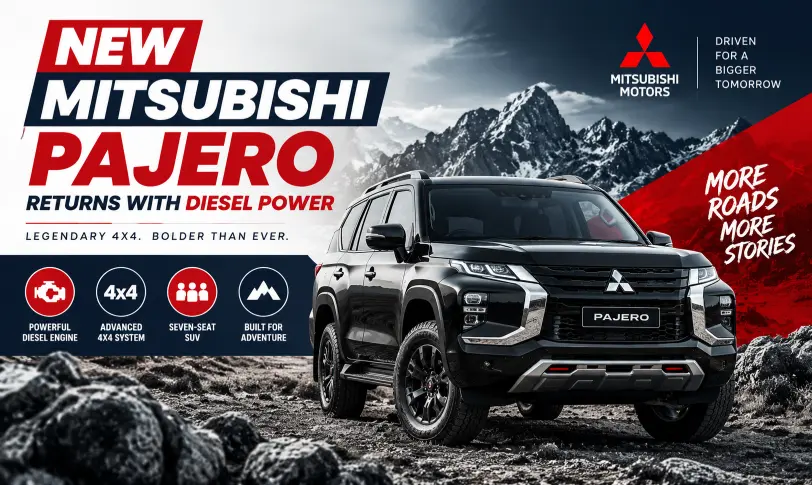

The legendary Mitsubishi Pajero is making a comeback after 5 years. However, instead of chasing electrification trends, Mitsubishi is leaning harder into diesel power than ever.
New Mitsubishi Pajero Comeback Explained
It’s official, but the all-new Pajero has been unveiled in Japan and reinvigorated a nameplate that debuted back in 1982. Launched back in 2021, the previous iteration was withdrawn, but the badge is now coming back as a seven-seat, 4×4, bold Mitsubishi “Grand Charisma” design flagship.
The new Pajero will be built on the same ladder-frame platform as the Triton pickup and is set for sale in certain markets from the end of 2026, which includes Australia in December. It will be sold in about 100 countries, including countries in ASEAN, Latin America and the Middle East, by Mitsubishi in the future.
Details regarding the New Mitsubishi
It is the first Mitsubishi engine to be compliant with the Euro 6d emissions standard and is fitted with AdBlue and an auto stop-start system. It’s a significant accomplishment for a diesel engine right now when a lot of competitors are converting to hybrid or electric powertrains.
The power flows via an improved 8-speed automatic, featuring a greater ratio spread and “blipping” on downshifts for smoother gear shifts.
New Mitsubishi Pajero Built for Serious Off-Roading
Off-road performance is also always a big part of the Pajero. It features Mitsubishi’s flagship Super Select II 4×4 system with 2H, 4H, 4HLc and 4LLc modes and includes Super-All Wheel Control and Active Yaw Control in seven drive modes: Eco, Normal, Gravel, Snow, Mud, Sand and Rock.
Differential Lock and a Low-Range Transfer Case are standard on all grades. The chassis itself features a high-rigidity ladder frame that employs more high-tensile steel and has independent double-wishbone front suspension and a newly developed five-link rigid back axle. It combines rough-road handling with highway comfort, enabling Mitsubishi to achieve what it calls “off-road comfort.”
There’s also a substantial 3.5 tonnes of towing capacity included, making the Toyota Prado a competitor.
Why Diesel and Not Electric?
As other SUV manufacturers bring about electrification, Mitsubishi’s decision represents what consumers in this class actually need. Low-end torque, towing and predictable driving are more important to serious 4×4 road users than the emphasis on top speed numbers. That is still provided by a good diesel in a body-on-frame SUV that’s more consistent than the current electric or hybrid options.
Mitsubishi hasn’t ruled out electrification down the line, but for now, the reborn Pajero makes its statement with diesel power front and center.
Conclusion
Instead of giving way to the electric shift that the rest of the automotive industry has adopted, the new Pajero is a serious off-road flagship, based around the reworked diesel engine. With an emphasis on what buyers in this segment are demanding in terms of towing and off-road capability.