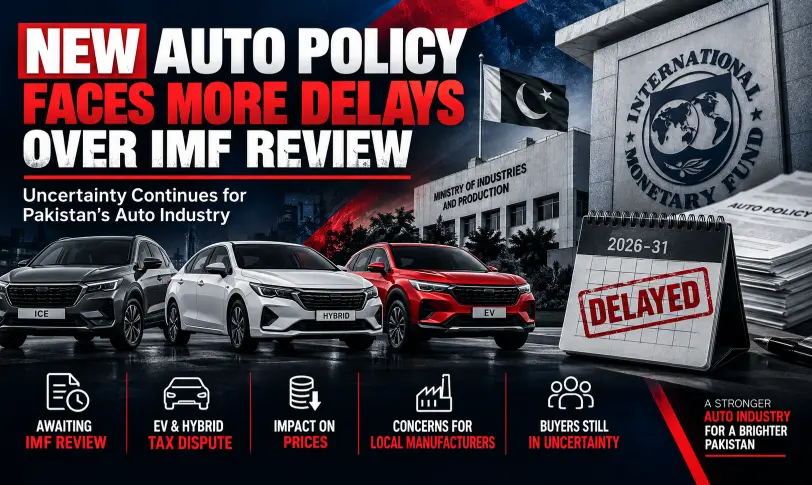

The second delay for the new Auto Policy 2026-31 is now apparent, just when it looked like it was about to be finalized. This time, it’s right through the International Monetary Fund.
Why Is the New Auto Policy Delayed?
Talking about approval, if the Auto Policy has to be approved by the end 164-173 then it has now tied up with the IMF consultations, sources in the Ministry of Industries and Production claimed. The draft has been prepared. The green light of the visiting team of IMF is missing, which would arrive in Pakistan around 23rd September.
This follows the policy being granted the nod in principle by Prime Minister Shehbaz Sharif on September 9. That was only the first step, however, in gaining official approval. The policy now requires IMF sign-off, before undergoing further scrutiny at the Economic Co-ordinating Committee, the federal cabinet and then Parliament, via a Finance Bill.
Why Has the New Auto Policy Faced Repeated Delays?
This isn’t the first setback. The previous Auto Policy of Pakistan ended on 30th June 2026 and the new Auto Policy was planned to be released in July but August was also kept as the tentative date. Bitter conflicts between the government and local manufacturers over EV and hybrid taxation, localization rules, and tariffs continued to delay deadlines.
New Auto Policy Tax Dispute With the IMF
This delay is rooted in one particular tax controversy. The government’s proposal involves an 1% sales tax for new energy cars, and a 9% sales tax on hybrids. The IMF wants to have a uniform 18% GST charged on all vehicles, stating that reducing the rate would result in market distortion and missed revenue in a fiscally constrained environment.
The IMF recommends providing direct subsidies to EVs and hybrids rather than tax cuts, which the government has not yet taken up.
Why Does This Matters for the Industry?
The IMF programme already includes a plan to substantially cut protection in the auto sector, such as removing further customs and regulatory obligations, lowering the weighted-average tariff to under 6% by FY30. The final results will have a significant impact on vehicle pricing, local manufacturers competitiveness and future investment options.
It’s a real uncertainty. Meanwhile, hybrid and EV buyers were waiting for clarity on pricing, in the absence of a clear roadmap forward, despite a previous policy that ended months ago.
What Does This Means for Buyers?
Those considering purchasing an electric or hybrid vehicle today still have their price on edge. The outcome, within the government’s proposed tax range of 1-9% or the IMF’s flat 18%, will determine the actual cost of these vehicles as the policy comes into force.
Conclusion
The Auto Policy 2026-31 has passed the domestic approval process but will be subject to all review talks with the IMF later this month. Uncertainty remains very much in the air until that consultation finishes off, and what the eventual post-consultation tax rates will look like for buyers.