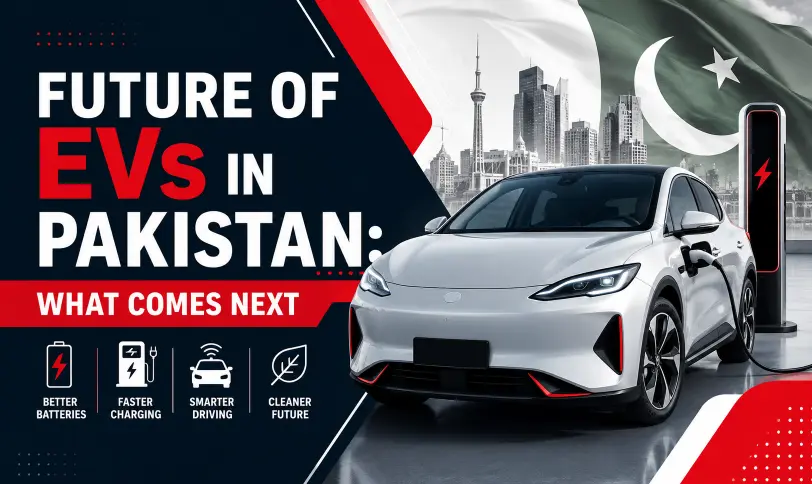

The future of EVs in Pakistan is becoming an important topic as electric vehicles change how people think about cars. Throughout much of the 20th century, a car was mainly defined by its engine, size, sound, and fuel type. Electric vehicles have introduced a new powertrain and changed buyers’ expectations about performance, technology, comfort, and efficiency.
Electric vehicles are doing more than replacing petrol engines. They are changing consumer expectations, manufacturers’ strategies, and the way vehicles are designed. Developments in batteries, charging, software, and driver assistance will accelerate this transformation.
Future of EVs in Pakistan and the Global EV Market
By 2025 the global share of new vehicles sold that were EVs was more than 25%. That is up from less than 5% in 2020. A majority of vehicles purchased in China were battery electric or plug-in hybrid. Europe saw more purely Electric vehicles than petrol vehicles come on roads in December of 2025.
Battery prices decreased from USD 1,100/kWh in 2010 to approximately USD 130/kWh in 2025. This fall is what has facilitated EVs’ competitiveness to petrol-powered vehicles. Gartner estimates that 116 million EVs could be on the world’s roads by 2026.
The fear of running out of range has begun to fade, too. Almost all the new EVs on the market today will allow for at least 400 km of actual range. With most, it’s sufficient.
How Electric Vehicles Are Changing Car Buyers’ Priorities
The transition to electric has changed the order of importance for buyers’ needs. Software, connectivity and over the air updates are now more significant than ever. Once a car makes an automatic improvement because of a firmware update, it’s a different kind of product!
The cabin experience also has been brought to the forefront. When the engine has no noise and vibration, the interior is everything. Increased screen size and speaker quality, and the comfort of seats, are now the main differentiators. BYD was aware of this early on. Its rotating screens and premium interiors are not extras. They’re the product.
Changes in expectations for performance have also occurred. In the world of instant torque, super car levels of acceleration in family sedans is the new norm. The BYD Seal AWD accelerates from 0-100km/h in 3.8 seconds. That would have been a miracle 10 years ago.
Technologies Shaping the Future of EVs
Solid-State Batteries
This is the most awaited innovation in the EV world. The liquid electrolyte in a battery cell is replaced with a solid material in solid-state batteries, which reduces the primary risk of fire and improves the energy density. Toyota is dedicated to commercially developing solid-state vehicles by 2027 to 2028. In the short term, BYD and CATL are developing semi-solid-state models.
Once solid state batteries scale, charging times would be reduced to 10 or 15 minutes. Range increases dramatically. Battery weight also reduces, increasing efficiency more.
Vehicle-to-Grid Technology
EVs are starting to function as mobile energy storage. Vehicle-to-Grid technology lets a car’s battery return electricity power to the house, or into the grid. This is not a novelty in Pakistan where the supply of electricity is not reliable. An average house can be powered by a 60kWh battery pack for several days. As this technology evolves, the car and the energy system relationship is evolving as well.
Better Driver Assistance
With every model cycle, ADAS is getting better. In a few markets, the path to Level 3 conditional automation is underway. Although full autonomy is still a long time away, the direction is still clear. The features found on existing models on the market in Pakistan such as the Haval H6, BYD Seal and the MG HS were premium extras three years ago. These make strides toward people of the next generation.
The Used EV Market
In 2026, approximately 243,000 EV leased globally are expected to expire. This is three times as much as in 2025. It will stimulate the production of many more inexpensive and renewable used EVs. Many of these vehicles may soon be available to those who can’t afford to buy new EVs right now as Pakistan’s import policies change. This is one of the more recent near-term developments of particular significance for Pakistan.
What the Future of EVs in Pakistan Means for Drivers
The future of EVs in Pakistan will depend on vehicle prices, local assembly, government policy, and charging infrastructure. The country’s electric vehicle market is still developing, but more models are becoming available. Charging facilities are also expanding in major cities, although access remains limited in many smaller towns and rural areas.
All the above technologies will be coming late to Pakistan. The key is now to raise awareness and create infrastructure that will support the transition.
Conclusion
Electric vehicles have already changed the automotive industry and the driving experience. Solid-state batteries, vehicle-to-grid technology, improved driver assistance, and affordable used EVs will accelerate this change. The future of EVs in Pakistan now depends on how quickly the country can develop charging infrastructure, increase public awareness, and make electric vehicles more affordable.