
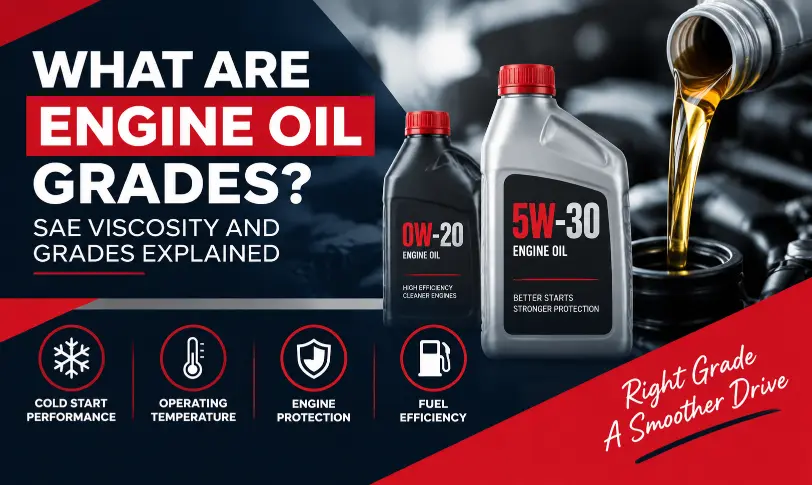

All engine oils come with a code such as 5W-30 or 0W-20 on the label. Understanding engine oil grades helps drivers choose the correct oil for better protection, performance, and fuel efficiency. Most people do not know what these oil grades signify and it causes confusion. Here is the explanation regarding engine oil grades.
What Viscosity Actually Means?
The main term of Visco is the resistance to the flow of a fluid. Honey has high viscosity. The viscosity of water is low. Engine oil falls somewhere between, and changes viscosity based on temperature.
SAE J300 is a standard established by the Society of Automotive Engineers (SAE) that rates engine oils according to their viscosity. That’s what creates the codes like 5W-30 and 0W-20.
Engine Oil Grades: Understanding the First Number
In 5W-30, the “5W” is the winter grade. A common mistake is using the term W as weight instead of Winter. This figure represents the quality of cold flow of the oil.
The lower number the better the cold start performance will be. An oil with 0W viscosity has a lower resistance to flowing when the engine is cold than a 5W oil.
Engine Oil Grades: Understanding the Second Number
The higher number (5 in 5W-30) is the High temperature designation. Measures the oil’s viscosity at a temperature of 100°C which is the oil temperature in a fully warmed engine.
The higher the number, the more viscous the oil will remain when it is at operating temperature. This may or may not be positive or negative. Relies on the design of your engine. Each oil grade has different requirements, using the wrong grade can impact protection and fuel efficiency.
The Manufacturers Recommendation and its importance
Your owner’s manual will not print the grade as it is a requirement. Modern engines are made with oil channels and clearances corresponding to a certain oil viscosity. Just two oils with comparable SAE viscosity are not necessarily compatible, as the base oil technology and additive packages are still varied between different oil brands.
This is significant because the country’s climate is changing in Pakistan
Grades are really influenced by climate. Thicker grades, such as 20W-50 or 15W-40 oils, are more likely to be in use in hotter climates because they will retain their protective film at higher temperatures for a longer duration. Always specify exactly what you want according to your climate and manufacturer’s spec, not what’s on the cheap.
Conclusion
Engine oil grades do not represent marketing numbers. They are an accurate way to monitor the behavior of oil during colder starts and at operating temperature. Making a decision about SAE viscosity grades will help you choose the right oil for your vehicle the next time around, rather than opting for the oil that your mechanic offers.