
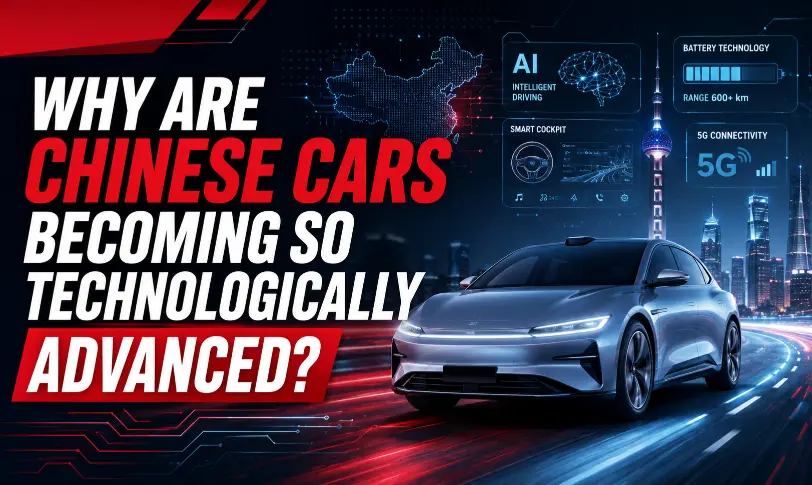

Chinese car technology is advancing faster than ever, driven by intense competition, growing R&D investment, EV innovation, AI, and smart vehicle software. At the 2026 Beijing Auto Show, humanoid robots, automotive LLMs, and auto-driving SoCs were showcased alongside the latest vehicles. At the forum in 2026, Roland Berger projects that the advantage of local Chinese carmakers in core technologies will expand over the coming five to 10 years. That’s a sharp shift from a decade ago. At that time, the Consumers primarily recognized Chinese brands for their competitive prices. The improvement is genuine, and realisation of it depends on a certain set of conditions and not pure luck or just subsidies.
Competition Driving Chinese Car Technology
The Chinese home market actually has more competitors than it needs. Chinese automakers launched more than 500 new and updated models in the first half of 2026. This now makes more than 100 car brands to locate in the country, ranging from luxury to high-tech, premium to entry-level. The density that entails forced evolution. If any car company fails to deliver real change from year to year, they’re overtaken by a dozen automakers that do.
In early 2026, China’s sales of passenger vehicles were down 20-23% year-over-year. One of the reasons for the decline was that the government had reduced EV or hybrid subsidies. That slowdown actually made technology more of a determining factor in the competition among automakers. At the same time, exports jumped 63% in the same quarter.
Local Automakers Move Faster Than Joint Ventures
The pace at which China has caught up is due to performance of structures, rather than technology. Domestic Chinese brands roll out smart features for domestic buyers at a rapid pace, says Ron Zheng, senior partner at Roland Berger. By contrast, foreign joint ventures remain stuck in global vehicle platforms and slow, centralized vehicle approval processes.
A local brand can find a consumer preference and send a matching feature within a few months. Scheduling a global sign-off will often be requested by a multinational first. It was in 2023 that Guangzhou Automobile Group, an ally of Toyota and Honda, declared the era of the Joint Ventures over in China’s automotive industry. This statement is no longer a forecast but a description of where the market has ended up.
R&D Boosts Chinese Car Technology
Chinese automakers are lending a helping hand by investing dollars to this pace. XPeng has invested heavily in intelligent driving, AI-powered vehicle technology, and connected-car software. Even in the year 2025, it invested almost $1.32 billion in R&D, marking an increase of 46.9% from the previous year. Those funds aren’t being largely allocated to engines and transmissions. It will move to areas such as software, self-driving, and connected in-car experiences, where Chinese brands are stepping up rather than taking the lead.
Chinese car technology has moved beyond traditional improvements in engines and vehicle quality. Now, Chinese manufacturers are playing the game of AI integration, over-the-air updates, and in-car intelligence.
The Supply Chain Is Now a Technology Asset
Chinese car technology has also benefited from suppliers that have built deep technical expertise alongside local automakers over the years. This includes batteries, electric drive trains, autonomous systems, domain controllers, and thermal. Close collaboration for years has yielded rich experience with development system integration. It’s a type of experience that you can’t just purchase off the shelf.
This is important because it alters the products that China’s supply chain really has to offer to the business world. A low-dollar production method is no longer the only choice. It’s an actual source of proven and field-tested technology that global automakers have to think around, not bypass.
Hybrid Technology Is Advancing Alongside EVs
Chinese car technology is not limited to pure EVs, as local manufacturers are also making rapid progress in hybrid systems. This growth also reflects the wider development of electric vehicle technology. BYD has developed several hybrid technologies, including its DM-i system, as part of its broader new-energy vehicle strategy. It has a dedicated PHEV engine with a 15:1 compression ratio and a BTE of 43%.
Unlike electric vehicles, Chinese manufacturers have ensured that their hybrids boast the same technological credibility.
Conclusion
The rapid advancement of Chinese car technology is not the result of a single factor. It’s driven by relentless competition in the domestic market, continuous iterations, a significant competitive advantage from joint-venture partners, and sustained advancement on battery and hybrid fronts.