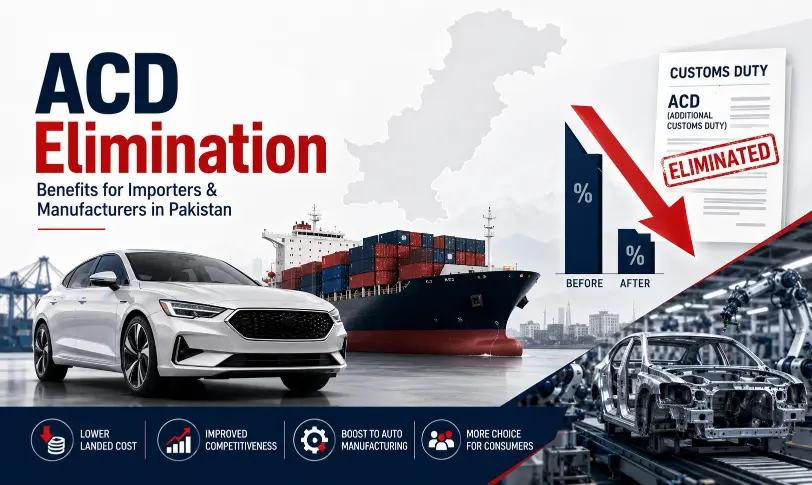

If you have read Pakistan’s tariff changes policy announcements, you must have heard the words ACD, reductions in customs duty, and a new auto policy. What is ACD? Why is its removal so important? Who benefits from its elimination?
We will explain it in simple terms for all those who are directly or indirectly a part of importing cars or auto parts. It is important to understand how this policy has affected the car market.
What Is ACD and Why Did It Exist?
ACD is Additional Customs Duty. It is an additional duty that is imposed while goods are imported into Pakistan. It was originally designed to generate revenue temporarily, from customs without an official act of an increase in customs rates. Over time, which was designed to be a temporary measure, it was transformed into a permanent one, increasing the price of nearly all foreign products imported into the country.
About 7,476 of Pakistan’s total 7,589 tariff segmentations were covered under ACD at some stage. It’s almost the complete import catalog. For car importers, this involved paying customs duty and then another duty at an additional cost for ACD; there had been no public policy justification for this extra charge.
Where Things Stand Right Now
The government has already taken initial steps to phase out ACD in the Finance Act 2026 and the National Tariff Policy 2025-30. The changes were to be effective on July 1, 2026.
During the first phase, the share of ACD has been reduced across 569 tariff lines from 2% to 0%. An ACD on more than 2,100 tariff lines was lowered from 4% to 2%. A new set of SROs is in effect, which replaces the previous ACD rate of 6% for imported cars with a new 4% for all vehicles.
The NTP 2025-30 aims to eliminate ACD from all tariff lines by 2029, meaning that by that time, importers and manufacturers will no longer have to pay an extra charge beyond customs duty.
Auto Importers Guide
Importers of fully built cars have faced multiple levels of duty by the government, with ACD being one of them, which made cars unaffordable to Pakistanis. If 15,000 USD is the CIF, then customs duty, ACD, regulatory duty, sales tax, and advance income tax can all be added together, meaning that the landed cost can be more than four times the original cost.
This stacking effect decreases as the amount of ACD is progressively lowered and finally removed. Imported vehicles become less expensive land to land, allowing price-competitive commercial importers just enough margin to be profitable. The timing is right now, as commercial used car imports are legalised starting from July 2026. New entrants to this space should reap steadily declining ACD as the policy unfolds, thus leading to enhanced economic parameters.
What This Means for Local Manufacturers and Parts Suppliers?
The upside for local manufacturers may be less apparent, but still just as important. The majority of auto brands in Pakistan manufacture cars with a combination of domestic and imported components. All imported raw materials, components, and intermediate goods are subject to customs duties, and in the past, ACD on top was applied.
This is a real saving for the industry attempting to remain competitive in a market that is also being flooded with more cheap imports by the government. It enables them to compete price-wise and not be squeezed between high production costs and a more open import situation.
Lower rates for inputs before consumer goods included in the ACD reduction schedule have been specifically identified in the NTP 2025-30 to aid raw materials and middlemen. This is by design; it helps protect the production side of the business during the transition and towards a Cleaner and Simpler overarching tariff.
The Bigger Picture: Why ACD Elimination Matters
The combined effects of ACD and Regulatory Duty increased the prices of almost all imported goods by several per cent in the country.
The elimination of ACD is another step in the trend of replacing tariffs as a revenue measure with tariffs as a real trade policy measure. This reform has also been called for by the IMF as part of Pakistan’s economic stabilisation programme in the context of the ongoing Extended Fund Facility. There will be no introduction of any new Regulatory Duties, and ACD will be on a scheduled path to zero.
The import and manufacturer community won’t have to look far for this message. The price of the trade in imported goods is slowly dropping in a planned and predictable manner. That certainty is in itself worthwhile, as businesses can make their investments, pricing, and sourcing decisions with a better sense of their responsibilities at this time.
Conclusion
One of the more realistically important changes in Pakistan’s current round of tariff adjustment is the elimination of ACD. For vehicle importers, it translates to lower landed costs and a viable commercial import business in the coming four years. To the local manufacturers, it represents low-cost inputs and an improved chance of being competitive when the market reopens. As of July 2026, the reform is already in progress, and the benefit will only increase with each passing year. Knowing where this is going in advance empowers importers and manufacturers to make wise decisions at present.