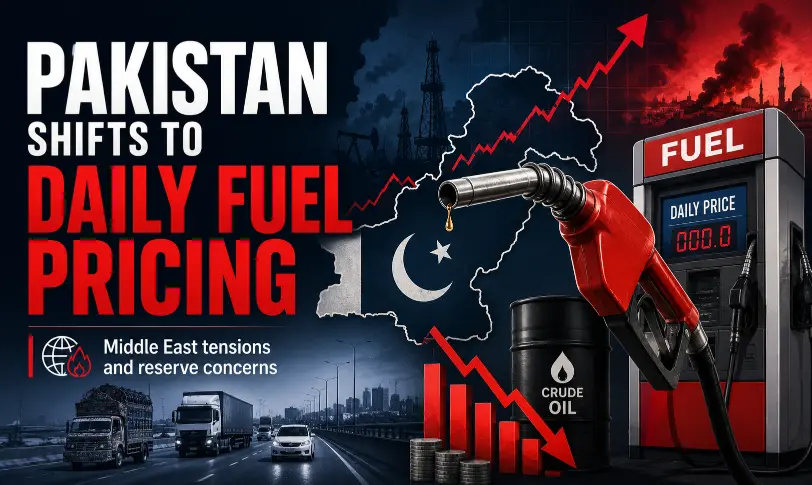

Pakistan is on the verge of changing the Daily Fuel Pricing and may introduce austerity or fuel conservation measures as early as this week. Recurring confrontation on a Middle East scale is driving up oil prices, and foreign currency reserves are already rolling back from their recent highs.
These are two separate changes currently taking place, each with direct impacts on road users and the economy as a whole.
What Has Changed Under Daily Fuel Pricing?
The government has switched from fuel price revision per week to a daily fuel pricing revision for petrol and high-speed diesel. The Petroleum Division will now announce prices daily (Monday to Friday) in the evening. A statement released on Friday will see the following rates stay in effect for three days, until Sunday.
This was made public as a move towards deregulation. The senior government official told Dawn it is not. The government has total control over the petroleum levy, climate levy, customs duty, deemed duty, and margins for petroleum companies and dealers. As earlier, the Oil and Gas Regulatory Authority will determine price difference on a daily basis and working papers will be submitted to the Petroleum Division for final notification.
There’s only one real difference in operation, and that’s frequency and transparency. Details of the government’s pricing workings will now be posted on OGRA’s website, which it stopped doing about 15 years ago when the government moved fuel price decisions to the PM level.
Why Reserves Are the Real Story?
The foreign exchange reserves stood at USD 23.99 billion on July 1 and USD 22.67 billion on July 10. The resulting decline in the value of the currency has put reserves at less than a three-day import cover level, regarded by the country’s economic managers as the lowest safety level.
Today, safeguarding that floor is now the priority. “In principle, a decision has already been made not to lower the reserves to less than three months of import cover,” said a senior official. That’s the reason the fuel saving is now back on the cabinet agenda as oil prices rise globally due to tension in the Middle East.
What Fuel Conservation and Austerity Could Look Like Again?
The measures that are being proposed are not new ones. The threat of closure of the Strait of Hormuz to oil tankers in March 2026 led to a price increase, and Pakistan had to adopt austerity measures to combat the situation. The measures were lifted in the third week of June, when the US-Iran ceasefire helped oil markets stabilise. Recently, prices have gone back up again, and the full package is back once more.
The measures taken in March involved the working week becoming shortened to four days per week for government offices, and staff going half-time. Moreover, all government vehicles were cut in half, official meetings were held online, no foreign travel by staff, restrictions on non-employee spending, and salary reductions for top-earning employees.
Market timing rules also applied to stores and businesses, with some modifications for certain industries. Schools, which are already on their annual vacation, will be encouraged to offer more online schooling.
A formal cabinet decision is expected next week or next, assuming regional concerns evolve and input reaches the Ministry of Finance and the State Bank of Pakistan on the economic considerations.
What Daily Fuel Pricing Means for Drivers
With the introduction of daily fuel pricing, a new condition is thrown at drivers and fleet managers. Weekly price fluctuations might suddenly impact people, rendering fuel cost planning more difficult for companies dealing with logistics or transportation services.
Under this rule, on a day when prices are due to increase, “filling up early in the week, before the price rise has taken effect in the evening” becomes an awareness factor. Even if all decisions end up with the government, OGRA will be publishing the daily price on its website, making it more visible than previously.
In the event of austerity being reintroduced, speed limits on highways and motorways will have a direct impact on inter-city commuting times. A previous speed limit restriction was in place on all key routes. The measures are part of a logic of gas savings in the public sector, given also the anticipated four-day working week for government institutions.
The Bigger Picture
Prices of fuels are a derivative of the volatile international crude oil market, Pakistan’s oil residue management, and its political economy. The current levy and government margin on petrol is about Rs 110 per litre while diesel’s is Rs 96 per litre. The costs for those fixed services will remain constant with the daily pricing. The flip side is about international crude and product prices, which Pakistan cannot influence, with those changing daily.
The government has admitted there could be a day when there is “genuine” deregulation, with oil companies truly competing on price.
Conclusion: What to Expect From Daily Fuel Pricing
The implementation of a daily fuel pricing changes in Pakistan is more about dealing with a challenging mix of high global oil prices than deregulation. If approved by the cabinet this week, the fuel conservation and austerity measures would be the second set of emergency measures in four months that Pakistan has had to implement. These are key developments to keep an eye on as they unfold in the next few days, for drivers, businesses and fleet operators.