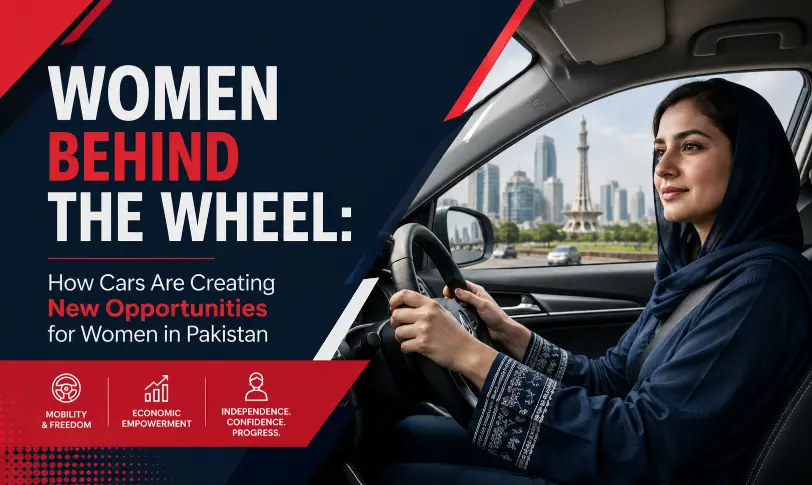

Women drivers in Pakistan are becoming increasingly visible on the roads, particularly in major cities such as Karachi, Lahore, and Islamabad. Seeing a woman driving her own vehicle is becoming increasingly common. Behind this change lies a powerful story of independence, economic opportunity, and social transformation. It is becoming commonplace. A story of independence, opportunity for economic success, and quiet, but profound social transformation lies beneath that normalisation.
How Women Drivers in Pakistan Are Gaining Independence
In Pakistan, for a long time women’s freedom of movement was completely hinged on other people. A male member of the family, a driver, or lack of reliable public transport were a contributing factor. This reliance was no simple luxury. It constricted avenues of employment, hours of work and ability to seek career paths that demanded some degree of self-mobility.
That is all erased when someone purchases and drives their own car. Now women can commute more freely to get to work, go to university, go and see the client or pick up the kids without arranging around another person’s time. This control can manifest itself in career choices, business decisions, and men’s and women’s perceived opportunities.
Economic Opportunities for Women Drivers in Pakistan
Women drivers in Pakistan are gaining better access to employment, business, and professional opportunities. Independent mobility allows women to accept jobs farther from home, maintain regular working hours, and pursue careers that require frequent travel. Women can secure jobs farther from home and work early-morning or evening shifts. Independent transport also enables them to start businesses that require regular travel.
The rate of female labour force participation in Pakistan is also one of the lowest in the region. A woman without the means to attend regularly to a workplace can’t maintain a job at a work location. No one can solve this problem directly as the car does.
Women drivers are also finding new earning opportunities through ride-hailing platforms such as inDrive and Yango. Several platforms have launched women-only rides, establishing a need for women in a professional driving profession with passengers who specifically requested a female driver. This is an actual economic opportunity now open that 10 years ago was not there when cars weren’t around.
Women Drivers in Pakistan and Access to Education
The enrollment rate of women in universities has increased considerably in Pakistan in the past decade. Access to university has always been an obstacle, however, especially for women who do not live in a region directly connected by public transport. Male equality in access to education has benefited from the rise of women’s car ownership, as well as the shift to daughters driving.
Independent transport is not a luxury for those at university, seminars or continuing education for those working or part-time learners. It is what makes it possible to participate. The growing number of women drivers in Pakistan is also making universities, training centres, seminars, and professional courses more accessible to female students.
The Safety Dimension
Safety is one of the most frequent reasons given by Pakistani women for buying their own vehicles. Unlike most cities in Pakistan, public transport in many places is not a safe option for women, especially at night or on less used routes. Street harassment, lack of gendered specific spaces and routes and too many people on board make public transport a very real barrier.
The vehicle offers a private and controlled setting. So, the ride from home to destination is independent of a bus timetable, an overcrowded van, or a rickshaw drive. For the women who work late shifts, the safety factor of car ownership is really important.
Car Manufacturers and Dealers Are Paying Attention
The manufacturing side of the car industry is slowly accepting that women are a major and increasing client base for those interested in cars. The pattern can be seen in Pakistan from various ways of marketing the cars and the features being highlighted in those ads. Female buyers appreciate the safety features, ease of parking, fuel economy and comfort inside the vehicle.
In Pakistan, models such as Suzuki’s Alto, BYD’s Dolphin and Honda’s City have all experienced great appeal with first-time female buyers.
Things are changing with digital platforms that allow anyone to buy, inspect and finance a vehicle, including services such as Fame Lease. The social and other barriers are diminishing, and now women can buy cars online through FameWheels and finance it through Fame Lease.
Conclusion
Women drivers in Pakistan are using cars to access employment, education, entrepreneurship, and safer transportation. Independent mobility is helping women build lives that are less restricted by geographical and logistical barriers. The change is seen in all communities or income groups. It’s real, it is growing and it is one of the more impactful social movements currently bringing change in Pakistani cities.