
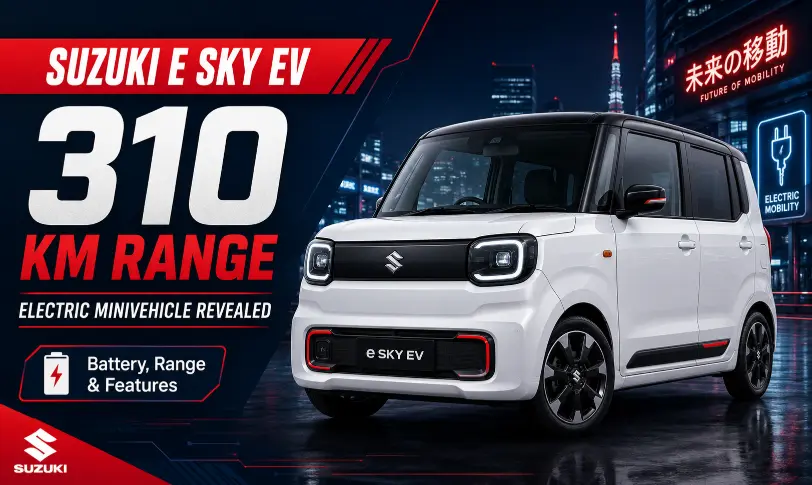

The Suzuki e Sky EV has been announced as the company’s first electric kei car, and the headline figure is impressive in the category: 310 kilometers of range. The small, boxy hatchback was designed specifically to be a ‘kei’ car, and has been named the ‘e Sky’.
Suzuki e Sky EV: What Suzuki Actually Announced?
Suzuki released the near-production Suzuki e Sky EV online on Monday, August 24, 2026. It is planned to be sold in Japan sometime in the autumn before the end of the current fiscal year in March. Suppliers have not revealed the final price, but at least Suzuki hopes the car will be affordable enough to make many car buyers switch to an electric vehicle.
This isn’t Suzuki’s first EV. It comes after the e Vitara subcompact SUV and the e Every kei van. But it’s the first Suzuki attempt to enter Japan’s electric kei-car segment, in particular, something for which the company has decades of experience.
The Real Story Is the Battery, Not the Range
A range of 310 km would be nothing extraordinary. There are plenty of EVs that make that claim. The batteries that the e Sky requires to get there are minimal. Suzuki claims an energy use of 97Wh/km, and a battery pack of only 26kWh isn’t that large even for a kei-car.
Comparably, BYD’s rival kei EV Racco requires about 38% more battery power to go about the same distance. This space is Suzuki’s real engineering proposition. Instead of trying to acquire a larger pack, the aim of the company was reducing the weight and increasing efficiency. Suzuki’s Heartect-e platform used to help achieve the e Sky’s 1,030-Kg weight.
Size and Design
The Suzuki e Sky EV is based closely around Japan’s rigid kei-car size standards. It measures 3,395 mm long, 1,475 mm wide and 1,625 mm tall, with 2,460 mm wheelbase and a tight 4.4-metre turning radius experimentally demonstrate,
Although it is small, the high roof and long wheelbase is intended to maximize interior space. The styling features black front panel, black roof, rectangular headlamps with C-shaped LED daytime running lights and squared wheel arches. A special Immersion Blue colour and matching interior styling is also available on Suzuki.
Suzuki e Sky EV: Important Details
The e Sky is fitted with a 26 kWh lithium iron phosphate battery under the floor of the front, which drives the front wheels. Suzuki is claiming a range of 310 km in Japan’s WLTC test. Support centers include AC charging up to 6 kW and DC fast charge up to 50 kW, and charging to 10-80% with support of fast charging takes about 25 minutes, according to preliminary reports.
Suzuki has also included an extra heat-pump system and an air-heated electric heater that help cut down on how much cabin heating takes from driving range, a major downside of small EVs in cold weather.
Who and what does it really compete with?
The e Sky is also joining the seriously competitive market. The Japanese electric kei car market already has a number of models: Nissan Sakura, Honda N-One e:, or BYD’s Racco. Against most of these, Suzuki’s 310 km claim is one of the longest in the category, a positive selling feature for those who are accustomed to convenience road trips with petrol fuel.
The larger picture of things is equally relevant. Current sales of electric kei cars make up about 30-4-% of the total new sales, but only 0.4% of that massive segment is electric. Potential for a lot of improvement, this is the reason why Suzuki’s comes from a company with decades of experience in kei-car making.
Will it reach other markets?
Nothing is confirmed outside Japan but reports from the industry have said the UK and mainland Europe may be seeing the e Sky in 2027. Further, it is an unconfirmed speculation that Maruti Suzuki may offer an Indian variant of this platform with a competitive range as Tata Tiago EV or MG Comet EV.
Conclusion
The Suzuki e Sky EV isn’t just another small EV announcement. The Suzuki formula of less battery, more efficiency and less weight could be more important than the kei-car rules in Japan when it proves that this is also the solution in other price-conscious EV markets. The vehicle is legitimate, the range is statistically valid thanks to a very small battery pack, and Japanese customers are in for a deal before the end of the year.