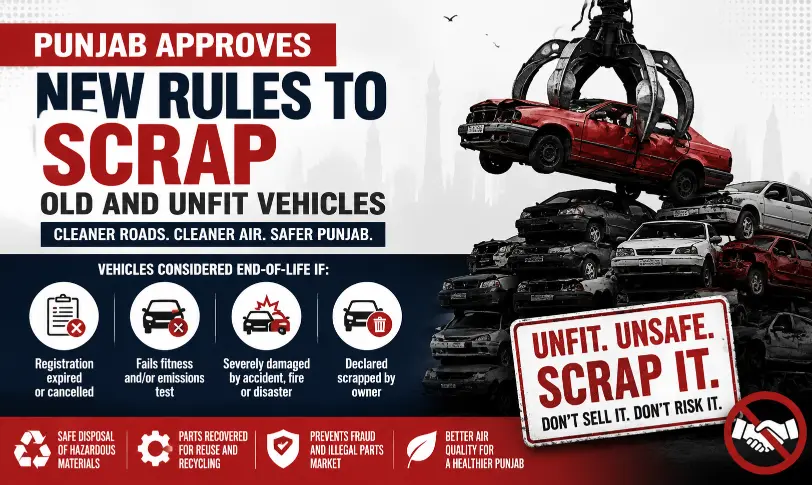

Punjab is now implementing new Punjab vehicle scrapping rules to remove old and unfit vehicles from the province. These rules introduce a legal process for identifying and scrapping unsafe vehicles. Until this year, it didn’t have any such rules. The province just closed a gap that had existed since 1965. Let us discuss which vehicles will be considered unfit and how will the process take place.
Punjab Vehicle Scrapping Rules: What Actually Changed?
Sardar Saleem Haider Khan, Governor, signed the Provincial Motor Vehicles (Third Amendment) Ordinance 2026 to be enforced. It took effect immediately, since the Punjab Assembly wasn’t in session at the time. The ordinance covers a new chapter in the original 1965 Motor Vehicles ordinance. That chapter introduces a term referred to as an end-of-life vehicle, and once it has met all the criteria, having to be scrapped.
Which Vehicles are actually eligible?
If the vehicle meets any of these criteria, it turns into an end-of-life vehicle:
- Its registration has expired or been cancelled.
- Fails required fitness test and/or emissions test and is not able to obtain a valid certificate.
- It has suffered significant damage from an accident, fire or natural disaster.
- It is declared as scrapped by the owner of the company.
Once a car is deemed so, it should be scrapped in an authorized facility. These facilities are being set up in both the public and private sectors. Instead, owners are not allowed to abandon a car or sell it informally.
What Happens During Scrapping?
Facilities should first drain hazardous fluids, such as engine oil and other liquids that should not be exposed to the surface. All parts are recovered for reuse. Any remaining materials are recycled instead of disposed of.
It minimizes car damage to the environment in the trash dumps. It prevents the reuse of old parts and chassis numbers on new vehicles which is a common problem in the used car market in Pakistan.
Why Now?
The government gives the reason for air quality. Punjab doesn’t have any legal mechanism for scrapping old automobiles that pollute significantly. The province is also working toward electric cars and eco-friendly mass transit, and officials say transition required a means to remove them. If those unsafe, pollution-spewing vehicles are sent back on the road again and again, there’s no way to build towards cleaner transportation.
This is part of Chief Minister Maryam Nawaz Sharif’s broader transport and emissions initiative, Vision for Transport 2030.
The Confusion Worth Clearing Up
That’s where many people misjudged. Social media posts quickly surfaced claiming that Punjab would take all vehicles above 20 years and no exception. This triggered a true catastrophe. Some people were said to hold back from purchasing or selling cars as a result of it.
That is not true. The ordinance mandates no age requirement per se. Scraped vehicles are those that fail to pass fitness or emissions or due to loss of valid registration or serious damage. A 20 year old Corolla that has been well cared for and meets requirements is not subject to this law.
There is, however, a separate proposed protocol for an age-based phase-out which will begin in Lahore & Faisalabad for vehicles older than 20 years. But that’s an unapproved plan, not an ordinance that just went into effect. It is precisely this conflation of the two that causes the panic in the first place.
What Owners Should Actually Do?
Maintenance is more important now than ever. A properly-maintained vehicle passing fitness and emissions tests is not covered by this ordinance.
Having the car registered and regularly serviced is no longer just ‘good practice’ but important for a car being road legal. There are more detailed rules that are pending. It has not yet finalised the testing procedures, defined age restrictions for any subsequent phase or complete register of approved scarring centres. Such information will impact the implementation of this in practice.
Where This Fits Into Punjab’s Bigger EV Push?
This ordinance isn’t in isolation. It serves as the law’s foundation for a far bigger transformation the province is trying to make. The draft also calls for reducing registration fees, token tax and route permit costs to 95% for new vehicles for the first three years and a goal of more than 3,000 new charging stations across the province.
It does tell us why the scrapping ordinance was drafted at this time. There can’t be a widespread EV transition and age-based phaseout without a legal system in place for the retirement of unsafe vehicles.
Conclusion
The Punjab vehicle scrapping rules establish the province’s first legal framework for retiring unsafe and unfit vehicles. Rather than targeting all old vehicles, the policy focuses on those that fail fitness or emissions requirements, have expired registration, or are beyond repair. This step creates a foundation for cleaner transportation, better road safety, and Punjab’s long-term shift toward sustainable mobility.