
Pakistan’s Export-Led Growth Plan Under Pakistan NTP 2025-30 The trade situation of Pakistan in the year 2026 is not for the faint of heart. In the first half of fiscal year 26, the trade deficit increased by USD 19.2 billion. Exports declined by 9% while imports rose by 11%. The nation still has one of the most complex tariff systems in South Asia, which has traditionally been protectionist rather than productive or import-substituting.
The Pakistan’s National Tariff Policy 2025-30, which the Ministry of Commerce is now implementing, is the most structurally bold in its attempts to change this. It is based on a basic change of mindset: switching from taxing to using tariffs as tools for competitiveness and global value chain integration.
The Anti-Export Bias Problem
To grasp the concept of NTP 2025-30, an understanding of the impact of Pakistan’s former tariff regime on exporters is needed.
High import duties on raw and intermediate goods developed an anti-export bias. The fact that Pakistani manufacturers had to pay more for the production inputs than those of countries like Bangladesh, Vietnam, or Indonesia was not due to lower productivity, but rather was anticipated from the very beginning as a structural cost disadvantage by the tariff structure. That cost showed up in all the units manufactured and quoted to any international buyer, leaving Pakistani exports less competitive in the market.
The total customs duty component of the combined rate of duty in Pakistan is the highest in South Asia. China averages 7.5%, Malaysia 5.6%, and the ASEAN bloc 6.49%. In Pakistan, nearly 39% of the Tariff lines have duty rates over 15% as against 4.4% in Cambodia and 9.3% in Indonesia. The competitive disadvantage this brings is not a ‘marginal’ one.
The Four Reform Tracks
This is tackled through four parallel, time-bound reforms outlined in Pakistan NTP 2025-30.
- Customs Duty Rationalisation involves moving from the current five-slab structure to four cleaner slabs of 15%, 10%, 5% and 0% over five years, while ensuring that the highest rate never crosses 15% by 2029-30.
- Our effort will Phase-out Additional Customs Duties in 7476 out of 7589 Tariff Lines in four years, ACD Elimination. ACD’s were originally temporary measures that added between two and seven percent of the cost of almost all of the imports, especially impacting export-oriented manufacturers.
- Regulatory Duty Phase-Out cuts RDs on about 2,000 tariff lines over five years without giving rise to the type of discriminatory cost structures seen in the past, and without any trade policy justification.
- Over 4-5 years, the Fifth Schedule Transition either eliminates almost all of the industry-specific concessions originally in the First Schedule or introduces them for all importers, including small competitors, eliminating a system that favourably treated large industry players at the expense of their smaller competitors.
Key Targets at a Glance
| Reform Area | Current Position | Target by 2029-30 |
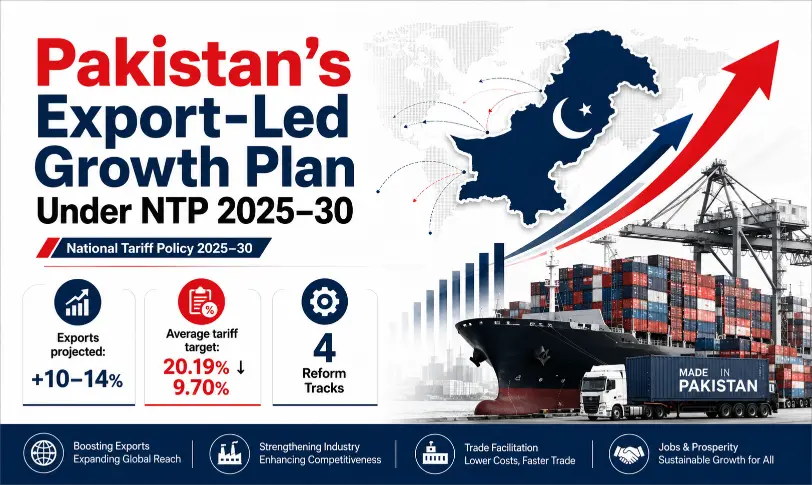
| Simple Average Tariff | 20.19% (all duties) | 9.70% |
| Customs Duty (maximum) | 20% plus peaks | 15% |
| Additional Customs Duty | 7,476 tariff lines | Eliminated |
| Regulatory Duty | 1,996 tariff lines | Eliminated |
| Tariff Slabs | 5 uneven slabs | 4 clean slabs |
Projected Economic Impact
According to the government’s modelling and analysis using GTAP, exports will have grown by 10-14% thanks to these reforms; for imports, the growth will be between 5-6%, helping to reduce the trade deficit. In the model, resources are concentrated on more productive, market-oriented industries as their prices decline.
Implementation has been initiated. The first phase lowered tariffs on around 7000 tariff lines, focused on raw material and intermediate goods, with an estimated reduction of Rs. 200 billion in benefits to trade and industry. Sector-specific measures include the abolition of customs duties on reefer containers and semi-trailers to cut logistics costs. Additional cuts to duties on special construction machinery, and cuts to duties on pharmaceutical raw materials such as raw materials for cancer medicine manufacturing.
Structural Risks
An honest analysis needs to face the implementation risks.
Pakistan’s NTP 2019-24 provided a cumulative 1% tariff cut after 5 years, which is significantly less than the target. Protected industries have successfully delayed reform timelines in the past through political pressure, enforcement weakness, and institutional accountability defects.
The takar hawala models’ estimates are that PKR 500 billion will be lost in tariff revenues. The net positive revenue effect is 7 to 9%, when the second-order effects of decreased smuggling, increased trade, and improved compliance are also taken into account (shown in GTAP dynamic calculations). Multi-year political commitment is the key variable of the policy, and the external support from the IMF’s Extended Fund Facility, expressed in a commitment without a new regulatory burden, creates room for continuity.
Conclusion
The Pakistan NTP 2025-30 is the most coherent trade reform package that Pakistan has ever developed in years. The targets are specific, measurable, attainable, and a result of regional benchmarking. The initial phase has begun, and measurable results have already been achieved. The big question is whether the full reform will survive in five years of fiscal and political pressure, and for the export-oriented sector, it will make the difference in Pakistan’s economic journey in the coming decade.