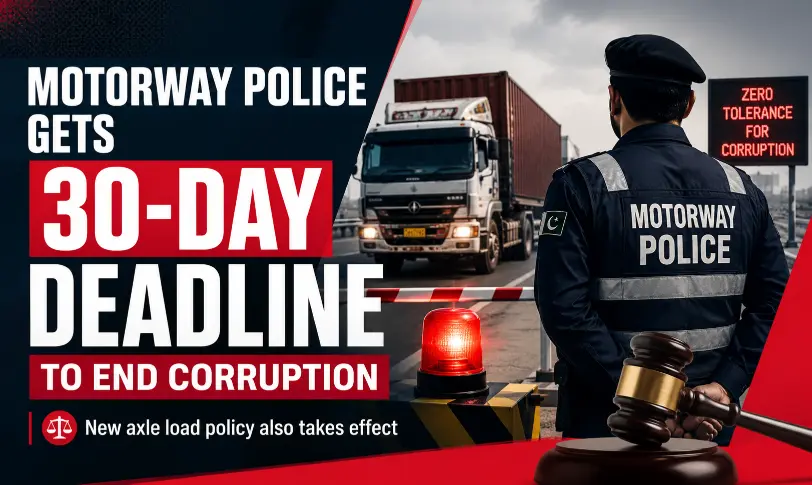

Federal Minister for Communications Abdul Aleem Khan has set a 30-day hard deadline for Motorway police to get rid of corruption from its ranks. The authorities will sack and prosecute any Motorway Police officials involved in bribery or corrupt practices. Abdul Aleem Khan announced the decision during a video meeting with members of the All Pakistan Goods Transport Alliance on August 8, 2026.
Why the Motorway Police Corruption Deadline Matters
This isn’t the first complaint against the Motorway Police. Unofficial checks going to transport sector representatives, truck operators and motorists have been troubling them for a long time. The goods transport industry has long identified this as a direct cost to their operations.
Moreover, the minister held the meeting specifically to address the concerns of goods transporters. The corruption deadline is because the industry faces the burden of bribery on the motorways of Pakistan.
Abdul Aleem Khan admitted that they had valid concerns. He promised the alliance that its legitimate needs of goods transporters would be taken care of immediately. In addition, he said issues that would impact Mazda operators and ten-wheelers would be addressed in a “priority” manner.
Motorway Police Crackdown and the New Axle Load Policy
The corruption deadline was not the only ruling by the meeting. Meanwhile, Abdul Aleem Khan added to the axle load policy on the motorways and national highways, which will take effect immediately.
Under the new policy, authorities will stop overloaded vehicles from entering motorways. Furthermore, the minister said officials would prevent overloaded vehicles from entering the motorway network. He was pleased that goods transport owners had consented to work with the policy and considered the safety of motorways and national highways a national matter.
Implications of the Axle Loading Policy on Pakistan Roads are inevitable. One of the main reasons for bad road conditions on the motorways of Pakistan is overloading of vehicles. As a result, consistent enforcement of weight limits could preserve road quality and reduce maintenance costs.
Improved road maintenance means fewer pothole issues, better driving conditions, and longer life of the vehicles for regular motorists. Heavy vehicle overloading is directly linked to road condition and a significant problem for all road users.
What This Means for Motorway Users?
The first adjustment that should be made if the corruption deadline is implemented should be at checkpoints and with patrols. Motorists and transport representatives have previously reported unofficial payments at some points on Pakistan’s motorway network.
Whether a one-month deadline can have an impact on institutional change is another matter. Corruption awareness campaigns in Pakistan’s security forces have mixed outcomes. Some produce genuine results. Others put on a show of obedience and compliance until they get their attention distracted and then settle back into their old behaviour.
This time the difference might be in tracking enforcement. However, the minister announced the deadline publicly before industry stakeholders who will directly experience the results of the crackdown. The All Pakistan Goods Transport Alliance is NOT a passive audience. Where there is a constituency made up of those who are clearly conscious of and motivated to report on corruption existing at the same level after the deadline.
What Transporters Should Know?
The announcements are a direct concern for goods transporters and commercial vehicle operators.
The axle load policy is now in immediate effect. Therefore, motorway officials will stop overloaded vehicles at entry points until operators meet the required weight limits. Consequently, transport operators must now comply with the prescribed weight limits instead of treating them as optional guidelines. Those operators who practice overloading of vehicles and pay unofficial fees for passing through will not be able to do so.
He invited the representatives of the transport industries to Islamabad for further talks to address remaining problems. It’s more effective than resuming extreme measures, something the minister advised industry to refrain from.
For Regular Motorists
The day-to-day consequences of such misfortunes to normal motorists on the motorways of Pakistan are simple. A corruption-free motorway police department translates to dealing with motorway cops based on real violations, not undocumented negotiations. Stops for speed limit infractions, lane discipline, and fire extinguisher compliance should be the criteria, not a chance for a side deal.
For example, motorists should know their rights when Motorway Police officers stop them. You have the right to ask the officer to issue a proper challan through the official system. There is no need for an informal payment of anything. Under the announced crackdown, authorities may take legal action against officials who demand unofficial payments without issuing an official receipt.
Motorway Police Corruption Deadline: What Happens Next?
What Abdul Aleem Khan did was to post a publicly available corruption deadline with public consequences for the Motorway Police. The issue of the axle load is another problem of its own kind which has been ruining Pakistan’s road infrastructure for years. Ultimately, the coming months will show whether both measures deliver lasting results. The bottom line for transporters is that it is practical to follow the rules and request official channels.