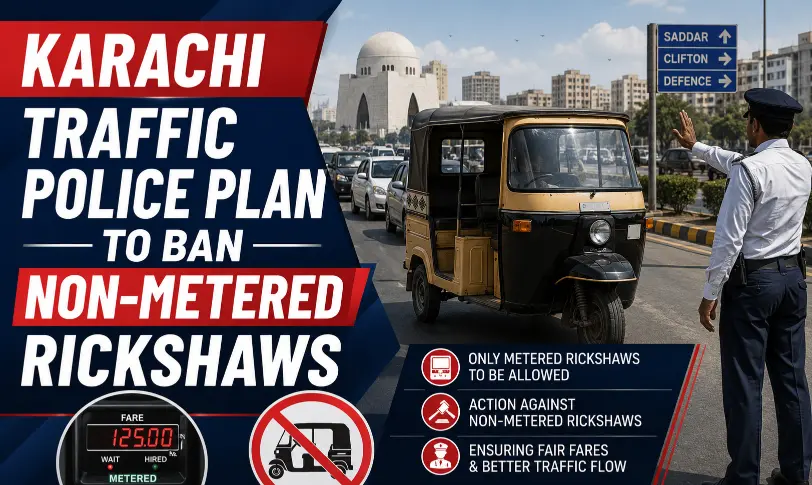

Karachi Traffic Police has said they will soon permit only rickshaws with meters, and Qingqi rickshaws will be completely banned from the city’s main streets. One of the most important things to note, before the headlines begin to fly, is that this is still a proposal. No announcement has been made, the ban has yet to take effect, and there is no blanket ban for the entire city. The idea is serious, and once it takes effect, it will impact several million commuters every single day.
What Did Karachi Traffic Police Actually Announce?
Speaking at the Karachi Press Club, DIG Traffic Pir Muhammad Shah revealed two major initiatives on which the department is working.
Qingqi rickshaws will no longer operate on the main roads. Since December 2025, the operation of these motorised three-wheelers has been limited on 25 major roads, such as Shahrah-e-Faisal, I.I. Chundrigar Road, Rashid Minhas Road, and Korangi Road. The new plan calls for expanding the city-wide ban.
Conventional rickshaws (without a fare meter) will be removed. As per the proposed policy, rickshaws with meters will only be able to be used in Karachi. The majority of the Rickshaws, still operating on negotiated rates, will have to install approved fare meters before they can keep on functioning.
The DIG has stated that eventually there will be some sort of date for the enforcement, which rickshaw owners will get in advance of the opportunity to comply before enforcement action.
Why is this happening?
The traffic authorities have stated there are three reasons.
- Traffic congestion: The risk of congestion in Karachi has been rather high due to the presence of Rickshaws on all the major arterial roads. These are being taken directly off high-volume roads to help with traffic flow.
- Fare transparency: The issue of negotiated fares is a dispute between passengers and drivers that has been a problem all along. A metered system bases the charge on distance travelled, which prevents overcharging of riders and eliminates the potential for dispute.
- Road safety: DIG has revealed that 164 accidents in which heavy vehicles claimed the lives of people took place in Karachi last year. The larger safety initiative includes getting non-compliant 3-wheelers off busy, public roads. He also added that 45,000 cars were operating in Karachi without a registered owner, indicating the larger issue of compliance that the city faces.
What Is Already in Place Right Now?
The limits don’t start from scratch. Motor Cab rickshaws have been removed from 25 major roads of Karachi from December 2025 onwards as per the rolling Section 144 notification issued by the Commissioner Karachi. This comprises major market corridors, Abdullah Haroon Road, Korangi Road, Shahrah-e-Quaideen, and Shahrah-e-Faisal. This restriction continues to be in effect, and the new proposal is in addition to it.
The DIG also said the Karachi Traffic Management Company was getting established so that the city could move towards more structured, long-term traffic planning, rather than do so through enforcement drives.
How Will this Impact Commuters?
For most of the city’s residents, a rickshaw service in Karachi is not so much a convenience as a necessity. If the number of rickshaws is cut for an equivalent replacement mode, most of the students, firm workers, and low-income people will have few alternatives at all.
At the moment, the proposal doesn’t include answers to several real-world questions. What break points are allowed on the meter? How will it be possible to prevent meter tampering? What will the money for the meters be raised from, and who will provide them? There is still no clarity on any of this in connection with the announcement.
Meanwhile, commuters and operators are sort of in a holding pattern until these details are cleared up and a formal notification is issued.
What to do as a Rickshaw Owner?
In the present scenario, no enforcement has started. If it does, there will be a specified date in advance. Rickshaws with meters will be left on the streets. The restrictions are heavy for the Qingqi shared rickshaw, especially on major roads.
Please wait for the formal government announcement, as requirements, details, and penalties will be clear at that time.
What Should Commuters Expect?
With appropriate standards and fare sheets, and support for operators during transition, it may be possible to genuinely enhance the rickshaw experience in Karachi every day. No more being overcharged at night, predictable commute costs are what a metered fare is all about.
Without such supporting frameworks, the rushed introduction of the plan could make rickshaws less available, negatively impacting the passenger experience. It is all the government’s implementation of the policy following actual notification that determines whether the outcome is good or bad.
Conclusion
Karachi’s partial ban on non-metered rickshaws is one of the bigger initiatives in urban transport changes the city has experienced in recent times. The objectives are to promote equity and improve safety. A proposal does not have to be as good as its implementation. Details, like the formal notification and the official guidelines on the meter and published fares, will be what it takes to make this work for the millions of people. Please be on the lookout for official announcements. Until that notification is issued, nothing changes.