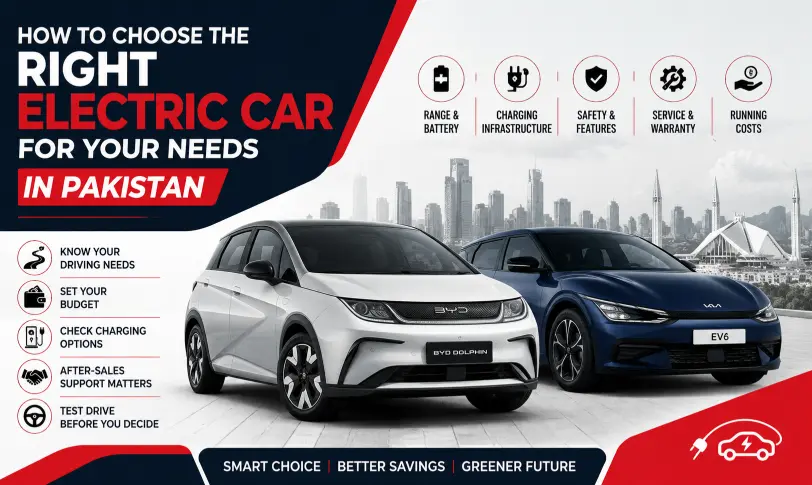

Choosing the right Electric Car in Pakistan requires careful attention to range, charging, budget and after-sales support. Many more choices with a variety of pricing options. But, that also makes the decision more difficult. Both the BYD Dolphin and the Kia EV6 are electric vehicles. They cater to entirely different buyers. The wrong one will cost a lot and will not even meet your needs.
Below is the correct way to consider it.
Step 1: Match the Electric Car to Your Driving Needs
Typically, buyers end up with more range than they require. Don’t tack your idealized vacations onto your regular routine.
For riders that drive 40 to 60 kilometres within the city, nearly all EVs on the market can handle that distance easily. When driving between major cities (200km plus drive) range and charging infrastructure becomes much more significant.
Spend some time asking three questions. What’s the average distance I drive each day? Is there a place available for overnight charging at home? How frequently do I really travel? The best Electric Car is one that comfortably covers your normal daily travel without making you pay for unnecessary range.
The one thing that contributes more to EV ownership satisfaction is charging at home overnight. For people who do not have a parking space assigned to their personal home, choices are more restricted.
Step 2: Set Your Electric Car Budget
The price of EVs in Pakistan starts from Rs 59 lakh and goes up to Rs 2 crore for the BYD Seal AWD or Zeekr X. Price variations do represent true differences in range, performance, safety, features, and life cycle costs. Your Electric Car budget should also include charging equipment, insurance, maintenance and long-term battery coverage.
Some facts to know. Because of the NEV Policy (1% duty for locally assembled EVs), cars such as the Dolphin are more competitively priced than fully imported alternatives. FameLease, the division’s financing tool, has the power to secure access to higher-spec cars at manageable monthly rates.
Take into consideration running expenses. The costs of home-charging are significantly lower than the costs of filling a petrol tank for the same distance. These savings can begin to accumulate rather quickly over the course of any number of years.
Step 3: Choose an Electric Car for Your Roads
Not every EV suits every road environment. It is more important in Pakistan than in markets with steady infrastructure. An Electric Car suitable for city traffic may not be the best option for frequent motorway or northern-area travel.
For city parking commuters, the BYD Dolphin or MG4 Standard Range will be the most practical. They are both small and efficient and are appropriate to city use.
If families require the extra space and higher driving position, they should consider the EV version of the Jaecoo J6, MG HS PHEV or BYD Seal. These provide space, warmth and the roadway presence that is required when driving most of the day as a family.
Intercity drivers need to pay attention to real-world range, not just WLTP figures. The ideal conditions in which WLTP is measured. Actual range will vary with speed, number and size of passengers, internal climate control and road conditions. Plan for charging stops on longer trips, working toward greater availability of fast charging along key corridors.
Real-world numbers, international safety ratings for all Performance buyers, including BYD Seal AWD or Zeekr X. Just know the fact that this premium service is a new thing in Pakistan for EVs as compared to petrol companies.
Step 4: Check the After-Sales Support
Currently, it’s the least talked about aspect of the EV market in Pakistan. It’s not just the car; it’s what happens after you drive it out of the showroom.
Before signing, ask the dealership certain questions. How many locations in the city do you have that can provide service? Do they offer replacement service for batteries in the local area? What is included in the warranty for the battery? What is the time span for common parts to be obtained?
In Pakistan, BYD and MG’s service network is more developed for the EV brand than that of others. Some newer competitors such as Zeekr and Jaecoo are slowly but surely carving out their own space, but depth of coverage remains limited. Maintaining a car with excellent service network capabilities is going to be cheaper in the long run than maintaining a car where parts have to wait weeks before they can arrive.
Step 5: Pre-test Drive Before Rejection
EVs are different from petrol cars. Adjusting the instant torque, silence, and regeneration is necessary. Some buyers adore it the second they buy it. Others need time.
You have to see several cars in person to make a decision. A Dolphin and a Seal do not have the same experience on the road.
If you’re thinking about buying a used EV, have an professional inspection first. Things a inspection reveal include battery health, charging system condition, and software status. Before you decide to invest in anything, the FameWheels inspection service assesses EV-specific checkpoints and provides a report.
Conclusion
Choosing an Electric Car becomes easier when you clearly understand your daily travel and charging requirements. There are five elements to consider when choosing the right electric car. your actual driving range requirements, the charging options, and your budget. Also, after-sales support of the car that you have decided on, and the feel of the selected electric car. If you get all five correct, an EV will provide you better service and be cheaper than a petrol car over the same life.