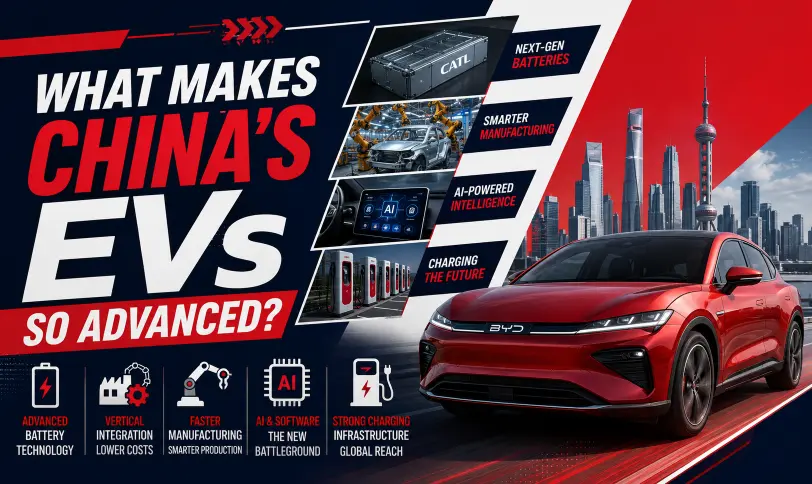

Several years ago, EVs made in China were only regarded as cheaper alternatives to Tesla and European car makers. That is no longer the case. In 2026, Chinese automaker BYD ranks first, followed by Volkswagen and Mercedes-Benz, in a global ranking of automotive innovation. China has become the home of about 60% of the global EV vehicle market. The bigger question is not whether or not Chinese EVs have caught up. It’s the way in which they have come this far and in this time period.
Battery Technology Is the Core Advantage
China’s most noticeable, and most significant, advantage is in batteries.
- 38% of the world’s lithium-ion batteries are supplied by CATL, the world’s largest EV battery manufacturer. It feeds 16 major auto makers, such as GM and Tesla’s Shanghai factory.
- The new Naxtra sodium-ion batteries made by CATL reached mass production by the end of 2026. Sodium is less expensive, more abundant, and safer in extreme temperatures than lithium, reducing cost and the risk of fire.
- CATL’s fast-charging battery, Shenxing (second generation), can provide a range extension of about 320 miles in just five minutes.
- It also now means that BYD’s redesigned Blade Battery can be topped up from 10% to 97% in around nine minutes, even at -30°C, a true feat for most EVs in the West.
- Another research triumph, from the other side of the globe (from China), has already produced batteries capable of more than 1,000 km of range per charge, with mass production scheduled for late 2026.
- Chinese companies are in the production and innovation in LFP (lithium iron phosphate) batteries, which make up about 45 percent of worldwide EV battery installations.
- Older chemistries typically based on nickel cannot be fully charged daily and are more thermally unstable and expensive than LFP.
It is not that it is a lucky or favored company. It’s a full battery system benefiting year-over-year, and it’s the one primary factor behind China’s ability to offer comparable range at a lower price than the West.
Vertical Integration Changes the Economics
Chinese automakers don’t only produce cars. Many manage the entire range from the raw materials to battery cells all the way to the final vehicle. This is not just important, it is critical.
The vertical integration, scale of production and reduced overhead costs were identified as the key drivers of EV price parity between Chinese and Western manufacturers, not state subsidy payments. An important observation, as subsidies are the cause usually mentioned in the West, in the media and in policy discussions. These are two facts. Since 2009, China has invested more than $230 billion in EV development, while government funding continues to represent sixty percent of world wide EV public funding. The Rhodium study does not suggest, however, that Chinese EVs won’t be structurally lower-cost vehicles even if they don’t receive subsidies.
Manufacturing Speed Is a Genuine Edge
Chinese EV manufacturers deliver automobiles two or three years ahead of original auto manufacturers. There are a number of reasons why:
- Gigacasting turns several welded components into one cast component. Xiaomi’s factory is utilizing one side only, requires 72 separate parts and cuts 840 weld points alone.
- Multi-brand shared auto platforms reduce engineering costs and reduce new car time to market.
- China’s manufacturing strategy has shifted to automation versus cheap labor, marking a long-term value-add for robotics over short-term savings.
The outcome: Chinese OEMs can introduce, tweak, and lower prices significantly ahead of most Western OEMs which are able to complete a single vehicle iteration.
Software and AI Are the Newer Battleground
Hardware got Chinese EVs to price and range parity. The next competitive opportunity is through Software.
- In Chinese EVs, advanced chips with the ability to engage in multi-turn natural language conversations are now used in the cockpits, as opposed to single-turn voice activation.
- Models that have sold more than 270,000 units cumulative to date are available with up to 500 lines and are upgradeable to 1,000 lines with lidar.
- For Chinese EVs, electronic braking systems are now gaining adoption in mass production, ahead of Western automakers.
- The Chinese plan for 2026 car standards explicitly includes input from the two sectors: AI and semiconductors. The software-defined vehicle is named as a priority for the nation, rather than merely a manufacturer’s feature.
Charging Infrastructure Supports Hardware
Battery fast charging is only relevant if there is infrastructure for fast charging. China has invested heavily in the infrastructure, and began to sell it.
- China accounts for about 80% of the global EV charging infrastructure installed.
- BYD has announced that it will put 6,000 charging port sections for its ultra fast charging Blade Battery system outside China by the end of 2026.
- Chinese EV exports increased by almost 40% in April 2026, and now Asia is the biggest buyer of Chinese EVs, while South Asian markets, such as Pakistan, have also entered this connected web.
The Price Gap Is Real, and It’s Widening
The best indication of an advantage is not a spec sheet; it’s the price. The fully electric crossover SUV announced by BYD that retails for about $14,000. The Chevrolet Equinox EV is the least-expensive EV model to hit U.S. retail markets, beginning at $33,600. The absence of that has prompted an American automotive trade association to call for a “potential extinction-level event” to the US auto industry if Chinese EVs break into the market at scale.
Conclusion
China’s EV advantage isn’t the result of one factor. The synergy of battery innovation, verticalization, short production cycles, aggressive software development and infrastructure development to support it. Partly this will depend upon what Western manufacturers do; partly upon Chinese pressures as the home market begins to cool while the exports increase. The trend seems like Chinese EV manufacturers are not chasing the global industry’s speed because they’re setting it.