
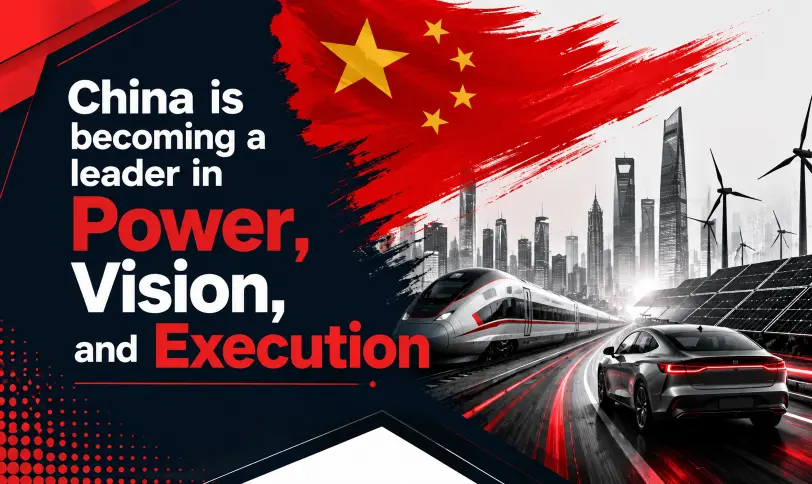

One of the most remarkable examples of a national strategy realized into real outcomes on a vast scale is the change in China over the past three decades, especially the China Automotive Ecosystem. What is amazing is not a single company, the technology, or a single industry. What’s notable is that China creates ecosystems.
That is important in more ways than most realize. For Pakistan, it’s a lesson far beyond admiration for what China has achieved.
Do you know what an Ecosystem actually means?
Most countries have a product-development focus. They recognize an industry, they invite investment, and they consequently generate output. But China did something structurally different. It brought the various industries together into a working system in which one element enriched another.
In the auto sector, this dogma is applied in the raw material extraction phase, battery chemistry, component production, software design, vehicle manufacturing, installation of charging stations, distribution, financing, maintenance and repair systems, data collection, and the recycling phase. All these links are domestic, large-scale, and are getting better all the time.
Now, however, Chinese auto firms are racing the world not only in terms of price, but of technology, manufacturing velocity, software prowess and product quality. BYD accounted for 4.27 million vehicles sold in 2024, but it wasn’t through creating a great car. It did so by creating a full range of ecosystem services supporting the car.
The infographic says it loud and clear: Don’t just create a product. Establish an ecosystem around the product.
How the China Automotive Ecosystem Got There: Vision to Execution?
China did not achieve success on the job simply by chance. It was envisioned via a process that any country, any business, and any organization could follow: Vision, Mission, Strategy, Execution, Scale.
The vision was developed before anything else. Decades ago, China chose to become the leader in manufacturing, technology, renewable energy, and eventually in the field of mobility. That vision was no slogan, but a life-altering faith. It became a policy, funding, infrastructure investment, talent cultivation, and enterprise coordination at all government and industrial levels.
This coordination is reflected in how the system of specific ecosystems is being created across industries in China. Technologies are linked to manufacturing, and technology is used to link with research. The connection of research with industry and infrastructure ties up to industry. The infrastructure is related to logistics. Logistics is linked via capital and talent and with global markets. All of these are intentional. Carefully planned and developed over the years.
The China Automotive Ecosystem as the Clearest Example
The automotive industry is the most obvious of the industries where China’s ecosystem approach can be seen. In a period of less than 10 years, China went from being an importer of automotive technology to exporting the largest number of EVs.
It’s because China thinks of the automotive transition as a systems problem, rather than a manufacturing problem. Batteries, components, software, vehicles, and infrastructure have not been built one after another. Government policy generated demand: even if not a lot of subsidies, there were mandates. Engineers were trained by universities and research institutions. State and private capital was invested. The manufacturing sector grew faster than the entire world, because the entire ecosystem to support the sector was already established.
This is reflected in the market of Pakistan. Today, BYD, Changan, MG, Chery, Haval, Jaecoo, Jetour and others are found competing in Pakistan. All of them are the result of China’s cycle approach to the automotive industry for more than two decades.
Lessons from the China Automotive Ecosystem for Pakistan
What Pakistan can learn from the China Automotive Ecosystem is not to copy the Chinese model, but to build one suited to its own context and capabilities.
There is a need for automotive ecosystems, technology ecosystems, manufacturing ecosystems, financial ecosystems, and energy ecosystems in Pakistan. The problem is that these can’t be constructed alone. Government, private businesses, universities, investors, financial institutions, and entrepreneurs need to be interdependent, rather than isolated individuals with their own agenda.
It is an opportunity that is a reality. Pakistan is a huge market for cooperation with Chinese investors, manufacturers, EVs, PHEVs, REEVs, batteries, mobility, and local manufacturers. Chinese companies are not only able to sell products in Pakistan, but they are also willing to provide services. They can help develop local supply chains, to educate the local workforce, and to transfer technology that Pakistan can be able to utilize independently in the future.
However, collaboration involves bringing to the table a market other than Pakistan’s. It demands institutional strength, policy continuity, and vision extending beyond the lifespan of government. They are the bedrock China worked over some years to establish for its ecosystems to grow.
Don’t Build Companies. Build Platforms
It’s not about the best individual ideas; it’s about the ideas that can be turned into systems, ecosystems, and scale.
This mindset is woven into every aspect of FameWheels, from its architecture to its user experience. Ambition to make no more another automotive marketplace. To create an ecosystem for the purchase, sale, car inspection, vehicle financing, vehicle insurance, and maintenance of vehicles in Pakistan. They are components in a system that are linked together.
Conclusion
The success of the China Automotive Ecosystem serves as a testament to the power of sustained vision, coordinated ecosystems, and execution. Pakistan not only has the opportunity but also the talent and the market. It is long-term thinking that is required to turn the automotive dreams into Pakistan’s reality.