
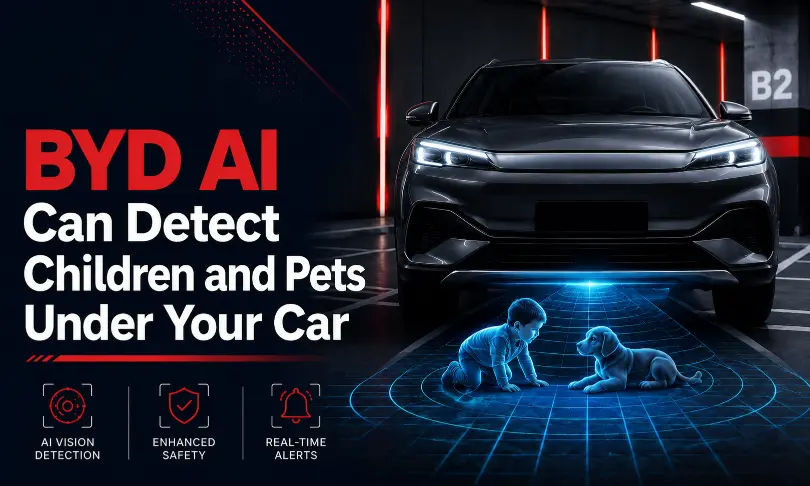

BYD AI could soon detect children, pets and other living beings underneath a parked car before the driver begins moving. The proposed safety technology uses underbody cameras and artificial intelligence to address an important blind spot that conventional parking sensors and reversing cameras may not cover.
Children, cats, and stray animals get hurt in the blind spot. The accidents happen often, and the driver never sees what’s there. By the time they figure it out, it’s too late.
BYD has filed a patent that addresses exactly this problem.
How BYD AI Under-Car Detection Works
It is an AI-powered underbody detection system, filed with the National Intellectual Property Administration of China under the number CN122200729A. It was published on June 12, 2026.
How it works: Cams installed below the car take a first shot of the earth beneath the car when the vehicle is stationary and turned off. That image will be remembered as a reference point.
The system takes new images when the driver returns and is ready to move, and compares them with the baseline. Does not take a detailed look at all the bottom surfaces. It only considers changes in areas after parking.
A second AI step is used to address a change, if applicable. It decides whether it is a change in a living thing, a child, an animal, or a person, or a change in the environment, such as a falling leaf or a moving shadow. Once detected, a living thing, a warning appears on the dashboard before moving.
Why This Design Is Smarter Than Standard Parking Sensors
With regard to conventional parking sensors and cameras, they are applied to the sides and the back of a car. They don’t watch them directly. It is that area this system covers.
With the comparison-based approach, the key and target are compared to eliminate false alarms. The characteristics of parking change rapidly, including Lighting shifts, shadows moving, and leaves blowing in. If the system examined each frame individually, it would be set to be alarming too many times, and drivers would tune it out.
The system is useful in any real-world scenario because it provides a baseline reference for a “clean” system and identifies only actual changes. That’s what changing wet to dry translates to in engineering terms: the patent.
Additionally, BYD registered a patent for separately detecting occupants who have stayed in the car through radar signals. One of the systems is on the floor and outside the car. The other will keep an eye on the cab. Two sensor types for two different safety problems.
The Bigger Automotive Safety Picture
This patent is no exception. The clear indication that this is a change in the direction of the EV industry. There’s been a long battle of ranges, charging speeds and acceleration for years between EVs. Those still matter. Now, though, all major brands are competing for price, with the next marketing challenge being AI-driven safety.
BYD posted a 41 per cent year-on-year rise in sales and generated 4.272 million vehicles in 2024. It accounts for approximately 18% of the whole global EV market. Its patent filing rate in China is 40 per day on average. Such a level of research output is not incidental. It’s a conscious business approach to leverage artificial intelligence as a differentiation tool on a broader scale.
In fact, this was the overall message from the Chinese manufacturers during Auto China 2026. Vehicles that are not only smarter to drive but also smarter towards surrounding people and animals.
Why BYD AI Could Matter in Pakistan
This technology addresses a scenario commonly found in Pakistan. In residential areas and housing societies throughout the country, children play around parked cars. In the summer, stray cats and dogs hide under cars, particularly if they are left out in the sun on concrete. These accidents take place gradually. They happen when no driver is looking under his car before moving.
There are already models from BYD available in Pakistan. The market today offers the Seal, Dolphin, and Atto series. Pakistani consumers may get a direct advantage from this system if implemented in the future versions of such vehicles.
Currently, there’s no word on a commercialisation schedule. The patent is the first step. However, the direction should be clear.
Is BYD AI the Future of Automotive Safety?
Traditional ADAS is about what’s happening while the car is moving. When driving, Lane assist is activated. AEB reacts to moving obstacles and Active lane change is included in blind spot monitoring.
BYD’s patent is unique and it emphasizes the moment before moving. The last safety check before the car begins rolling. Currently existing systems do not solve that problem, and a slip-up in those areas can lead to unforeseen outcomes.
Car manufacturers have been working for decades to make the vehicles safer when they are in motion. It is a newer and far more vital problem to make them safer while in a stationary condition.
How BYD AI Under-Car Detection WorksConclusion
BYD’s patent for an underbody AI detection tackles a blind spot that driving technology has almost overlooked. One of the most hazardous and under-guarded spots in regular driving is under a parked motor vehicle. It’s feasible due to the comparison-based approach for AI. It is actionable because of the alert on the dashboard.