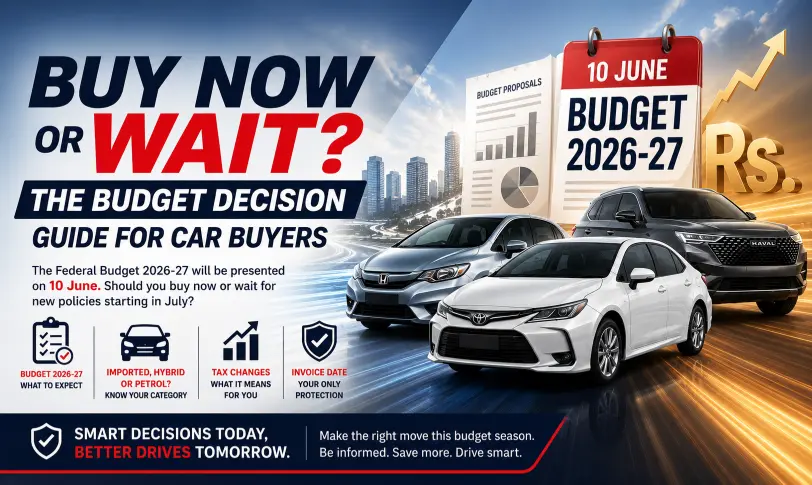

The Federal Budget 2026-27 will be presented on 10 June. So when thinking about a purchase, you might be asking yourself, should you purchase now or wait for the new policies starting in July?
All this depends on the type of vehicle you want to purchase. There is no one-size-fits-all advice. Let me explain by the category:
What Type of Buyer Are You?
The new budget is shifting the market in two different directions. Big tariff reductions may be achieved for imported cars. Hybrids and EVs assembled locally could have less of their current tax benefits if the International Monetary Fund (IMF) has its way.
This implies that different segments of buyers need to make entirely different choices.
Looking to buy an Imported Car?
Take your time if you are viewing a Japanese import (such as an Aqua, Vitz, Note, or Vezel) or a newly imported Completely Built Unit (CBU) from abroad. Time can be an important factor in saving you money.
The government has approved, in Phase 2 of the Tariff Reform Plan, a reduction of import tax. The purpose was to eliminate the local assemblers’ pricing power and offer consumers cheaper alternatives.
Here are the proposed tax cuts.
| Duty Component | Current Duty | Proposed Budget FY27 | Reduction |
| Customs Duty (CD) | 100% | 50% | 50% |
| Regulatory Duty (RD) | 50% | 20% | 30% |
| Total Tariff | 150% | 70% | 80% |
The cost of car imports will be reduced by over 50% if this policy is passed. The market value of the existing used cars will be reduced by 10 to 15 percent within three to six months of the arrival of these cheaper imports.
For the used Japanese import, sell it now. When purchasing, delay until fall.
Thinking about a Hybrid or an EV?
If you intend to purchase a locally made hybrid car or a fully electric model such as the Haval H6 HEV or the Toyota Corolla Cross HEV, make sure to move quickly. There’s a price to waiting.
IMF has demanded FBR to take away green energy tax exemptions to broaden the tax base. Here are the issues at stake:
| Vehicle Type | Current GST | What the IMF Wants | Likely Outcome |
| Pure Electric Vehicle (EV) | 1% | 18% | 12% to 14% |
| Locally Assembled Hybrid (HEV) | 8.5% | 18% | 12% to 14% |
It is the low tax rates that have made hybrid SUVs so popular these days on Pakistani roads. However, it’s almost guaranteed that a price increase of some sort would be forced by IMF pressure. The Ministry of Industries is negotiating somewhere between 12 and 14 percent, but that is a big jump from the current rates.
Why are Manufacturers Pushing Buyers to Book Now?
Hyundai Islamabad has begun its pre-budget marketing campaign to advise customers to book the new models at their current prices, because taxes can increase. Likewise, MG Pakistan has thrown in 0 percent markup on the MG HS PHEV, followed by Rs 550,000 in overall benefits to eliminate stocks before the end of the fiscal year.
These promotions are the most obvious sign that taxes will go up.
The Hidden Risk Most Buyers Ignore: The Invoice Trap
This is important. Even paying by a pay order or receiving a booking receipt will not shield you from upcoming government taxes. Your official factory invoice date is the only protection.
If you end up with the billings due after 30 June, then you are legally accountable for the new tax difference. The proposed GST increment in a luxury SUV may lead to paying for up to PKR 1 million (10 lakh) more when the car is picked up at the dealership. It will eliminate all promotional benefits you can get.
Purchasing a Petrol Car? Budget Change is Minimal
The cost of local versions of traditional petrol vehicles such as the Suzuki Alto, Toyota Yaris, and Honda Civic is mixed.
The government is considering targeted tax relief for local auto parts manufacturers to reduce the cost of production. Meanwhile, document and withholding tax enforcement against those who fail to file may get stricter, too.
High stockpiles and the lack of sales for many local assemblers make it impractical to add any sudden price increase to the consumer’s bill. This portion is in equilibrium. There is no urgency in “panic buying” and no drastic declines in prices.
Conclusion
There is one rule for this budget cycle: Avoid thinking about the auto market as a one-size-fits-all proposition. Each section is going in a different direction.
If you prefer a Japanese or CBU car, then wait. The economic advantages of an external adjustment may be in thousands of rupees. Only purchase a locally compiled hybrid or EV on July 1st if the dealer can assure you the invoice is completed before then. If you wish to have a standard petrol car, don’t feel obliged to buy it now. Prices are stable.
Make sure your invoice date aligns. But please keep in mind, they don’t make new taxes go away once you’ve been paid the invoice. Only your date of invoice does.
This is a tricky market that FameWheels can help you with. Our site connects trusted sellers and buyers together, helping individuals find a verified used car, get an inspection prior to purchasing, or explore financing options.