
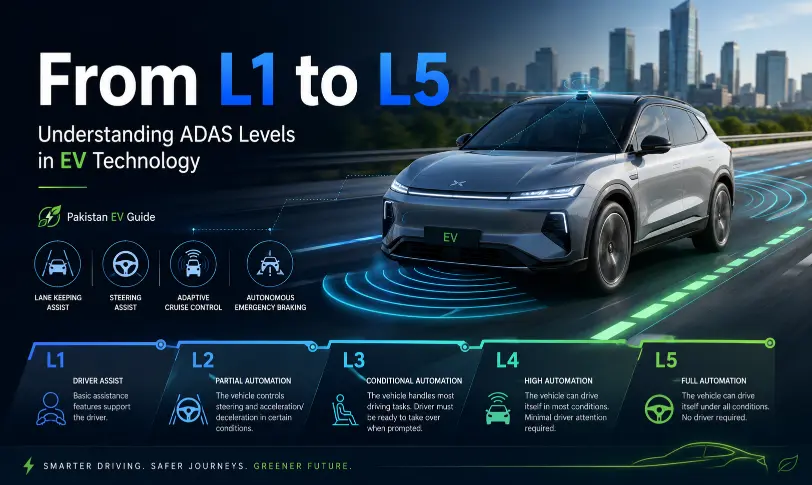

With each new EV launch in Pakistan, you’ll find a mention of autonomous driving (ADAS) levels, often ranging from 0 to 5. Most buyers go along and appreciate this number without fully recognizing it or its significance. One of the more confusing aspects of EV ownership these days is that there are a few brands, such as BYD, MG, and Hyundai, each posting how “smart” their cars can be.
Fortunately, the system of these numbers is not as complicated as it sounds. This is the SAE autonomy scale, and the next time you go into an EV showroom, you will understand exactly what you are buying:
So What’s the SAE Autonomy Scale?
The Society of Automotive Engineers (SAE) developed an original classification system that defines the advanced features of driving that a car can perform without requiring human intervention. It takes you all the way from Level 0: the car does nothing for you to Level 5: the car needs no human input at all. This scale is now the benchmark employed by car makers, regulators, and reviewers, which is equally applicable to a BYD Atto 2 in Pakistan as it is to a Tesla in California.
Advanced Driver Assistance Systems (ADAS) are the safety and convenience systems built into a vehicle, such as automatic braking or lane assist. The SAE ratings tell the story of the features coming together and the transfer of the driver’s responsibility. The higher a car is on the rankings, the more ADAS systems are in operation.
ADAS Level 0: No Automation
The human driver does everything at Level 0. Activated by manual steering and multiple braking systems. But despite having a forward collision warning or a lane-keeping assist beep, a Level 0 car is still a Level 0 car because these features warn but do not intervene. This is the category of most of the old cars that are seen on the roads of Pakistan.
ADAS Level 1: Driver Assistance
The first real module of automation comes in at level 1. The steering or a speed-controlling function can be activated, but never both at the same time. The textbook example is Adaptive Cruise Control. The car controls speed and maintains a safe distance from oncoming traffic.
ADAS Level 2: Partial Automation
This is where they truly get helpful, and where almost all EVs on the market in Pakistan can be found today. The Level 2 car adjusts both speed and turning simultaneously. A commonly used combination is Lane Keeping Assist with Adaptive Cruise Control, which is level 2. The Atto 2 by BYD has Intelligent Cruise Control, Lane Departure Warning, Automatic Emergency Braking, and a 360-degree camera system.
There is a difference between assist and independence, and level 2 is just assist.
ADAS Level 3: Conditional Automation
The car can drive in defined conditions only, such as on a clearly marked motorway driving a light vehicle, and this represents level 3. The driver doesn’t have to keep their eyes on the road at all times, but should be prepared to take control. A significant legal development is also being introduced at this level.
Very few vehicles in the world sport true Level 3, and Pakistan doesn’t have any production cars at this level yet. It is more of a glimpse of the technology’s future than ready for the consumer market now.
ADAS Level 4: High Automation
At level 4, the vehicle can navigate on its own in a designated space (a geofenced area) with no human interaction. Level 4 vehicles are only capable of full autonomy in specific scenarios, such as within a defined urban area or a known route. They cannot be driven autonomously outside of these areas. This is the level of robotaxi services operating in some cities around the world.
ADAS Level 5: Full Automation
The goal of level 5 is to reach the final stage. Passive cars at this level can be driven automatically anywhere, regardless of weather conditions. They do not need to have a steering wheel and pedals at all. No production car in the world has got to this stage yet, and only perhaps years down the track could it be possible.
The Real State of Pakistan?
So, the EV market in Pakistan is definitely on Level 1 and Level 2. Imported models from BYD, MG, and others have all the useful Level 2 features that positively impact safety on Pakistani roads.
Are you seeking an EV in Pakistan?
FameWheels also includes a wide diversity of EVs that are coming to Pakistan, including BYD, MG, and others with real “Level 2” ADAS technology. Everything from specifications to what driver assistance features each model offers to financing details can be found all in one place.
Conclusion
Understanding the SAE autonomy scale isn’t as daunting as it may seem. In Pakistan, major EV vehicles are at Level 1 and Level 2, which provide genuine and real-world safety without the promise of autonomous driving. Knowing exactly where a car is on this scale is the key to making an informed car purchase.