
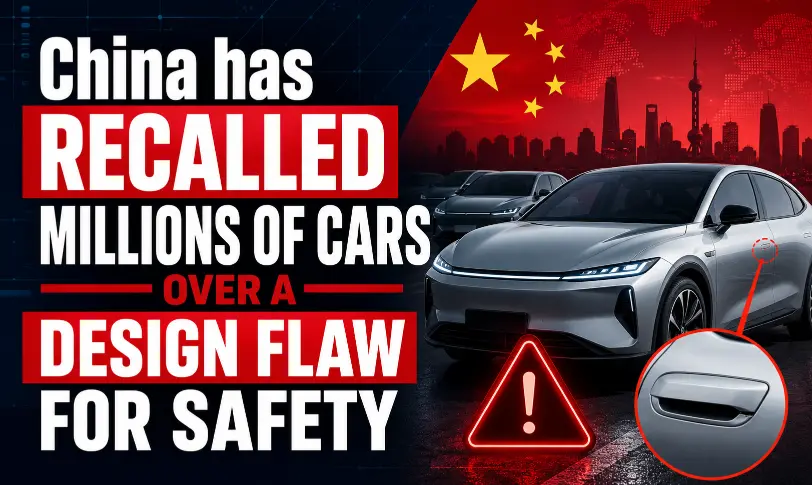

The recalls were announced by the State Administration for Market Regulation of China (SAMR) on August 21, 2026. Eleven car manufacturers are participating, such as Tesla, Xiaomi, Leapmotor, Xpeng, Zeekr and Lynk & Co, Chery, Dongfeng, BAIC and FAW. It has become the biggest cooperative recall in China’s automotive history.
The Actual Problem
These modern EVs increasingly rely on electronic door locks, key fobs, smartphone apps or capacitive touch panels rather than a similarly mechanical handle. The majority still have a manual release backup in the cabin to use in an emergency. It’s the backup that’s causing the issue.
On most of the affected vehicles, the emergency release fades into the background interior trim. It is almost the same color as all the surroundings. In the event of a normal circumstances, that’s simply a design selection. A severe crash results in the breakdown of the low-voltage electrical system and becomes dangerous. People living in the area are unable to get out of the building quickly. Outside the car, there is a problem for rescuers to get in.
How Big Tesla’s Share Is
For the most part, the recall is Tesla. Nearly 2.98 million vehicles are impacted, including imported and China-made Model 3, Model Y, Model S and Model X. That figure covers all 973,156 Model 3s and 1.96-million Model Ys produced in-house.
The fix will be performed without any hardware modifications made at Tesla. The company will provide a free warning label for the emergency releases and pack an over-the-air software update that will automatically dial back the windows if the vehicle sensors detect a severe collision. Those who already have the labels will only require the software update. Recalls become effective on 25th September 2026.
Every Other Automaker Involved
Nine other brands were recalled at the same time, all due to the same basic problem.
- Xiaomi is recalling 390,435 SU7 electric sedans.
- Leapmotor will recall 371,200 C01 and C11 vehicles.
- Xpeng will recall approximately 264,842 vehicles.
- Geely’s Zeekr is recalling 92,658 vehicles of the 007 and X variants.
- Chery is notifying 57,688 iCar 03s and 10,800 Fulwin X3s; it will be physically fixing the release covers, not just sticking labels on.
- Dongfeng has already issued a recall for 53,452 vehicles of four models.
- BAIC is recalling 46,850 Arcfox Koala units; the same type of replacement cover.
- FAW is recalling 11,908 vehicles across two models.
Most of these are done in the Tesla style: labels and software updates. Some, such as Chery and BAIC, are taking it one step further and taking the actual release cover out to replace it.
Why This Happened Now
This recall didn’t come out of nowhere. It comes after the deadliest 2025 incident with a Xiaomi SU7 that surged against the barrier, causing a fire. Three college students were killed. The door handles can’t be seen inside the door, and no one in the vicinity could find them in time.
All this was a catalyst for the Chinese government to take action in that case and in other similar situations that had occurred to some Tesla drivers. In February 2026, China set a new national specification, GB 48001-2026, that will effectively ban fully concealed electronic door handles that have no mechanical back-up. From 2027, all new vehicles sold in China will be required to have individually operated door release mechanisms, both inside and out, and emergency door handles must be well labeled and visible even in low-light conditions. Approved vehicles already in circulation, or to be sold, shall be given a grace period until January 2029.
This recall is to be viewed as transitional. Addressing the current fleet invisibility challenge by adding labels and software, the real hardware requirement will roll out over the next two and a half years.
China Is Moving Faster Than Everyone Else
This is a serious concern, not just a Chinese problem. The Euro NCAP 2026 rating system also mandates that exterior handles that are electrically powered shall be well maintained, regardless of whether they are located on a touchscreen, and those that also feature physical buttons are favored. But this is just a restriction, not a rule. Manufacturers that choose to ignore it will lose stars on a safety test.
Conclusion
China is the first nation to actually order a hardware change and therefore a recall for a design flaw. The fix for car owners in China is relatively simple: they have to do a software update and, in a few instances, a replacement cover. The United States is even further behind. At least 15 deaths have been attributed to Tesla door handle failures in emergencies by Bloomberg, with the National Highway Traffic Safety Administration. China has introduced a greater initiative by giving importance to safety concerns in vehicle designs. It gives a good direction to manufacturers.