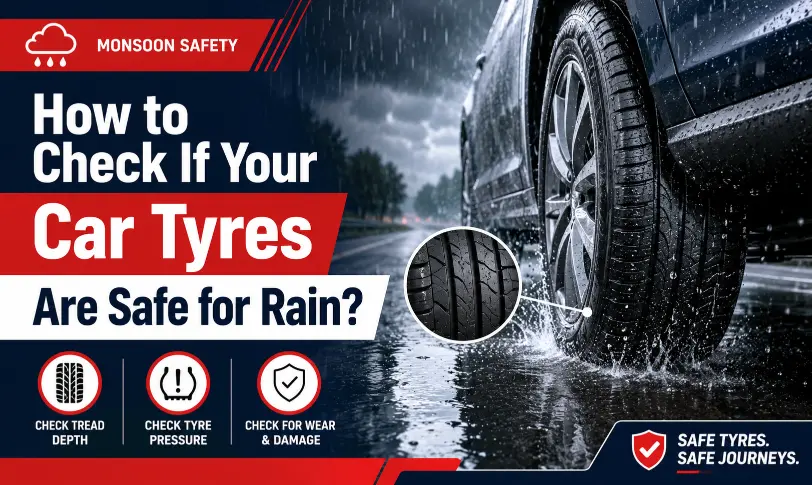

To check if your car tyres are safe for rain, inspect their tread depth, pressure, sidewalls and wear indicators before driving. Roads in Pakistan can become extremely slippery during the rainy season, reducing tyre grip and increasing the risk of skidding, aquaplaning and accidents.
Tyres often determine whether a vehicle remains stable and safe on a wet road. However, most drivers do not inspect their tyres until they experience a problem. By that time, the tyres may already be unsafe and require immediate replacement.
Why You Should Check If Your Car Tyres Are Safe for Rain
Under dry conditions, a tyre with worn tread may get a good grip on the road due to the high contact between the rubber and the ground. When it rains, that equation changes totally. Water is between the tyre and the road. The tread pattern is designed to direct water away and help maintain grip. When the tread is worn down, the tyre cannot clear water fast enough. The car starts rolling on the surface of water instead of on the road. This is known as aquaplaning, and once it occurs, the driver’s control of the steering and braking is virtually lost.
A properly designed tyre (with adequate tread) can release several litres of water per second while at speed. A worn tyre cannot. The difference between safe and unsafe driving on wet roads is less than most people think.
Check 1: Is Your Tyre Tread Safe for Rain?
Wet weather safety can be gauged by tread depth. Pakistan’s minimum requirement is 1.6mm, but most tyre experts suggest changing tyres much before reaching that limit. Wet traction starts to weaken at 3mm on the tyre. It is severely affected at 1.6mm.
It is best to use a coin test by dropping a coin into the tread to see if it’s worn out. Put a Pakistani one rupee coin in the central tread groove with the edge facing inwards. If you are able to glance the entire edge of the tread, your tread is extremely low, and the tyres should be replaced.
A tread depth gauge, which is widely available at most auto accessory stores, is inexpensive and will give you a more accurate reading. Inspect tyres at several spots around the circumference of the tyre, not just in the center. If there’s unequal wear on the tyre across the tread width, it may mean your suspension or alignment is off.
Check 2: Inspect Tyre Wear Indicators for Rain Safety
It is necessary to check tread wear indicators that come with tyres because if they are worn out then the tread level reaches a minimum level of safety. Getting your tyre replaced in that case can prove to be a wise decision rather than delaying.
Indicators can be found by searching for a small triangle or sidewall TWI markings. These are markers to indicate the location of the wear indicator in the groove. If the tread surface is level with the indicator, the tyre is used up.
Check 3: Check Tyre Sidewalls for Wet-Weather Safety
The external area of the tyre in contact with the vehicle is known as the sidewall. It is affected by kerbings, potholes and damage caused by road debris. Sidewall damage is more frequently observed on Pakistan’s roads under the existing road conditions.
Check for cracks, cuts, bulges or blisters. A bulge in the sidewalls is a very serious problem. This is a sign of compromise from a hard impact or other damage to the tyre’s internal structure. If the tyre bulges, do not drive it until it’s replaced; it can blow out at any moment and at any speed.
Tyres require replacement even if they aren’t used much because they lose flexibility and grip specifically under urban driving. In Karachi, tyres show more wear and tear because of manholes and potholes that are spread around in the city and broken roads.
Check 4: Check Tyre Pressure Before Rainy-Season Driving
Tyres which are under-inflated bend more than they are supposed to and cause uneven wear and tear as well as overheating. They also minimize the contact patch, which actually decreases wet weather grip.
Check the tyre pressure after an hour or more of time off the road. Your proper tyre pressure will be found on a label inside your car’s driver’s door panel or in your handbook. Never use the maximum pressure given on the tyre sidewall; this is the tyre’s limit, not your car’s requirement.
It is important practice to check the tyre pressure of your car more frequently during monsoon because any sort of carelessness can cost you your life. Additionally, the weather in monsoon changes more often; that’s why it is necessary to keep the car in check.
Check 5: Use Matching Tyres for Better Wet-Road Grip
For a car, ideally all tyres should be of the same brand, model and size. Differences in tyres can affect their braking and cornering performance, resulting in unpredictable handling, particularly on wet surfaces. When changing tyres, change them in pairs, either front or rear; do not change one tyre at a time.
Conclusion: Keep Your Car Tyres Safe for Rain
It only takes a few minutes to check if your car tyres are safe for rain, but these simple checks can make a major difference to your safety during the monsoon. Inspect the tread depth, tread wear indicators, sidewalls and tyre pressure before travelling on wet roads.
Replace tyres that have insufficient tread, cracks, cuts, blisters or bulges. Also ensure that your tyres are properly inflated and suitably matched. When something looks unsafe, get your car inspected by a professional expert at FameWheels before driving in heavy rain.