
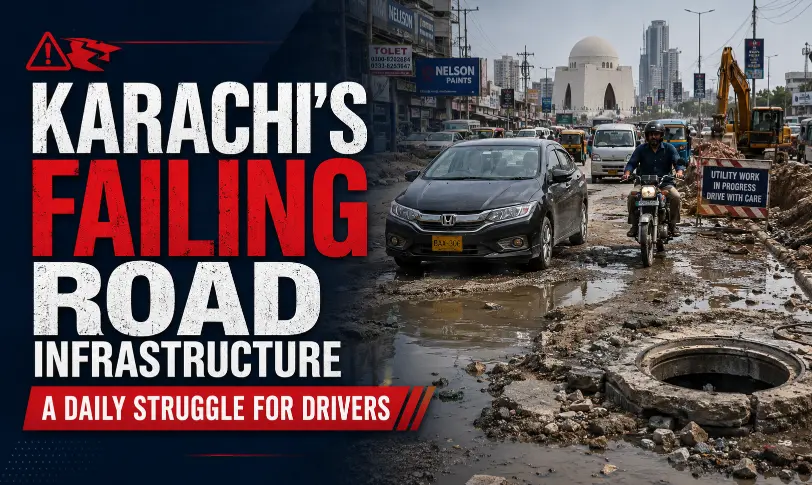

Karachi is Pakistan’s biggest economic hub and major city; however, it is also one of the harsher Road Infrastructure for frequent road commuters. The numerous potholes that can damage wheels, roads dug by utility companies without being fixed, sewage water standing in large intersections, and unsealed manholes that, in 2025 alone, took the lives of 27 people. This road system is more than an annoyance for millions of drivers and commuters who pass through this city on a daily basis.
How Bad Are the Roads in Karachi, Really?
The impact of this can be immense. Poor maintenance over the years and numerous utility cuts in North Karachi, North Nazimabad, Nazimabad, and the Federal B Area have left the roads barely usable. Road surfaces in some places, such as Korangi, Landhi, Malir, and Shah Faisal Colony, have been completely covered by layers of bad material. Disturbed roads and sewage water in Lyari and Shershah have made the situation as hazardous to victims’ health as it is to the vehicles.
This condition isn’t restricted to minor streets either. The University Road, MA Jinnah Road, and Rashid Minhas Road, which handle heavy traffic daily, are in poor condition, as most of the work has been ongoing for years without any meaningful effort to restore them.
The Utility Company Cycle That Never Ends
A major underlying problem in Karachi is the condition of the roads due to utility excavation, which worsens them. The Sui Southern Gas Company was criticized for excavating roads and filling them back in with poor material, such that the surface crumbles after only a handful of weeks.
Roads and infrastructure projects are never installed sequentially, thus being dug up within a few months of their construction.
What does it cost every driver?
Damage to the vehicle and suspension components, tyres, and wheels. Occasional repair bills are becoming regular. Anyone in Pakistan who keeps their car in decent condition will need to service it much more often.
Road damage and lags in construction add to commute times around the City. It’s taken up by commercial operators and logistics companies in the form of higher fuel prices and slower deliveries.
The safety aspect is the most critical one. According to road safety statistics 2025, 27 persons died in Karachi due to opening manholes, which included eight children. One of the biggest challenges is that of potholes and broken surfaces, which are especially harmful for motorbikers.
In 2025, 75% of all road traffic crashes in Pakistan occurred in the province of Punjab, with the majority being motorcycle crashes. Damaged road surfaces were recognized as one of the contributing factors. Road conditions are poor in Karachi compared to what is seen elsewhere.
Is the Upgrade Plan for Resilience Rs 4.2 billion enough?
In early 2026, KMC approved a Rs 4.2 billion rehabilitation plan for four main roads that goes beyond surface work and includes the installation of sewerage facilities and Green Belt infrastructure, as well as lane marking. Mayor Murtaza Wahab has insisted on quick tendering and construction, which is not just another promised development but a feeling that Murtaza Wahab wants things to be done soon.
The project, if implemented correctly, would help alleviate congestion issues on some of the busiest roads in the city. The commitments that the residents and commuters have had before are similar. Karachi’s record of infrastructure announcements that go through the motions, fail to meet standards, or simply don’t solve the issues. The proof will be in execution quality, and whether coordination mechanisms will be put in place to prevent newly made roads from being dug up again shortly by agencies that have different timetables.
What can drivers do straight away?
There are steps Karachi drivers can take while the infrastructure stays the same. Minimizing vehicle speed on poor road surfaces is the best way to safeguard suspension and tyres. Skipping the wet areas, which have an unknown road surface beneath, limits damage to the vehicle and the potential of hitting an open drain. In the city of Karachi, regularly checking for suspension and tyres becomes a significant concern when compared with other parts of Pakistan.
When purchasing a secondhand vehicle in Karachi, it’s important to get a professional inspection. Road damage can never be avoided or easily identified in a description, especially in a used vehicle on sale, even if the suspension is in good condition. Get the inspection done before purchase.
Conclusion
Poor roads are not a marginal problem in Karachi. It is a critical part of life for millions of motorists and can have very real implications for vehicle damage, time, and lost economic productivity. The Rs 4.2 billion rehabilitation plan is indeed a positive move, but it is hard to see how the city’s poorly maintained roads can be fixed in a few years. When a lack of investment for decades has allowed them to deteriorate to this state. While agencies work on co-ordinating their response moving forward, and while the physical repairs are made, the drivers of Karachi are going to be bearing the cost of this price for a long time to come.