
The top hazards to road safety in 2026 are not mechanical risks, according to a global study. It’s the increasing disconnect in what drivers think their car technology can do compared to what it can actually do.
The research, undertaken by Economist Enterprise, polled more than 1,000 transport and automotive experts across 10 key markets as well as 5,000 members of the general public on the street. The results indicate a safety problem not due to the machine itself but due to behavior and misplaced trust.
What the Study Found?
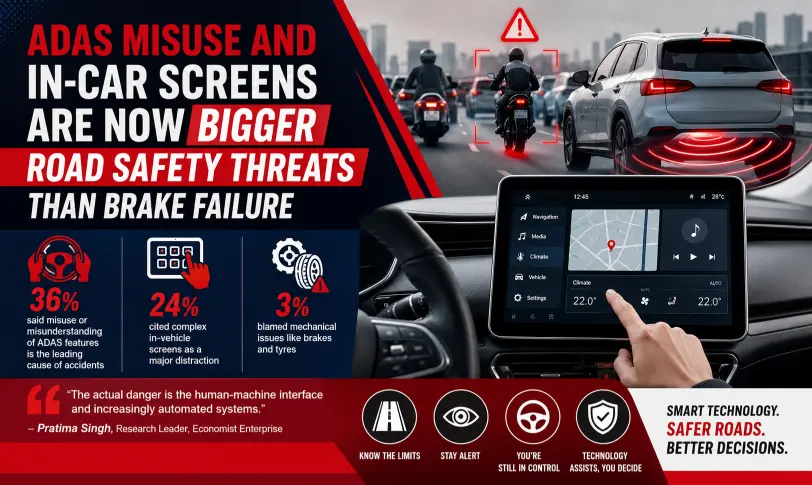
Transport experts said ‘misunderstanding or deliberate use’ of technologies like lane-keep assist was the biggest cause of road safety accidents. Another 24% cited that when in-vehicle infotainment systems become more complex as a major distraction. Just 3% thought that mechanical issues (including brakes and tyres) were the primary reason for accidents happening in modern motorized vehicles.
66 percent of the professionals surveyed reported that automotive advertising overhypes the ability of Level 2 driver assistance, dropping unrealistic expectations.
The actual danger is the “human-machine interface and increasingly automated systems,” said Pratima Singh, Economist Enterprise’s research leader.
This is what researchers are calling the trust gap. The driver who thinks their car has unrealistic power on the road is more dangerous than a driver driving a car that has no technology for assistance.
The Infotainment Problem?
Today, big touchscreens are a defining feature of any modern vehicle interior. Few manufacturers now offer 15- to 17-inch screens that package together the climate, navigation, audio, and vehicle controls into a single display. The principles of the design are simple, comfy cottages, and a luxury feel. The safety issue is that the driver must take their eyes away from the road for each interaction.
If you glance at the screen for 2 seconds at 100 km/h, you are doing more than 55 metres of ‘eyes away’ driving. Muscle memory is possible with physically round buttons. Touchscreens do not. If 24% of global transport experts cite screen complexity as a top safety issue, it isn’t a small detail. It’s a stark criticism of a design trend that the industry has observed far too much.
Why do the roads in Pakistan make this even worse?
Previously a reserved domain of luxury imports, ADAS is now the choice for a new breed of vehicles in Pakistan. Locally built crossovers, such as the Haval H6 and Kia Sportage, come standard with automatic emergency braking and lane-keep assist. The technology is available right now. Much of the “infrastructure” in which it was constructed no longer exists.
Lane-keep assist is based on the reading of the painted road markings. On many roadways in Pakistan, those markings are not visible or are not used consistently. If the system doesn’t see a line, it disengages too, generally without providing any warning to the driver, who may already hand over control.
These ADAS sensors are trained to detect typical traffic behaviour by vehicles, trucks, and pedestrians. They are not calibrated for overloaded Qingqi rickshaws riding between roads without indication, motorcyclists riding between cars at high speed, or pedestrians crossing without any crossing facilities. The span between the system and what it sees on a typical road in Pakistan is quite large.
Phantom braking is the most common problem reported. The owners of the vehicles have recounted instances where their cars’ ADAS systems had fired the full emergency brake without being able to detect a motorcycle or a roadside barrier as a potential threat. Hard brakes are no safety measure on motorways. It is a hazard.
The Practical Takeaway
This is in no way an argument for avoiding the use of ADAS. They actually decrease accidents when applied, if used within their design limitations. These parameters lack communication, are often exaggerated in marketing, and fail to align with the road conditions faced by the majority of Pakistani drivers on the road.
On clear, calm road parts, the adaptive cruise control system on the M-2 truly is a sensible, exhaustion-reduction gadget. It isn’t a system for transferring to others to deal with the responsibility when traffic is dense or unpredictable. Lane-keep assist is effective on a well-marked highway and is not reliable if the lane markings don’t exist. In real emergency situations, automatic emergency braking could save a life, and in situations where it misinterprets, it can trigger dangerously.
Drivers of modern vehicles must know the difference between what these systems can and cannot do. It’s a common safety obligation.
Conclusion
The results of the study are indisputable: technology is outpacing driver education, and the imbalance is affecting safety. That gap is larger in Pakistan than it is in the markets this technology was designed for, as the road conditions make it more complex than most ADAS are not designed for. The answer is not less technology. From manufacturers, regulators, and drivers themselves, there is more honesty regarding what the technology can and cannot do.