
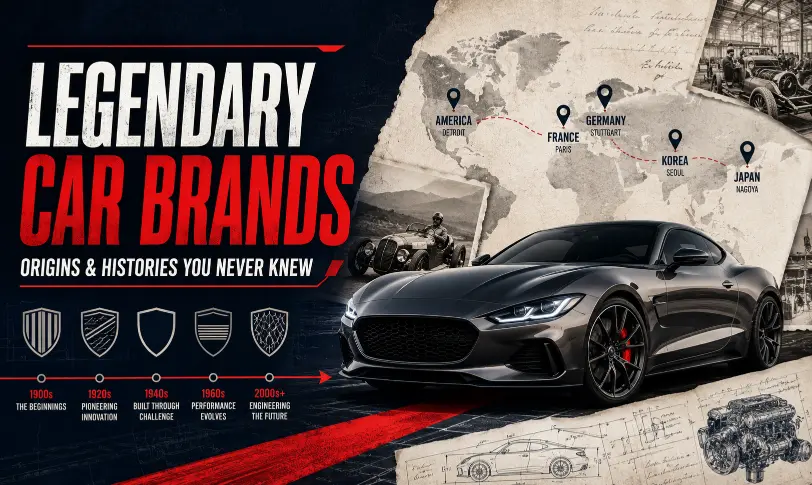

Whenever you encounter an automotive logo, you are witnessing a tale. Among those stories are more than a century old, based on family names, pre-historical myths, nationality, or even a few horrific stories of the twentieth century in some cases. The origins of these brands we recognise instantly today on the road are way more interesting than what most people might think had started somewhere specific, which is really quite old.
The truth about the world’s most iconic car brands
Honda
Founded in Japan in 1948 by Soichiro Honda and Takeo Fujisawa. The word Honda is created with a Japanese meaning of “original field,” which is not only the family name of Honda but also the agricultural history of Honda. Honda began manufacturing motorcycles, progressed to cars, and eventually became one of the world’s most renowned engineering businesses. The “H” in the brand is clean and symmetrical, symbolizing the precision on which the brand is based.
Hyundai
The term “Hyundai” translates to modernity or the present age in Korean. The letter H in the logo is also slightly tilted to the right, symbolising motion, and is intended to give the impression of forward momentum to the brand when it embarked on its international expansion. The name has aged well, for a company that began in 1967 in South Korea and now ranks among the world’s top five car makers.
Chevrolet
Chevrolet was established in 1911 by Louis Chevrolet and William Durant and became one of the most iconic American car brands of the 20th century. It was during the 1930s that Chevy became the nickname and stayed that way. In fact, Louis Chevrolet was Swiss-American, a racecar driver who gave the name to one of the most popular car makes in history, until he finally parted ways with his namesake company.
Chrysler
It was established in 1925 by Walter Chrysler. The surname is German and is believed to derive from a term that means ‘spinning top’. Kids, it was intentional or not, a suitable coincidence for a man who was a builder of engines!
Citroën
The French company was established in 1919 by André-Gustave Citroën. Citroën’s name is where things get interesting. Citroën comes from the word relating to “citrus”, which is French for lemon. Many people think that Citroën’s double chevron logo is a design abstraction, but it’s not. It is a reminder of the herringbone mechanism that the firm used to make before its car production; an homage to the technical heritage of the brand.
Infiniti
Infiniti is a made-up word with no history. It’s a calculated mutation of the word infinity, developed by the Nissan promoting group for the brand’s luxury launch in North America in 1987. This concept is symbolised visually in the logo: the road stretches out towards the vanishing point on the horizon, which is one of the more peculiar origin stories in the automotive world.
Jaguar
Jaguar’s name change is political. In the 1930s, the company was founded as S.S. Cars Limited. Following World War II, it was unfortunate that the letters S.S. became inextricably linked with the Nazi Schutzstaffel. The business changed its name to the animal and has never looked back. It’s one of the darker examples of world events influencing a commercial name like a car’s name.
Mercedes
The Mercedes name is not of a founder, nor an engineer. It was in Mercedes Jellinek’s possession, the daughter of Emil Jellinek, a rich Austrian diplomat, who was an early customer for racing cars built by Daimler. He named the cars after his daughter, and once the cars began winning races, it stayed that way. The name in itself has been used for more than 100 years by that girl from Vienna; the combined company was later added to her.
Toyota
The company was founded by the Toyoda family and originally named Toyoda. After being renamed to Toyota, it was changed because the new name is easy to write in Japanese, and eight happens to be lucky in Japanese culture. A fortuitous number choice was implemented in the 1930s and is now one of the world’s best-known brands.
Volkswagen
Volkswagen means ‘people’s car ‘ in German, and it was just that. The company was established in 1937 during the Nazi period as a state-owned car-making plant to make an affordable car for working-class Germans. The VW logo was first used in 1938. It is one of the more remarkable industrial transformations to successfully reinvent the brand as one of the most successful car companies in the world post-World War II.
Conclusion
There are decades and decades behind each logo of every car. Names that were selected for explorers, daughters, lucky numbers, and other ancient gods. Brands that began as loom companies, as teams, and as government-backed projects. Driven by our cars today are more histories than people realise, and now with this knowledge, every drive is just a bit more interesting.