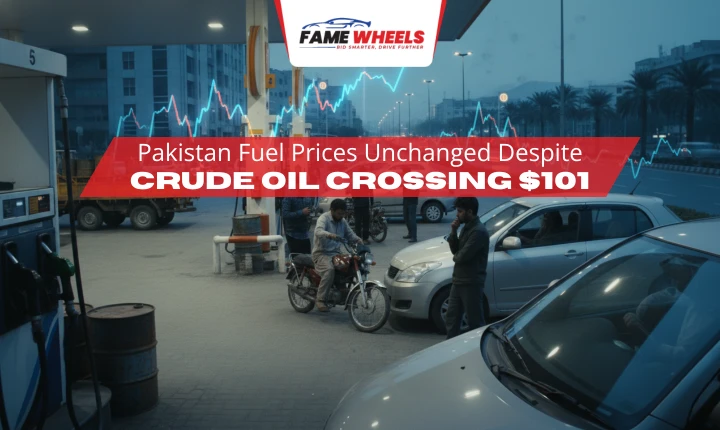

Brent crude oil now trades at $101.77 after Iran officially rejected the arguably false claim by President Donald Trump that some progress had been achieved in negotiations with Tehran. These geopolitical tensions have added new sparks to world energy markets, and the effects are felt directly by the nations that rely on imported oil.
To Pakistani consumers who were dreaming of relief at the pump, the situation ends any realistic hope of petrol and diesel being cheap soon. This is what you should know about what is happening, how the government is reacting, and the future.
No Immediate Relief in Fuel Prices
Any real chances of petrol and diesel becoming cheaper in Pakistan in the near future are largely killed by the fresh increase in Brent crude.
With international oil prices this high, it is very unlikely that local fuel prices will go down. According to market analysts, in the event petrol and diesel prices were to decline significantly, international oil would have to drop significantly, to or below the $70 per barrel mark. In fact, cheaper fuel in Pakistan without such a type of decline is not likely.
In the short term, the government might keep attempting to keep prices stable, as it has done in the past two weeks.
The government holds petrol and Diesel prices
Pakistan had already declared that petrol and diesel prices would not be increased before the recent revival in oil prices.
The government, in its weekly fuel price announcement on Friday evening, stated the petrol and diesel prices would not rise, although the global fuel prices had risen. The government asserts at present, it will take the increased cost instead of transferring it to consumers.
Current fuel prices remain:
- Petrol: Rs321.17 per litre
- Diesel: Rs335.86 per litre
Authorities verified that the state is subsidising petrol and diesel, and the extra cost is paid by the public budget. To this end, the Prime Minister has set aside Rs 46 billion to meet the price difference.
Change into High-Octane Uses
Afterwards, on Saturday evening, the government raised the tax on the high-octane gasoline, and it is now no longer about Rs 335, but it is now more than Rs 550+ per litre.
Key points about this move:
- High-octane fuel is primarily applied to high-performance cars and expensive cars.
- The government claims the additional load must be placed on the upper mole.
- Relief is being offered to regular petrol and diesel users.
This is actually a cross-subsidy in which premium fuel consumers are shouldering a higher portion of the price shock in the international market, enabling the government to maintain normal fuel prices to the multitude.
Current Fuel Pricing Strategy of Pakistan
The government’s response to the international oil crisis may be summarized as:
- Petrol is not to be increased for ordinary people.
- No rise in diesel costs of transport and of agriculture.
- Increase in tax on high-octane fuel for high-end auto owners.
- Budget aid to absorb the global price spike.
The point of this strategy is to limit the effects of global oil volatility at the domestic level without increasing the cost of fuel to the majority of households and other fuel users.
This subsidizing of Fuel is not the Long-term Solution
Although the government intervention will provide short-term relief to consumers, analysts caution that subsidizing fuel will not be a viable long-term solution.
Key concerns include:
- Fiscal burden: When the global crude oil prices are high, the government will have to bear a greater fiscal burden.
- Budget limit: Rs 46 billion to pay the price difference might not be enough, provided the prices keep rising.
- IMF considerations: Long-term subsidies may be an issue in the current IMF program in Pakistan.
- Uncertainty in the globe: Oil prices will remain unstable over the months, with tensions in the Middle East still unresolved.
The government is literally goalpost collection, as one commentator remarked, as it is hoping that world prices will go flat or fall before the fiscal bill comes due.
The implications for the Pakistani Consumer
Up until now, the only effect it has on the consumer is the high-octane price increase. The short-term effect will not be a price increase to regular petrol and diesel users.
Key takeaways for consumers:
- Motorists and car owners: Auto prices do not rise suddenly.
- The transport and agriculture: Diesel is not moving.
- Royal drivers of cars: NOW, the high-octane gasoline is more than Rs 550 per litre.
- Cost-conscious consumers: Does your car actually require high-octane fuel?
But when the world crude oil prices remain above 100 per barrel over a long period, the government shall be tested with the cost absorbing capacity, and it is not ruled out that future price increases will occur.
FameWheels Advantage
To Pakistani vehicle owners going through these turbulent times, knowing the cost of fuel is only one part of vehicle ownership. It is more important than ever to make informed choices when purchasing a fuel-efficient vehicle or assessing your current car’s fuel needs.
FameWheels assists Pakistani consumers in making better automotive decisions by:
- Full car check-up services to help you make sure your car is running well.
- Clear live bidding system, to purchase and sell without trepidation.
- Professional advice on the management of the car and its condition.
Having already accomplished more than 7,000 paid inspections and held more than 2,000 successful auctions, FameWheels is gaining trust in the Pakistani automotive market, one inspection at a time.
Conclusion
Once more, the price of Crude Oil at over $100 per barrel has pretty much killed the prospects of cheap fuel in Pakistan in the near future. Whereas the government has intervened with a Rs 46 billion subsidy to stabilize petrol and diesel prices, high-octane consumers are now paying above Rs 550 per litre.
This plan is a temporary solution with doubts about its applicability in the long-term. Regular consumers could heave a sigh of relief, but the situation could still change. With the ongoing Middle East tensions and unstable oil markets around the world, the fuel pricing strategy will still be put to the test by Pakistan.