
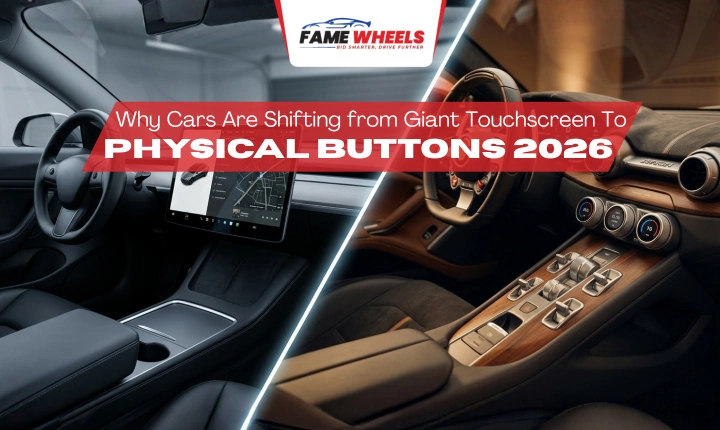

The automotive sector is transforming: the days of Tesla-like giant touchscreen are over, and the physical buttons and tactile controls are returning to the automobiles. The minimalist, screen-dominated interior is being significantly reined in by new safety rules in China and Europe, rising consumer impatience, and a broader self-correction by carmakers. The trend focuses on driver safety, ergonomics, and eyeglass-off usability more than on futuristic looks.
What is the Reason to leave Touchscreens?
Tesla’s massive central displays inspired the trend of touchscreen-intensive designs in the industry over many years. They assured smooth, tech-driven interiors in Electric Vehicles (EVs). Nevertheless, this concept has been criticized for adding distraction to drivers. Touch screens demand eye contact, even temporarily, to scroll through menus to open simple apps such as climate control setups, turn on wipers, or indicate turns.
Recent surveys and tests are showing the problem:
- A 2024 Hyundai survey identified drivers who were stressed and annoyed about having to use digital menus to perform basic tasks.
- A 2025 usability test by the German auto association ADAC showed declining scores, and many models failed due to touchscreen dependence.
- These results are in line with larger safety issues, and they require regulation at the global level.
New Regulations of China: Physical Controls are required
The Ministry of Industry and Information Technology (MIIT) of China has exhibited changes to the national standards (revising GB4094-2016) to have important functions on physical buttons or switches. These are turn signals, hazard lights, horn, windshield wipers, defrosters, power windows, gear choice, ADAS activation, and emergency calls.
Key requirements:
- Buttons should be permanently attached, blind operable (operated without looking), and at least 10mmx10mm in area.
- They must offer physical or audible feedback and be operable in the event of a failure in the primary system.
The regulations aim to cover cars produced after July 1st, 2027, and limit distractors and ensure a safer road environment in the largest auto market in the world. This comes after the previous action by China against certain designs, such as flush door handles and yoke steering wheels.
Europe Leads Euro NCAP Safety Ratings
Change is being imposed by Europe. Since January 2026, Euro NCAP (the free safety assessment program) has brought usability into its ratings in a reworked Stages of Safety model. Cars with only touchscreens as a core functionality (indicators, wipers, hazard lights, horn, and eCall emergency system) will score less and cannot be rated as five stars.
Euro NCAP insists on physical, intuitive controls to reduce eyes-off-road time. Although not legal, the five-star benchmark has a significant impact on sales and design decisions worldwide.
Automakers Are Responding: Reviving Buttons
The move is being changed by many manufacturers before laws are enacted:
- Touchscreen-heavy designs have hampered usability, forcing Volkswagen to go back to physical climate and audio buttons in more recent models.
- Mercedes-Benz substituted the haptic steering wheel switches with conventional ones.
- Hyundai and Kia resolved to use physical knobs on commonly used features.
- Premium moves: The recent Ferrari Luce (first EV by Ferrari), created in partnership with Jony.
I’ve and Marc Newson through Love From. It has a small central information display and emphasizes physical knobs and switches to the core functions that integrate cultural artisanship with minimalism.
Even Tesla is not resistant, and reports of changes in designs to address global outrage have been reported.
What does this imply for the Future of Car Design?
The pendulum is swinging back towards form after function. Safety and real-world usability are winning back prominence after numerous years of experimentation with screen-based EVs. The resulting trade-off between the high-resolution displays used as the navigation and infotainment system and hard physical controls used in tasks that are critical to driving may result in hybrid interiors.
This is good news to drivers, as there will be fewer distractions on the roads. To the industry, it is the death of the unfiltered minimalism and a return to driver-friendly ergonomic designing.
With regulations solidifying in China (2027) and global norms being adopted through Euro NCAP, more vehicles will abandon the all-screen craze in 2026-2028. The era of Tesla-style huge touchscreen? It’s officially fading. Keep visiting FameWheels for more updates.
FAQs
Rules like Euro NCAP 2026 to China 2027 fines on touchscreen-only key functions influence manufacturers to minimize driver distraction.
Physical or fixed indicators, wiper, hazard, horn, and eCall controls are required; touchscreen-only designs lose five-star rating points.
The MIIT requires the 10 x 10 mm button that is fully tactile, blind-operable, and that the turn signals, wiper, windows, and gears, as well as the ADAS and emergency calls of the new vehicle use such a button by July of 2027.
Buttons and knobs have returned to climate, audio, and driving necessities in Volkswagen, Mercedes-Benz, Hyundai, Kia, and Ferrari (Luce EV).
Regulations put Tesla under pressure; models with no physical control over key functions in Europe and China face a risk of lower ratings by 2026-2027.