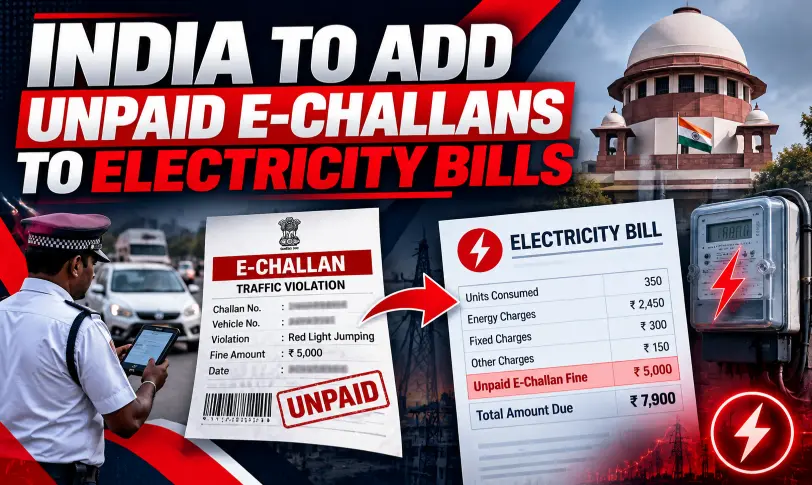

Unpaid e-challans in India could eventually be linked to electricity bills under a proposal discussed by the Supreme Court. The suggestion aims to improve the recovery of pending traffic fines by making unpaid challans harder to ignore. Under the idea discussed by the court, outstanding traffic fines could be added to electricity dues, although the proposal is not currently a binding rule or nationwide policy.
The Court suggested the following:
The idea came up during a hearing on the issue of unpaid recovery of e-challan fees before a bench presided over by Justice J.B. Pardiwala and Justice K.V. Viswanathan. The court said that giving challans alone is “not helpful” in addressing the situation. The authorities have to easily be able to recover the money.
It didn’t go unsaid by Justice Pardiwala, “If people are not paying traffic challans, put it in Electricity Dues book; They have to pay Electricity bill, otherwise the power line will be disconnected.
This is not binding, and it is a suggestion for states and union territories to consider, the court stated.
Why Unpaid E-Challans Are a Major Issue
The numbers provide a reason for why this court is pushing this. About Rs 45,000 crore worth of e-challan fines are due across India. Till now, only some Rs 25000 crore has been recovered. This leaves about Rs 20,000 crore of unpaid fines on the books.
If e-challans are issued, it is not just thousands and lakhs, but if nobody pays, then there is no benefit,” Justice Pardiwala commented.
Other Measures to Recover Unpaid E-Challans
The idea of using bills to link to electricity was not the only discussed one. They were also impotent between themselves:
- Blocking the renewal of registration certificates of vehicles.
- Not allowing the sharing of the ownership of vehicles for having unpaid challans
- Withholding fitness certificates and duplicate certificates
- Suspension of driving licenses for non-payment.
- Implementing disincentives for defaulters on the Parivahan portal
- Suspicion-based vehicle impoundments (a possible result of random vehicle checks)
These are the steps that aim to make unpaid fines difficult to ignore, and for people for whom paperwork is an obstacle, so are these steps.
The Legal Context
The suggestions came up during a hearing on implementing electronic enforcement under Section 136A of the Motor Vehicles Act, 1988, along with Rule 167A of the Central Motor Vehicles Rules, 1989. These rules provide guidelines on issuing and enforcing e-challans in India.
What Happens Next for Unpaid E-Challans?
The Supreme Court has only suggested this as an avenue for the States and UTs, not a law that springs out of the ground. Even if electricity bills are to be integrated with challans, the loading of the two systems should yet be worked out.
Conclusion
With the unpaid challan count at Rs 20,000 crore, the top court in India has now decided that the number of challans issued is not enough and needs to be addressed. For now, the idea of using electricity meter readings to replace traffic tickets is only a suggestion.