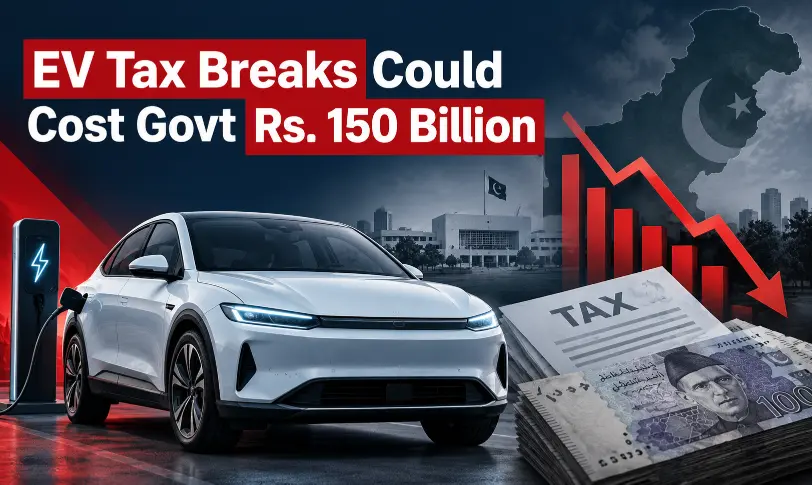

The shift toward electric vehicles is happening in Pakistan. A top industry source has now criticized the government’s EV tax incentives, saying it may cost the exchequer Rs. 150 billion every year.
Where Does the EV Tax Break Cost Estimate Come From?
Abdul Rehman, former chairman of the Pakistan Association of Automotive Parts and Accessories Manufacturers, explained the calculations for this figure. He predicts that New Energy Vehicles will sell 50,000 vehicles annually. The tax and duty savings in each of the vehicles are approximately Rs. 3 million on average.
Multiplying these two numbers yields lost revenue of about Rs. 150 billion. Currently, NEVs are being sold at a flat 1% plus tax in Pakistan, which is considerably lower than the sales tax on conventional vehicles.
Why This Is a Big Deal?
Rehman said that this was not a regular policy encouragement. He termed it as a big fiscal commitment because the government is opting to sacrifice Rs. 150 billion in potential revenues during the period when it is actively looking for more tax revenues elsewhere.
His statement brings a simple fact to the fore. Every time the government opts not to collect revenue, somebody has to pay for it. He drew analogies with the budget of the Higher Education Commission that takes about Rs. 35 billion for fiscal year 2025-26. That entire allocation is greater than the EV tax concession alone.
EV Growth Is Not the Issue, But the Incentive Structure Needs Review
Rehman was stressing that his opposition to Pakistan’s transition to electric cars is not against the movement itself. He admitted that lessening reliance on imported fuels, reducing emissions and creating a domestic EV industry are legitimate national goals.
His worry is for the one who benefits. He said there was no merit in financing such costly private vehicles, which the majority of the people in Pakistan cannot afford.
Rather, he proposed that the focus shift in this regard to electric buses, motorcycles, rickshaws, charging infrastructure, public transport and domestic manufacturing of batteries. Those options will bring electrification benefits not just to consumers of expensive private vehicles, he said.
Where This Fits in the Bigger Policy Picture?
The debate is happening during Pakistan’s process of finalizing the NEV Policy 2025-30 with the larger Automobile Policy 2026-31. The government aims to get 30 percent of all new vehicles to be NEVs by 2030, with a net economic benefit expected at Rs. 732.8 billion by then, largely through fuel savings.
Conclusion: Creating a Balanced EV Policy for Pakistan’s Future
While Pakistan’s EV incentives have legitimate objectives, the increment of Rs. The $150 billion price tag inevitably gives rise to doubts about who will gain from the structure and who will lose. While the procedure is being finalized, the debate is not about abandoning EVs. It’s about ensuring the incentives are delivered to the transportation sector that the Pakistani population relies on the most.