
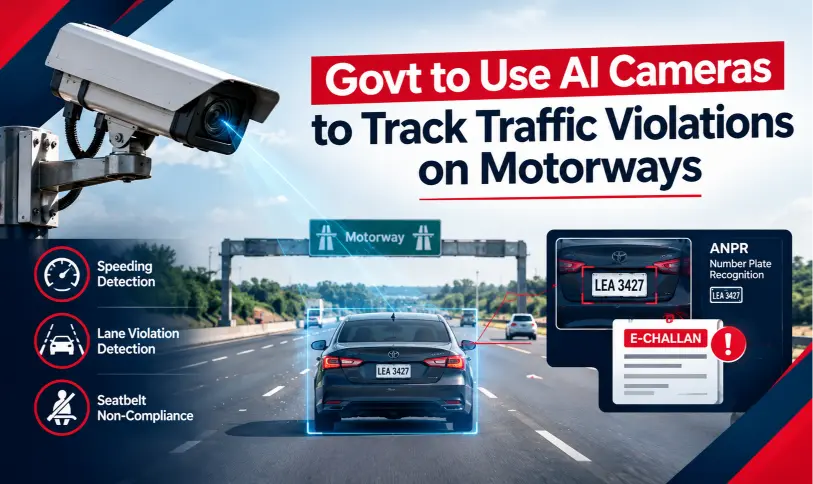

AI traffic cameras in Pakistan are giving motorways smart ‘eyes’. Officers no longer need to stop drivers for every violation, as AI-powered cameras can automatically detect traffic offences and help enforce motorway rules.
How AI Traffic Cameras in Pakistan Work
These cameras are based on AI software and Automatic Number Plate Recognition (ANPR). They provide real-time detection of violations and scanning of number plates. Lane violations, speeding, and now seatbelt non-compliance can all be detected without a single manual stop.
On detecting any violation, the system provides automatic generation of a challan. It is directly linked to the vehicle’s registration so that the fine is sent to the owner of the registration. There is no need for any officer to be there.
Why AI Traffic Cameras Are Being Used on Motorways
On motorways, heavy traffic with high speeds drives long distances. That makes them difficult to manually police, but perfect for 24-hour camera policing. AI has already been put to the test on Pakistani bustling highways, issuing dozens of challans daily for violations of the lane only. It is a logical next step to expand the same model to the motorway system.
How AI Cameras Will Affect Motorway Drivers
The fundamental change is that violations are caught more systematically today. The cameras are always on, and they are not dependent on an officer being in the vicinity for a violation to be missed.
It also clears away one of the controversies held with human stops. The system is not a matter of an officer’s word against a driver’s, but rather is based on footage and data. This minimizes clarification plus reduces informal negotiation at the roadside.
What Drivers Should Actually Do?
Compliance is really important in this day and age. Make sure to wear your seatbelt, stay in your lane, and obey signs that regulate speeds. This is all standard guidance; with 24/7 camera footage, there is a low probability that a violation is going unnoticed.
You can also get the challan situation of your vehicle regularly, as if you frequently drive on a motorway. In fact, ignoring the rules may cause future problems, ranging from blocking vehicle transfers to license renewal issues.
Conclusion
This expansion is part of a general movement of traffic management in Pakistan from manual to camera-based policing. The message for drivers is simple. The cameras are not going away, and the only sensible way to do things is to just stick to the rules, as there really isn’t that much room for a fault to be missed.