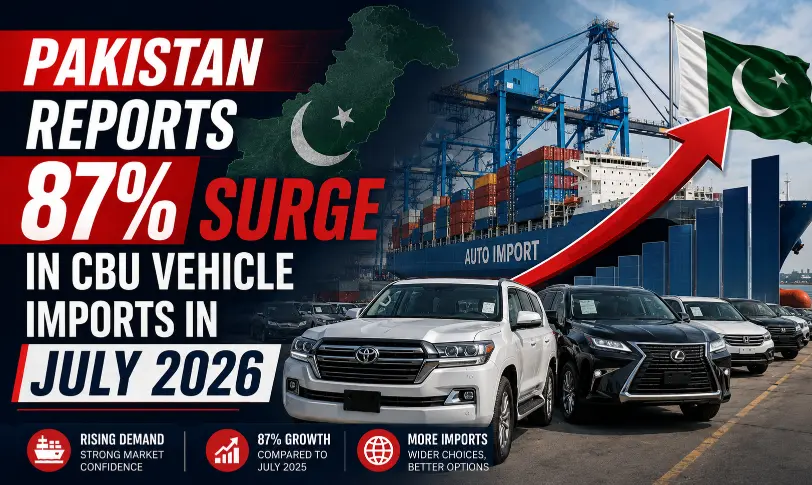

CBU vehicle imports Pakistan recorded a sharp surge in July 2026, highlighting major changes in the country’s automotive market following tariff reforms, easier imports, and lower financing costs. The numbers indicate that the market is rapidly evolving and not everyone is pleased about it.
CBU Vehicle Imports Pakistan: July 2026 Statistics
According to provisional Pakistan Bureau of Statistics data, Pakistan’s total transport group imports hit $422.31 million in July 2026. Nationwide, that is up 39.71% from $302.28 million reported in the same month a year ago but down 10.97% from the June amount.
The majority of that spending was by road motor vehicles, including both categories CBU and CKD/SKD at $372.90 million (+37.42% YoY). The growth in the category of CBU was represented by higher growth, especially. The price of CBU motor cars increased by 74.84% per year to $57.43 million. Heavy equipment vehicles (buses, trucks and other heavy vehicles) saw an even stronger gain, increasing by 131.67% to $21.21 million. Combined growth from CBU categories is where the PKRvenues 87% headline comes from.
Still, the biggest category was CKD/SKD motor cars, brew-ups built from kits instead of entire vehicles imported, at $187.88 million. That number, meanwhile, increased as well, rising 39.69% from a year earlier, but dropping 21.79% from June.
Why Is This Happening Now?
There is a collection of several forces acting simultaneously.
The increase in CBU vehicle imports Pakistan recorded during July reflects changing consumer demand and increasing competition between imported and locally assembled vehicles.
- Lower interest rates: SBP has lowered policy rates rapidly within the last year, which has considerably enhanced the attractiveness of financing auto loans.
- Eased import restrictions: The government eased import restrictions on CKD parts, allowing domestic CKD assemblers to resume activity.
Pakistan’s new National Tariff Policy has further reduced CBU customs duties to a maximum of 15% for the next five years from high rates often above 50-100% for different categories of vehicles. There seem to be some buyers/importers lining up for early deals.
Sales figures also reflect this trend. Pakistan Automotive Manufacturers Association statistics indicate that car sales increased 141% in July 2026, going from 7,135 to 17,216 units. Split passenger PAMA data shows a 79% jump to 19,818 units in passenger numbers. Regardless, the trend is still the same: a market that’s gaining ground rapidly out of a lengthy downtrend.
Not Every Segment is Improving
In July, Jeep and pickup sales actually declined 33% year-on-year, with sales at 2,602 units. It’s in the Hyundai Tucson sales alone, down 69%, and the Honda BR-V and HR-V are following suit. That divide indicates that it’s probably not the SUV segment that is driving the growth in sales and imports, but rather the smaller, more affordable end of the spectrum.
The Tension This Creates
Rising CBU imports give buyers more vehicle options and improve the availability of fully built cars. They are more of a worry to Pakistan’s local assemblers. The industry sources have called on the government to intervene since the proposed tariff reductions under the new National Tariff Policy could leave local manufacturing in jeopardy if CBU imports continue at their current rate.
It’s not a new tension, but it’s heightened now. For decades, the Pakistani auto industry has been shielded under high protective tariffs and enjoyed direct and indirect subsidies of over Rs 250 billion in recent years. That protection helped create a domestic component industry, but it also allowed assemblers to avoid direct international competition on cost and quality. This shelter began to diminish as the tariffs were reduced.
Pakistan Auto Market Changes After Rising CBU Vehicle Imports
This increased import of vehicles is not an isolated event. In July 2026, Pakistan’s overall trade deficit increased by 25.1% year-on-year to $3.95 billion. Import payments rose nearly 18%, while exports grew around 10%.
Conclusion
July’s figures are reflective of a transitioning market. Financing costs have also declined, import restrictions have relaxed, and tariff policy will be liberalizing over the next 5 years. That’s driving more CBU-to-market and local sales up at the same time, sounds good all the way around.
The problem is that both trends can’t keep going like that forever. But if CBU imports continue expanding at this rate and tariff lowering continues, local assemblers will be under real pressure. But The new tariff system will determine whether the local industry strengthens or faces greater pressure in the coming years.