
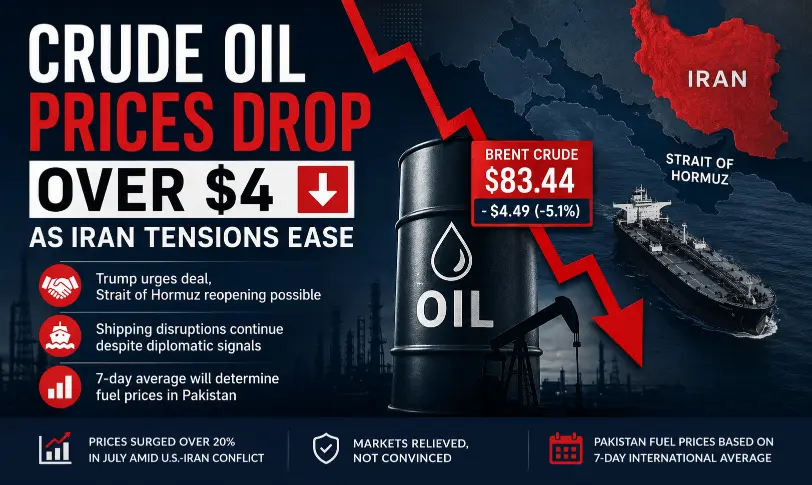

International crude oil prices dropped by over $4 a barrel Monday after U.S. President Donald Trump urged a deal on opening back the Strait of Hormuz. Brent crude futures fell $4.49, or 5.1%, to a closer to America’s $83.44 per barrel, per Reuters data.
What Triggered the Drop?
Followed by indications that tensions between Washington and Tehran have come to a thaw. Trump said Saturday that Iran and other Middle Eastern countries requested more time for negotiations, saying it could result in the “immediate and complete” reopening of the Strait of Hormuz.
A significant portion of the world’s sea transport of crude oil passes through the strait. With any sign of shipping resuming there is a speedy change of the pricing. That’s what happened on Monday.
Markets Are Relieved, Not Convinced
Even the decline hasn’t been considered conclusive. International analysts are keen to know if Iran continues to make use of control of the strait to leverage its negotiating position.Traders are closely monitoring Iran’s use of its lever on the strait in negotiations.
Such caution is well advised. Through 2026, prices have varied widely between near $70 a barrel during the ceasefire phase and above $110 during active strikes. They depend entirely on the phase of the fight and the talks at the time. This market has been known to swing by several dollars a barrel on day’s trading, following a single positive or negative word from a diplomat. A release on Monday was no exception to this trend and, just like most other releases that came before it, it is being called encouraging but not conclusive.
For the third time in three days, shipping disruptions still occur on the ground.
Diplomatic indications have not “yet” brought back normal commercial trade. Since Saturday, the United Kingdom Maritime Trade Operations has reported three more attacks on tankers, with traffic in the Strait of Hormuz decreasing since a series of such incidents in recent weeks.
Not every road is impacted the same, however. Saudi’s oil crossed the Bab el-Mandeb Strait and departed the Red Sea over the weekend, hinting at other shipping paths being partially operational despite the problem in the Hormuz route. The difference is relevant to actual supply in the short term. That’s because any price change for a single day would have less of an impact than if the main route remains impacted, contingent upon a diplomatic breakthrough on Hormuz.
The Bigger Picture: A Volatile Month Behind It
The decrease is after a sudden surge last month. Fighting between the U.S. and Iran intensified in July driven by both increases in Brent crude and increase in WTI crude by over 20%. Tanker attacks off Oman were fueling concerns that the supply disruptions could spread wider, prompting shipping companies to steer clear of the Gulf region.
A 5% plunge for a single day can be significant, however, but it can only partially reverse a month of steady gains. Current diplomatic de-escalation has helped relieve some of that strain.
Now, what this means for the price of fuel in Pakistan.
The mechanism is not linked to same-day foreign prices and Pakistan now has a daily formula to update fuel prices. The average of the previous seven days international crude oil price is used, rather than the price on the day of the revision.
This means the drop won’t be felt on the pumps in Pakistan on Monday. It needs to find its way into the rolling seven-day price averages used to determine domestic prices. The downward trend in international prices could give some relief to consumers in Pakistan as the decrease in international price level may eventually bring that average down. If instead prices turn around, as they have so many times during this conflict, that relief may never happen at all.
This time lag should be understood as a lag. It would ensure that Pakistani fuel prices always lag crude prices by a couple of days, muting some day-to-day fluctuations.
Conclusion
The price drop on Monday has been a sign of genuine hope for a Strait of Hormuz agreement. But this is far from a “resolved” situation as shipping continues to be disrupted and the market itself remains skeptical. An important value for consumers in Pakistan watching fuel prices is not the single day drop on Monday, but the drop over the past week. The real action at the pump depends on whether international oil prices keep dropping long enough to be significant, over the 7-day average.