
Pakistan’s proposed EV policy for 2026–31 has been withdrawn following strong opposition from local vehicle manufacturers and automotive parts associations. The policy was intended to accelerate the transition towards electric vehicles and reduce the country’s dependence on imported fuel. However, the proposed EV policy was withdrawn before formal notification after manufacturers raised concerns about localisation, existing investments and employment in Pakistan’s automotive sector.
The result is an uncertain automobile market, higher hybrid vehicle prices and no confirmed timeline for a replacement EV policy.
Why Was the EV Policy Scrapped?
The automobile industry’s main concern was that the proposed EV policy appeared to favour electric vehicles without introducing sufficient localisation requirements. Industry representatives argued that localisation requirements were essential to prevent Pakistan from becoming only an assembly market for imported EV components. Without local production, existing manufacturing investments and thousands of jobs could be placed at risk.
The Pakistan Association of Automotive Parts and Accessories Manufacturers, or PAAPAM, strongly opposed the proposed EV policy. It argued that excessive concessions for imported electric vehicles without localisation targets could weaken rather than transform the domestic auto-parts industry.
PAAPAM’s demands focused on three areas. First, tax concessions under the EV policy should be linked to annual localisation targets, including the local production of batteries, motors and power electronics. Second, there is a need for government subsidies for existing auto parts suppliers to transform their factories for making parts for EVs. Thirdly, the shift should be built on a roadmap that enables local assembly plants to make a gradual conversion from ICE production to EV, not be forced out of business overnight.
Who Is Paying for the EV Policy Delay?
That is a valid political/policy discussion. The one thing that’s not OK is who’s taking the brunt of the burden of a government that didn’t plan ahead for transition.
The current Auto Industry Development and Export Policy (AIDEP 2021-26) is set to lapse on 30th of June, 2026. This was a date that the government knew for five years. These should have been prepared and communicated prior to that date through a replacement policy. It was not done.
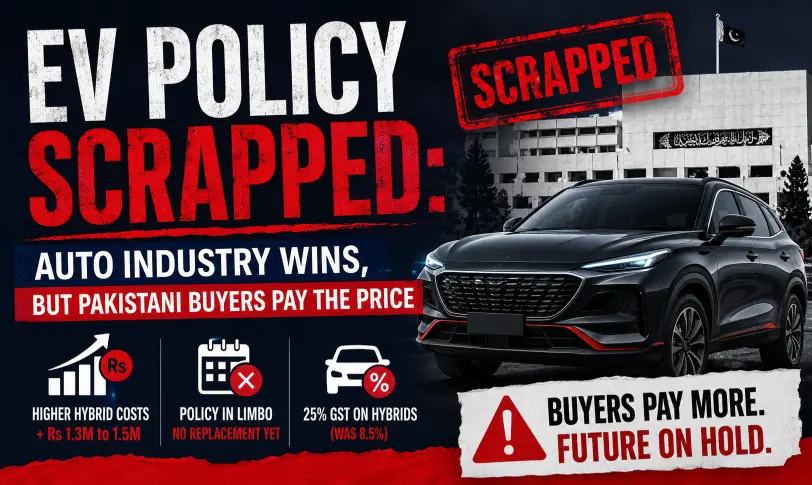
The Federal Board of Revenue had reinstated the full 25% General Sales Tax on locally built hybrid electric vehicles and plug-in hybrids upon the expiration of AIDEP, as it did with diesel clean air vehicles. The previous concessionary rate was 8.5%. An interim rate of 18% had been proposed by the industry. On July 1 buyers had to pay 25%.
| Vehicle Category | Rate Before July 1, 2026 | Current Rate | Industry Proposed |
| Hybrid Vehicles (HEV/PHEV) | 8.5% GST | 25% GST | 18% GST |
| Conventional Petrol/Diesel | 25% GST | 25% GST | 25% GST |
The demand for popular hybrid versions went up by Rs 1.3 million to Rs 1.5 million almost as soon as they were launched at the markets. Announcers who had anticipated a hybrid model purchase using the old price have been dealt a devastating blow.
Where Things Stand Now
A high-level committee headed by Deputy Prime Minister Ishaq Dar has been set to draw up an alternative policy after PM Sharif intervened. There is no indication of a release date. There is no announcement of any interim relief package, yet, both PAAPAM and major assemblers are lobbying for the 18% bridge policy until the new one is finalised.
The market will stay in the same position until the committee headed by DPM delivers a new draft and it is formally announced. Prices for ‘hybrids in the middle’ are high. Buyers are uncertain. The new-generation vehicles that had relied on policy framework are in hold-up with manufacturers not launching new models. But the original policy’s goal of promoting EV adoption has been suspended indefinitely.
The Flipside of the Coin for Car Buyers Today
If you’re thinking about purchasing a hybrid car, the truth is that you should wait to see what happens with the policies before you actually purchase. If an interim relief package is announced, the prices look to come down and will save Rs 500,000 or more on a popular hybrid model. But this overall regulatory uncertainty impacts the number and rate of new models and charging infrastructure’s development.
The inspection and verification processes continue to be crucial for any utilized car purchase in this setting. Prices of vehicles are changing and people need to know what they will be getting before buying.
Conclusion
The cancellation of the Auto Policy for the years 2026–31 is an actual conflict between safeguarding local industry and the rapid shift to EVs in Pakistan. It’s a fair concern from industry on localisation. The lack of a policy handover plan by the Government is not ok. The repercussions of that lapse are on the Pakistani buyers now, when they are slapped with a sudden tax hike of 16.5 percentage point on hybrid cars. That situation will not improve until the new committee has issued a clear proposal for the incentives for EVs, and the localisation requirements.