
Spare tyres have been standard in every car for decades. Open the trunk, and there it was, a full wheel waiting for the day you needed it. Many drivers wonder why new cars don’t have spare tyres when older vehicles always included a spare wheel. The change is mainly linked to weight reduction, efficiency improvements, EV range, and modern vehicle design. At first sight it seems like a cost-cutting exercise. It isn’t because Engineering strategy has nothing to do with corner-cutting.
The Weight Problem Nobody Notices
- This weight reduction enhances fuel efficiency and emission reductions.
- With EVs, it directly improves driving range; EV platforms are designed to maximize range by minimizing weight.
- Another advantage is the ease of manufacturing, as there are fewer parts to purchase, fit, and maintain.
Why New Cars Don’t Have Spare Tyres: The Real Reasons
Understanding why new cars don’t have spare tyres requires looking at several engineering decisions made by modern vehicle manufacturers.
1. Improved efficiency: Reduces vehicle weight by cutting 14-27 kg, resulting in better fuel economy and lower emissions.
3. EVs are helping to precipitate the change: For electric platforms, every drop in space and weight counts to provide a competitive range, yet without too large batteries.
3. Better packaging: The extra room is designed for batteries, luggage capacity, safety, and better exhaust systems.
What Replaces Spare Tyres in New Cars?
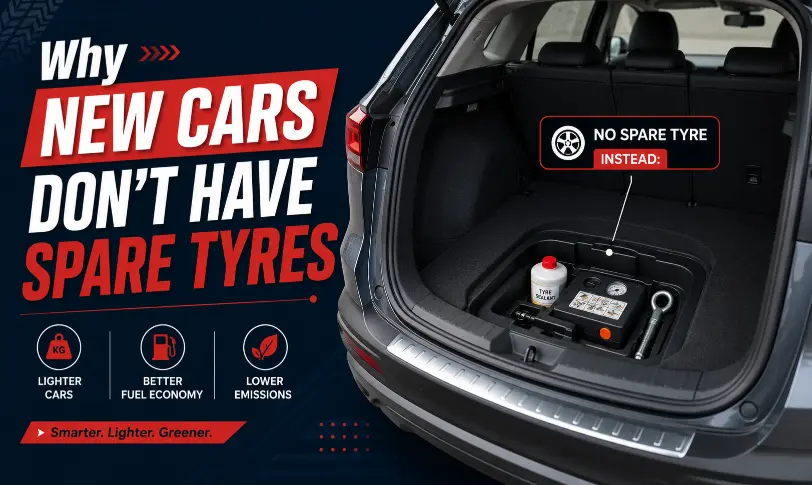
The reason why new cars don’t have spare tyres is also connected to the availability of alternative solutions like repair kits, run-flat tyres, and roadside assistance.
- Tyre repair sealant kits allow for the temporary repair of small punctures. They’re light, compact, and easy to use, best suited for nails, screws, and minor punctures.
- Run-flat tyres are sidewall reinforced so that they can be driven safely for short distances in the event of loss of air pressure, suitable for controlled use until a viable repair can be performed.
- Nowadays, many newer vehicles include roadside assistance as a standard feature, and it provides services including on-road or on-site support, as well as towing services on weekends and holidays.
Where Spare Tyre Alternatives Fall Short?
Sealant kits do not replace a spare tyre, and there are some things to understand about their capabilities.
- They are unable to mend sidewall punctures.
- Not used for significant holes.
- They’re not capable of making up blowouts.
- Wheels can be damaged even if the kit is used, and this necessitates a tow.
That is why many have continued to advocate for a real spare wheel being on board. Especially when on a long drive on highways or in rural areas where roadside assistance may not be as readily available.
What Drivers Actually Think?
Despite the engineering rationale behind the transformation, the customer sentiment is not 100% on board. Global Automotive Consumer Surveys indicate that 67% of drivers think a spare is an item of personal safety that should always be present. It’s quite a difference between what manufacturers are working toward and what is still expected.
Why Some Vehicles Still Have Spare Tyres
The spare tyre isn’t being phased out evenly across all vehicle categories.
- Typically, SUVs, pickups, and off-road vehicles still include a full-size or temporary spare tyre. As having a spare in harsh, rural, or mountainous conditions is more important than the minor boost in efficiency of saving it.
- The shift is most apparent in the passenger car and EV classifications, where looking to save weight, extend range, and reduce costs is more important than packing away a seldom-used second spare tyre.
What This Means for Dealerships?
This transition is presenting a real opportunity, and real responsibility, at the point of sale. Sales consultants should:
- Make it clear what is provided in the car.
- Show a demonstration of the repair kit before the customer really needs it in an urgent crisis.
- If available, discuss the option to have a spare wheel.
- Make roadside assistance available as a part of the overall value and not an afterthought. There’s nothing more to give customers trust than transparency at delivery.
Conclusion
The question of why new cars don’t have spare tyres has become more common as manufacturers continue moving toward lighter and more efficient vehicles. It signals another trend in the way cars are being designed, where efficiency, package, energy and intelligence become as much of a focus as speed and power. With the increasing popularity of EVs and stricter emissions standards, there will be more vehicles than ever without a spare. Smart engineering doesn’t always sound good on a spec sheet.