
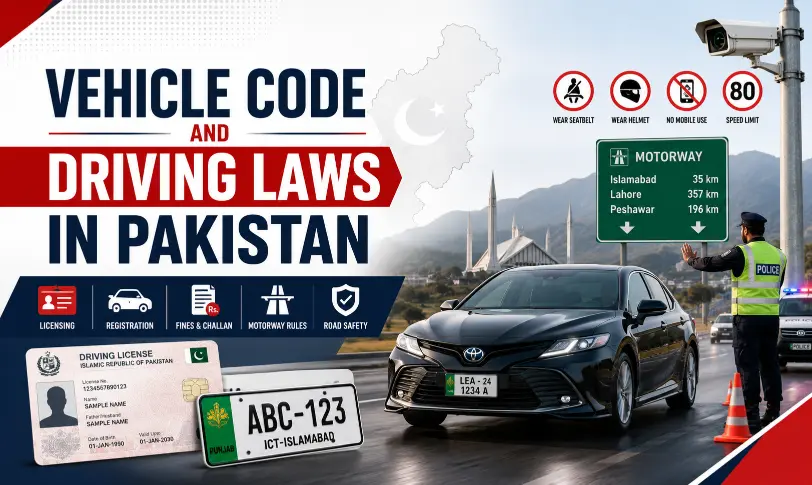

Vehicle Code and Driving Laws in Pakistan establish the legal requirements for drivers and vehicle owners. These rules are based on the Motor Vehicles Ordinance 1965 and are also updated through provincial regulations and digital enforcement systems. Understanding the rules is more than a matter of avoiding a fine. It revolves around first knowing what is legally necessary before driving.
Legal Foundation of Vehicle Code and Driving Laws in Pakistan
The legal foundation of the Vehicle Code and Driving Laws in Pakistan is primarily based on the Motor Vehicles Ordinance 1965, which regulates vehicle registration, driving licences and road traffic. The transport authorities in each province (Punjab, Sindh, KPK and Balochistan) have their own rules in addition to this ordinance. In Punjab, however, the rules can differ from those in Sindh, and yet both are originally based on the same federal law.
Driving License Requirements
Anyone who is driving a car or motorcycle shall possess a valid driving license to drive on public roads.
- Minimum age for cars and motorcycles is 18 across the country.
- Minors are not legally allowed to drive, including with verbal authorization of a parent. In violation of the Motor Vehicles Ordinance.
- Learner permits will need supervision. Minor or adult learners are never left unattended. It is against the law to drive a car without a passenger.
- Licences are issued and verified provincially, with the age and eligibility criteria remaining the same nationwide.
- The minimum age to hold and renew a licence is not specified; the applicant must be deemed medically fit to hold and renew.
For example, in some cities, digital verification is used, which means that traffic police can check a licence on the computer.
Vehicle Registration
All cars must be registered and use a registration mark on their front at all times. When a vehicle is registered with an owner, the registration will also be useful for resale, insurance claims, or even for traffic enforcement purposes. One of the most typical errors when purchasing a vehicle is failing to register the vehicle under the new owner’s name.
Fines and Penalties for Common Violations
The amounts of fines will differ slightly by province and city, but the basic pattern is this:
- For driving without a valid license: Rs. 2,500 to Rs. 5,000 for motorcycles, Rs. 5,000 to Rs. 10,000 for cars, and Rs. 10,000 or more for commercial vehicles.
- Underage driving: Rs. 10,000 to Rs. 25,000 depending on the vehicle type, with possible legal action against parents or owners who allowed it.
- Motorcycle helmets and motorcycle passengers must have a licensed motorcycle helmet with the strap secured.
- Seatbelt violations: Passengers in most jurisdictions are now required to wear seatbelts.
- Unpaid challans can cause trouble in registering or renewing the license and also cause the car to get blacklisted.
Both cities of Karachi and Islamabad depend heavily on enforcement through cameras, which range from Safe City cameras to ANPR cameras.
Motorway Rules Under Vehicle Code and Driving Laws in Pakistan
Vehicle Code and Driving Laws in Pakistan also include specific regulations for national motorways, enforced by the National Highways and Motorway Police.
Overtaking is only to be done from the right lane. Slow-going vehicles should remain on the far left.
- Generally, motorcycles are not permitted on most motorways.
- The fast lane is not for use by heavy vehicles, even when there is no traffic.
- All passengers must use a seatbelt, even those in the front seat.
- More than one overspeed citation will cost you your license and not just your money.
The rights of the driver during traffic stops
Traffic law isn’t one-directional. Drivers are entitled to protections in enforcement that must be known by both driver and enforcer to avoid confusion and misconduct in enforcement.
- Police need to provide a clear justification for stopping a car.
- There are no cash fines allowed. Payment shall be made officially, and not directly to an officer.
- Taking personal vehicles, even for minor offenses, isn’t a legal option. Only severe infractions warrant impoundment.
- It is legal to record any traffic stop in the presence of others, provided it does not hinder an officer’s duty.
- It also allows drivers to appeal the challan and ask for it to be corrected if it was issued incorrectly.
Changes to Vehicle Code and Driving Laws in Pakistan in 2026
Provinces are making a lot of rule changes this year. The traffic law change in Punjab implements age limit verification, a compulsory road test program for new applicants and a digital platform to detect fake photo IDs from applicants. Candidates who fail a driving test three times must now wait 30 days before reapplying. Several cities have also extended their camera enforcement program through AI, so more violations are being detected and processed without police assistance.
Conclusion
Understanding the Vehicle Code and Driving Laws in Pakistan is essential for every driver, vehicle owner and motorcycle rider. Pakistan’s traffic system is gradually moving from manual enforcement toward digital licence verification, surveillance cameras, automatic number-plate recognition and electronic challans. Drivers should maintain a valid licence, complete vehicle registration transfers, follow helmet and seatbelt rules and regularly check provincial traffic-law updates. Compliance not only prevents fines and legal problems but also protects passengers, pedestrians and other road users.