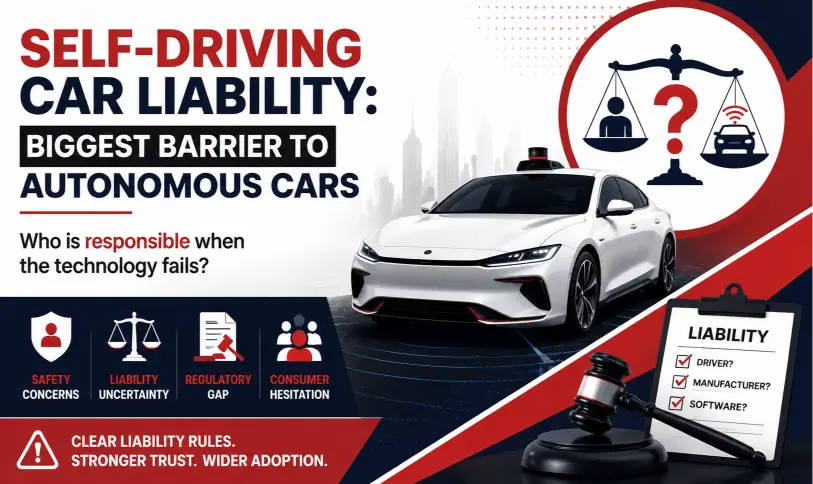

The biggest challenge facing autonomous vehicle adoption today is self-driving car liability. While technology continues to improve, consumers remain concerned about who will be responsible when autonomous vehicles fail
Why Self-Driving Car Liability Remains Unresolved?
One of the latest industry surveys found that 50% mentioned liability as their primary concern. Safety came in second at 41%. Federal and state rules conflict in 35%. When it came to cybersecurity, though, only 16% of respondents were concerned. The responsibility is more on the buyer side than on the technical risks.
This gap matters. It implies that despite having eliminated all the sensor issues, automotive companies would still get challenges at the dealership, simply because it’s not about performance worries. It’s about consequences.
This is confirmed by other studies. Only 13% of US drivers said they’d trust riding in a self-driving car in 2025. This is an increase from the previous year’s 9%, but remains low. And 61% said they were “very afraid” to try it. And 74% agreed that until there’s tighter control, these vans are not to be taken on the road in force. 58% of UK drivers would simply wait and see before relying on the technology.
However, the interest in the technology itself did not end. Hands-free highway operation is a preference of 43 percent of new car buyers. That’s 20 points higher than last year. So it’s not resistance against automation that the problem is. Who bears the costs to utilize when it goes wrong?
Why Liability Remains Unresolved?
Typical car accidents occur when only one party is at fault. Self-driving cars are an exception to that model. The uncertainty around self-driving car liability exists because autonomous vehicles combine human decisions, artificial intelligence systems, hardware components, and software algorithms. A single accident may involve multiple responsible parties, making traditional insurance and legal frameworks difficult to apply
Here’s how it typically plays out:
- Even in “self-driving” cars, a driver who should have been paying attention to the system has been found liable in court cases.
- Under normal product liability law, a defect results in the manufacturer being liable if a sensor or braking system fails.
- The software company may be held liable if it makes a wrong judgment, such as when it fails to detect a pedestrian in the way.
- In full driverless mode, responsibility seems to fall largely on the company operating the vehicle.
This isn’t hypothetical. A Florida jury ruled against Tesla in 2025 for causing a fatal crash in which a company’s Autopilot system was proved to be defective. This is one of the biggest automotive product liability verdicts ever in the United States. Situations like these are helping to define liability. However, there are no firm, direct standards. Each case is determined individually.
The Regulatory Gap
This issue has yet to be fully addressed in any country. The US shows why. There is no federal liability legislation for self-driving cars. The NHTSA mandates crash reporting and investigates crashes, while fault determinations go to court and individual states.
In February, the SELF DRIVE Act of 2026 was introduced and has passed through committee. Increases federal safety enforcement capabilities. Demands manufacturers to provide extensive safety records. However, it does not establish any new rules of liability. It doesn’t shield manufacturers from lawsuits, either. The bill deals with safety certification and not who pays after an accident.
States are supplementing this on their own. California’s Assembly Bill 1777 will go into effect in July of 2026. If the self-driving system is activated while a traffic violation occurs, it permits police to directly issue formal violation notices to manufacturers. It’s a small step, but a telling one. If there is not a national plan, however, results are still all over the map in each state.
Why Self-Driving Car Liability Matters More Than Safety Statistics?
Many people already think that automation would reduce accidents that are directly due to human failure. The actual concern is accountability. When something goes wrong, who’s to blame? And will that process be fast and fair?
This distinction is important to auto manufacturers and regulators. Having more sensitive sensors and more intelligent software isn’t enough to solve the problem of adoption. But at the heart of it, the lack of trust is not caused by the smallest technical update, but by liability rules that simply aren’t clear.
Establishing transparent self-driving car liability rules will be critical for the future of autonomous transportation. Consumers are more likely to accept driverless technology when manufacturers, regulators, and insurers provide clear accountability standards.
Conclusion
That means it’s likely to remain the same until liability laws catch up with the evolution of technology. There are Continuous fears of a completely autonomous car. And legal outcomes are decided case by case, not under one consistent rule. If automakers can provide clear guarantees, such as being publicly accountable if their system is responsible, it just might provide a real edge.
So, for now, the data is telling us clearly that it’s not technology barriers that are causing the delay for self-driving cars. The unanswered question is, who is at fault when the tech fails?