

Ethanol-blended gasoline is now completely regular in most nations. Many vehicle drivers fill up their tanks with E10 as if nothing had come up on the label. Others are able to select between E15, E20, and even E85 based on their residence. Other regions keep ethanol levels much lower due to concerns of vehicle compatibility and sustainability; in Brazil, an E30 blend is being implemented nationwide.
That gap is at the core of the ethanol discussion worldwide. Does adding ethanol make gasoline “cleaner,” or is it only a transfer of expense to consumers, taxpayers, and farm products?. Maybe it depends on what is used to produce the ethanol and the amount of ethanol blended.
Ethanol Blended Fuel: What is it?
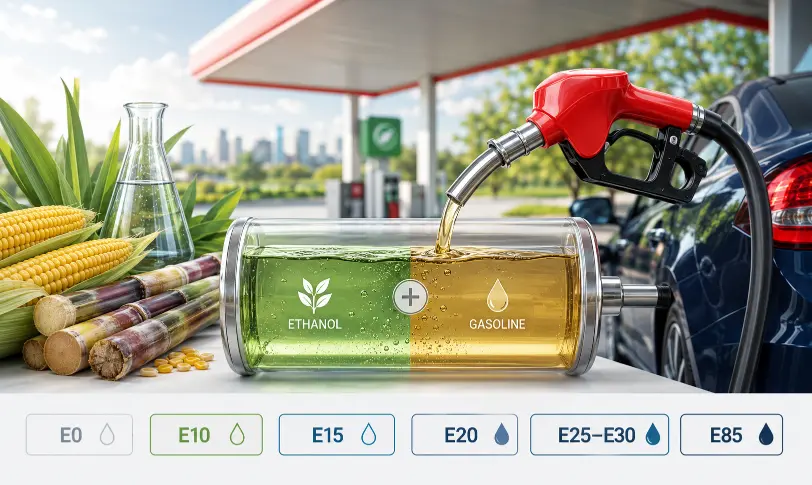
Ethanol is an alcohol-based fuel derived from fermenting crops or other plant material and blended with regular gasoline.
| Fuel | Composition | Common Use |
|---|---|---|
| E0 | No ethanol | Ethanol-free petrol, where sold |
| E10 | 10% ethanol | Standard gasoline in many markets |
| E15 | 15% ethanol | Approved vehicles, select markets |
| E20 | 20% ethanol | Markets moving to higher blends |
| E25–E30 | 25–30% ethanol | National high-blend programs |
| E85 | 51–83% ethanol (seasonal) | Flex-fuel vehicles |
Why Do Governments Push Ethanol So Hard?
- Energy independence: Economical use of ethanol produced domestically instead of oil that would otherwise have to be imported. That is an important factor for a nation without a substantial own oil reserves.
- Support for farmers: Mandated blends ensure continuous demand for corn, sugarcane, sugar beet, and other crops. Agricultural groups make strident efforts to ensure they are legislated.
- Reduce emissions: Ethanol can reduce lifecycle emissions compared to straight gasoline, and it all depends on the crop, farming practices, fertilizer application, and the efficiency of the refining process. Giving them plants doesn’t guarantee a victory.
- Fits existing infrastructure: Even at lower quantities, ethanol can fit into existing fuel systems. This benefit diminishes as the blend ratio increases, with higher percentages requiring upgraded tanks, pumps, and vehicle components.
How Do Ethanol Rules Differ Around the World?

In the United States, E10 is the standard, and almost all gasoline uses ethanol. EPA emergency waivers have enabled E15 to grow, and now it’s available year-round nationwide through mid-2026. Under the Renewable Fuel Standard, the primary feedstock is corn.
- Brazil: It is the most integrated market in the world with ethanol. In August 2025, Brazil increased the obligation from 27-30% (E30) and may reach 35% if the sugarcane crop is strong. Some 70% of new cars sold there are “flex-fuel”, which use either pure gasoline or pure hydrous ethanol (E100).
- EU: Most EU countries only sell E10 petrol (with Spain, Portugal, Italy and Greece continuing to sell predominantly E5 petrol).
- India has championed the blending of E20 grade fuel by netting 20% of the blending by 2025, which is five years early, and now the country is pursuing E30, E85, and E100 vehicles. E20 will not impact insurance coverage, although rubber parts and gaskets on older vehicles could require replacement.
- Canada doesn’t have an approach at all; its federal Clean Fuel Regulations are applied to carbon emission intensity over the lifecycle of fuels. Other rules apply province by province; actually, the quality of petrol may differ depending on where you fill up.
Does Ethanol Fuel Lower Your Mileage?
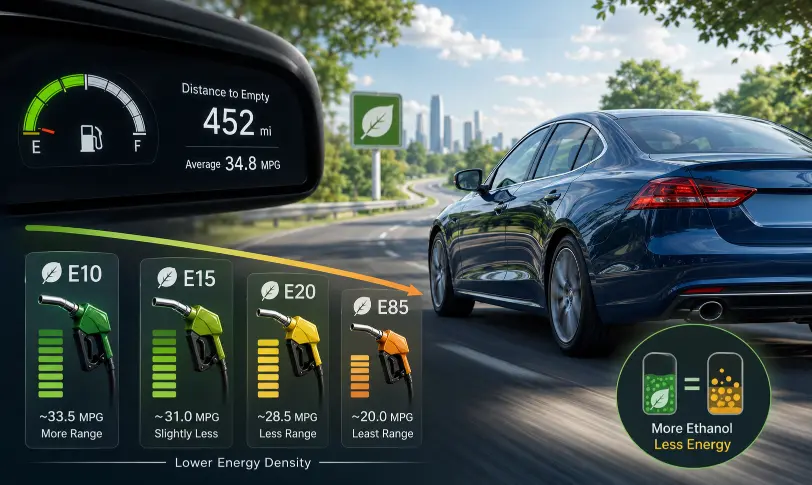
Ethanol does not have as much energy as regular gasoline. A gallon of E10 carries about 96.7% of the energy in a gallon of pure gasoline. The actual effect upon either your mileage depends upon the blend percentage, your engine, and how you drive, but the trend is reliable:
- E10 makes a minor dip. The EPA is estimating a reduction in mileage of approximately 1 ½–2%.
- E15 and E20 are slightly lower due to an even lower amount of energy per gallon.
- It, of course, has less energy density than gasoline, and E85 can significantly reduce MPG.
- That loss is offset in part by the higher octane that ethanol provides for engines made to fit that use, such as the flex-fuel vehicles in Brazil.
Will Ethanol ruin your engine?
Ethanol does not have as much energy as regular gasoline. E10 contains approximately 96.7% of the energy of pure gasoline per gallon. The actual effect upon either your mileage depends upon the blend percentage, your engine, and how you drive, but the trend is reliable:
- E10 makes a slight bend. EPA is estimating that the mileage is expected to drop by about 1 ½-2%.
- E15 and E20 are slightly lower due to an even lower amount of energy per gallon.
- It, naturally, isn’t as dense as gasoline, and E85 certainly harms MPG.
However, that shortfall is mitigated by the increase in octane that ethanol allows for fuels engineered to run on ethanol, for example, flex-fuel vehicles that exist in Brazil.