
The EU recently became the first region to mandate Driver Monitoring Road Safety systems in any vehicle registered after that date. According to years of data, significant research, and simple logic, driver safety technology that can detect when a driver is distracted or fatigued before the accident occurs should be mandatory. The EU has taken steps in response to that finding. The rest of the world and even Pakistan have to follow.
What is a Driver Monitoring System?
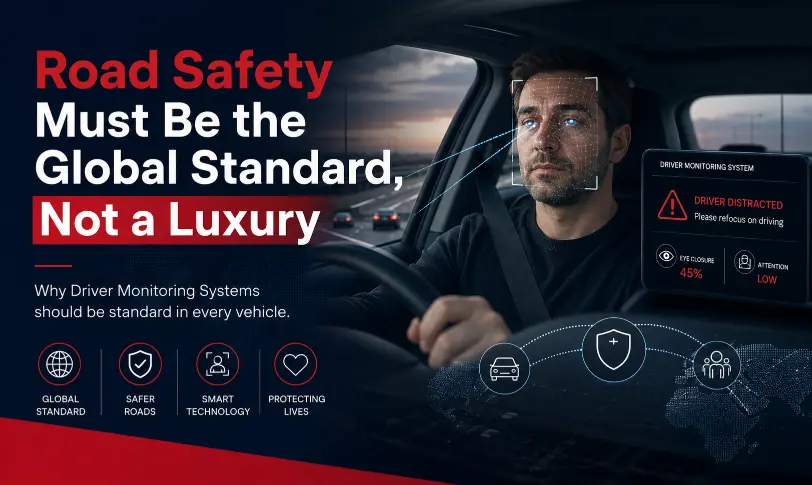
The Driver Monitoring System (DMS) is an AI-powered infrared camera system installed in the vehicle’s cab that continuously monitors driver behaviour in real time. It doesn’t sit and wait for an accident to occur. It’s paying attention to the signs that tip it in advance.
Modern DMS technology identifies:
- Errors in judgement, like getting dazed or dozing off
- Mobile phone distraction
- Eyes leaving the road
- Listens with poor focus or poor sustained attention
- Seat belt non-compliance
- Number of people in the car, including children
- Occupant detection for airbag and safety system optimisation
If any of the risk indicators are identified, the system will give the driver an immediate warning to change their driving habits and thus prevent an accident. In the case of commercial vehicles, these alerts are also recorded and sent to the fleet manager in real time.
Why This Matters More Than People Realise?
According to the World Health Organisation (WHO), 1.35 million people per year are killed on the road worldwide. On Pakistani roads alone, some 30,000 lives are lost every year. Many of these are not in relation to mechanical failure or poor road design. They can result from human error: tiredness, distraction, inattention, and the rapidly growing practice of fleeting glances at a mobile phone at the wrong time.
If that’s the reason you’re reading this, and you’re searching for something to make your life better, you need DMS. Technological equivalent to a co-pilot who never sleeps, never looks away, and never comes late. There is already sound evidence on its effectiveness, so much so that the EU has shifted from a recommendation to a mandate.
Whether or not it works is not the question. It does. Why is it perceived as a luxury as opposed to a standard feature in most markets?
The Commercial Vehicle Argument Is Even Stronger
Where passengers’ comfort is important in cars, it’s a necessity in commercial vehicles. Truck drivers, bus operators, taxi drivers, and logistics workers drive much longer than the average commuter, which causes them to fatigue much more quickly. If an on-duty truck driver lapses for just a few seconds at highway speeds, it could result in an accident with many involved.
Companies that have implemented DMS Road Safety and have seen tangible accident reductions, cost savings, and evolved a new focus on driver accountability. The benefits of the technology outweigh the cost with regard to the insurance claims avoided. This is a short-term cost argument that invariably neglects the long-term financial and human cost of the accidents that it would prevent.
What does Pakistan’s auto industry need?
The market for cars is growing in Pakistan. The regulatory framework is undergoing a reform to make way for Auto Policy 2026/31. It is the perfect time to establish the number of vehicles being produced and sold in Pakistan and what they contain as standard.
If a country puts together, or imports, cars without requiring basic active safety, they are taking unnecessary deaths as part of making the vehicles less expensive. This is not a winning combination in the longer term.
ADM must be standard in every automobile manufacturer that sells cars in Pakistan and worldwide in every passenger and commercial vehicle. Just like airbags and ABS are today and have become standard on all mature car markets.
The technology is well-developed, in use by manufacturers who have decided to make safety a priority, and commercially available.
Conclusion
The EU Driver Monitoring System mandate is not the end line.’ It should be a metric that all auto markets strive to match. The rising auto sector in Pakistan has the right chance to make safety an objective, and not a secondary consideration. Today, DMS technology saves lives, and nobody has a credible reason against having it as an option. Road safety is about investing in human lives, and every journey should be a safe journey.