
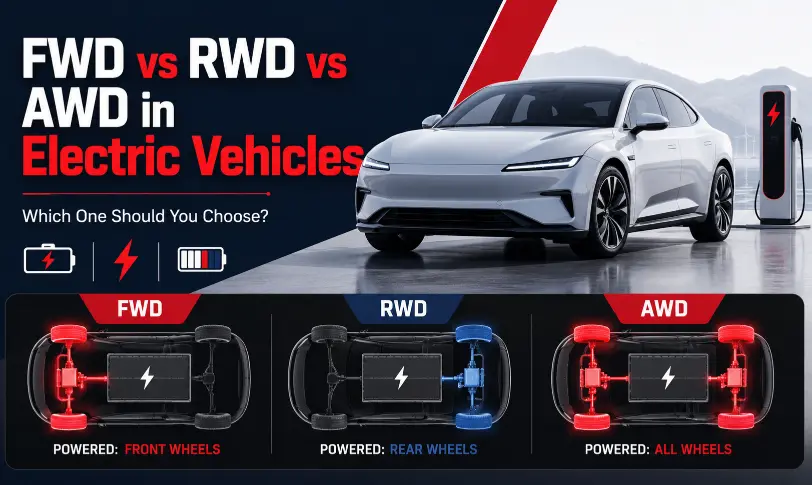

The three most common comparison metrics are power range, charging speed, and cost when comparing EVs. However, when choosing a variant, another key question appears on the spec sheet: FWD vs RWD vs AWD. These refer to Front-Wheel Drive, Rear-Wheel Drive, and All-Wheel Drive. What is the difference, and does it really matter?
Most people have a sense about this in a petrol car. FWD for reliability and fuel economy, RWD for performance, AWD when you want both. However, EVs operate differently, so let us discuss their comparison.
Why EVs Change the Equation?
FWD gives a traction edge in a conventional petrol vehicle, as the weight of the engine is over the front wheels, providing compression. It is for this reason that the mainstream car has increasingly turned to FWD over the past couple of decades.
Unlike hybrid electric vehicles, EVs don’t sport a heavy engine at one end. The battery pack is positioned flat on the ground to distribute weight evenly on the front and back. It alters the performance characteristics of every drivetrain when on the road. The shipment of RWD in an EV doesn’t have the same penalty as petrol. And FWD takes away one key selling point it offered over petrol-based rivals.
Front-Wheel Drive: The Budget-Friendly Starting Point
FWD refers to the use of one electric motor to power the front wheels. It’s the standard arrangement in basic entry-level convertibles such as the MG4 Standard Range or most basic range-extended hatchbacks.
The draw can be summed up plainly. When it comes to this, one motor makes for easier engineering, less weight, and increased efficiency. Most low-cost EV designs are based on this configuration because it has lower manufacturing costs. Some manufacturers also use the freed-up rear space for extra boot room.
Torque steer is the limiting factor. Electric motors give their full power almost instantly, and when the torque appears in the front wheels coupled with steering, the result may be a car that pulls over when accelerating hard. Front tyres tend to wear out more quickly since they are used for both steering and driving. The FWD version of the EV can be less comfortable on wet ground than the sorted RWD version.
If the buyer degrades to being a typical city-only driver who wants to save money and isn’t weirded out by performance, FWD is an eminently logical option.
Rear-Wheel Drive: The Sweet Spot for Most Buyers
RWD stands for Rear Wheel Drive. It’s also the default configuration on mid-range EVs and appears on the base Tesla Model 3 and the Hyundai Ioniq 5.
This is where the EV advantage begins to become apparent. RWD in an EV is much easier to control in wet conditions because the battery level has been distributed across the car. The balance is on point, the wheels at the front steer, and it’s definitely a more natural, more confident driving experience. Acceleration is cleaner. The steering input more directly influences the steering action of a car. Most people who test drive a good RWD EV are amazed at how solid it is on the street.
The real limitation is what should be considered a difficult situation. A single motor (AWD) must work harder than a dual-motor arrangement to get traction on flooded roads, loose gravel, or steep slopes. In modern times, a lot of this is managed by the traction control, but in extreme conditions, AWD still has the edge.
RWD is the most efficient, driver-friendly, and cost-effective option for most buyers in Pakistan who are subjected to heavy traffic in the city, daily motorway runs, and sometimes the occasional downpour in the monsoon.
All-Wheel Drive: Capacity at High Cost
In an AWD EV, the two motors are almost always at both ends. Its motors control its own wheels independently, and the software allows the power to be switched between front and rear wheels in milliseconds. It is used by the BYD Seal AWD, the MG4 Trophy AWD, and higher levels of several other EVs in Pakistan.
Notable change in performance. The BYD Seal AWD can generate 530 hp versus its RWD counterpart’s 201 hp, while the 0 to 100 km/h acceleration is just about 3.8 seconds. In addition to acceleration, AWD equates with the traction that all of the axles provide on all-weather roads, confidence on all types of rough surfaces, and a certain sure-footedness that larger families and frequent highway drivers notice.
The price and range are the trade-off. Efficiency is lost because of the addition of two motors, which adds weight and complexity. The available AWD variations of the vehicle are invariably more expensive and have lower range. That high premium is not on reward when the road is challenging, but off-road situations are not the case in most urban drives in Lahore or Karachi.
AWD is a logical solution when you want the best performance, multiple long trips into the city or city limits every day, or the largest possible application, regardless of the price.
A Simple Comparison
| FWD | RWD | AWD | |
| Efficiency | Best | Good | Lower |
| Performance | Moderate | Good | Best |
| Wet road traction | Moderate | Good | Best |
| Cost | Lowest | Mid | Highest |
| Best for | City commuting | Daily driving + highways | Performance + all conditions |
Which One is Best for Pakistan? (FWD vs RWD vs AWD)
RWD most often meshes nicely for the majority of buyers in Pakistan. While urban roads are crowded, clumpy, and free of ice, the benefits that AWD has over a well-sorted RWD EV are minimal to none in major cities. FWD is suitable for short urban trips where efficiency and price are a priority.
The premium cost of AWD is justified for situations where top performance is required, a long commute between cities, or when purchasing a vehicle that must perform under all conditions.
Conclusion
All three of FWD vs RWD vs AWD make sense in the appropriate context. FWD is efficient and cost-effective. RWD offers a more pleasant driving experience than most drivers would expect from an EV. AWD provides you with the maximum traction and performance when you really need it. It’s all about the right set-up for the way you drive, not the one that looks best on paper.