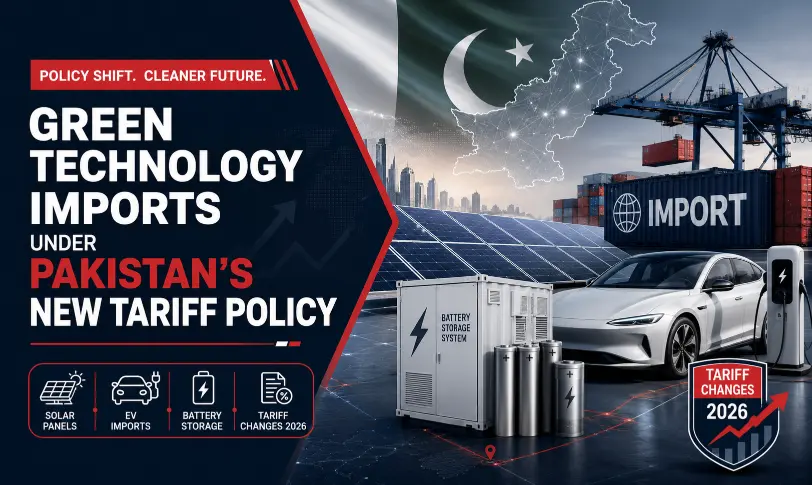

Pakistan has entered into one of the most important energy transitions in its history. It is estimated that today, about 25% of the country’s electric power comes from solar energy. In 2024 alone, the country imported 17 GW of solar panels, nearly twice as much as in the previous year. EV sales are rising, battery storage is expanding, and the government has just revealed its most impactful green technology tariff plan ever with the Finance Act 2026 and the National Tariff Policy 2025-30.
However, it is not an easy task to lower duties for everyone. The new strategy of Pakistan is eminently two-tracked: giving large incentives to local assembling and mass-marketing green technology, while imposing higher taxes on high-end imports. This is what it means for each of the categories.
Green Technology Import Duties: Quick Overview
| Category | Previous Rate | Current Rate (2026) |
| Solar panels (imported CBU) | 0% GST | 10% GST (from July 2025) |
| EV CKD components (batteries, motors) | 1% customs duty | 1% (extended to June 2027) |
| Luxury imported EVs (Rs. 2 crore+) | 0% FED | New Federal Excise Duty |
| PHEVs | Standard rates | 1% GST (concessional) |
| Standard Hybrids | Concessional | 40-45% on locally sourced parts |
| ACD on green tech imports | 2-7% (varies) | Phased elimination by 2029 |
Solar Panel Imports: The Zero-Duty Era Has Ended
Pakistan had a zero-duty policy on solar PV imports for years. Altogether, that policy led to one of the fastest solar transitions from the consumer side in the region, along with an appreciable drop in global panel prices and an almost tripling of electricity tariffs over three years.
This changed on July 1, 2025, when a 10% General Sales Tax went into effect on imported solar panels, after the industry protested the originally proposed 18% rate. The cost of the import per watt is slightly higher, but there is still no significant slowdown in deployment. The government argues that it needs to encourage domestic production of solar power, away from future import reliance, although it’s not clear if local production capacity can achieve that.
A clear two-tier policy for EV imports
The Finance Act 2026 kicks in on July 1, 2026, by introducing a new value-based framework for Federal Excise Duty on CBUs of electric vehicles to distinguish affordable EVs from luxury ones.
First, locally assembled EVs and REEVs are still well protected. The concessions for CKD have been extended till June 2027; for components of EV, the customs duty levied is just 1 %. Concessional charge on parts for local manufacturers retained with Electric bikes and e-scooters.
On the other side of the coin, luxury imported EVs costing Rs. 2 Crores and above are subject to a new Federal excise duty. These vehicles enjoyed unfunded green mobility privileges, while paying lower taxes than petrol vehicles with similar value. The Finance Act puts an end to that.
PHEVs will be treated separately with 1% GST while standard hybrid vehicles now bear 40-45% tax on locally sourced parts. The difference between these two categories sends a clear message as to which technologies the government is seeking to promote.
CD Elimination: The Advantage No One Is Discussing
One of the most important, but not talked about, advantages for green technology importers is the ACD (Investigation Schedule) with NTP 2025-30. Additional Customs Duty is now levied on almost all imports in the import catalogue, on top of the customs duty, in most product lines, 2 to 7%. EV components, solar inverters, and battery storage will continue to have landed costs drop over time, regardless of duty adjustments, with ACD being fully phased out by 2029.
Given this four-year compounding relief, it is now time to make green technology investments in Pakistan.
Battery Storage: Growing Market, High Import Costs
As Pakistan’s solar revolution continued, the country imported 1.25 GWh of batteries in the past year as well. Assuming current trends prevail, projections estimate possible battery imports of as high as 8.75 GWh through 2030.
The main difficulty is the expenses involved. The average landed cost of battery storage now contains approximately 48% taxes and customs. Still, home storage systems pay back in three to five years, and commercial systems pay back in four to six years. Battery Storage continues to become more economically viable as electricity costs stay high and net metering buyback rates are under threat of reductions.
Conclusion
The 2026 green technology import policy of Pakistan is not as straightforward as in other times. Solar panels are now subject to a low level of GST. EV policy is somewhat divided between privileges for local assembly and new taxes on luxury imports. Battery storage is still costly to install and use for the power grid. This will contribute to savings on all types of green technologies until 2029, with ACD elimination as the beneficiary. This is in the direction of a green market, and the government’s intention is in line with this, with an emphasis on local manufacturing, not endless dependence on imports.