
While searching for new EV/battery technology, you may have heard the terms LiFePO4 and solid-state batteries. There are already a billion electric vehicles on the roads now. The other is one of the most awaited technologies in the car industry, and Toyota, Samsung, and BYD are expected to bring it to market as the next big thing.
So, which is more reliable for EVs? Let us discuss the difference between LiFePO4 and Solid-State Batteries.
What Is a LiFePO4 Battery?
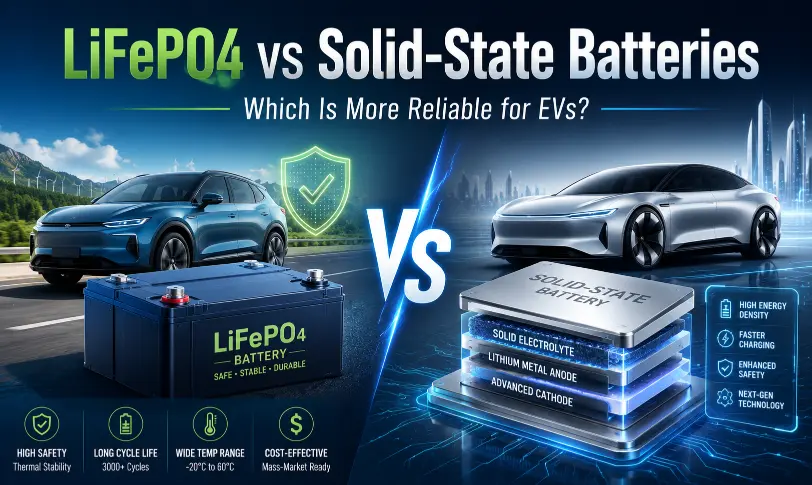
LiFePO4 batteries are also thermally stable batteries, which are very difficult to enter into the harmful thermal runaway. They are not cobalt-or nickel-based, which alleviates supply chain and ethical issues associated with cobalt mining. That said, they’re now the least costly mainstream EV battery chemistry on the market at about USD 50 to 60 per kWh (cell level).
One of the most popular battery types in Pakistan’s EV sector is the BYD Blade Battery, a Lithium Ferrite Phosphate (LiFePO4) design that is specifically tested to handle the ‘nail penetration’ safety test. It’s applied to all of BYD’s Dolphin, Seal, and Atto vehicles. Tesla’s Model 3 and YRWD’s are also based on the LiFePO4 chemistry, and MG4 Standard Range is as well.
What is a Solid State Battery?
The liquid electrolyte is replaced by a solid material, such as a sulphide, polymer, or ceramic compound, in a solid-state battery. It is a revolution in battery technology and capabilities.
The fire risk is significantly reduced, since no flammable liquid is inside. Solid electrolytes conduct ions very efficiently, which increases the speed of charging. It’s even demonstrated (in lab tests) the potential for 100,000 miles from an EV, which existing battery packs can’t match.
However, the purchase of an EV based on a completely solid-state battery pack is not possible as of 2026. QuantumScape, Solid Power, and Samsung SDI are operating pilot production lines. Toyota has made it an official objective to release commercial solid EV models by 2027-28. While this is a realistic possibility for 2030 and beyond, it is not currently within reality given the level of mass-market availability.
Head to Head: How They Actually Compare
| Factor | LiFePO4 | Solid-State |
| Energy Density | 120-160 Wh/kg | 400-500 Wh/kg (projected) |
| Safety | Very high, thermally stable | Higher, no flammable electrolyte |
| Cycle Life | 3,000 to 5,000 cycles | 1,000+ cycles (current prototypes) |
| Charging Speed | Fast, improving | Faster (projected) |
| Cost per kWh | USD 80-90 (2025) | USD 350-500 (2026 prototypes) |
| Commercial Status | Mass market, widely available | Pre-production, pilot stage |
| Cold Weather Performance | Moderate | Better (projected) |
There’s one number in that table that deserves a second look: cycle life. LiFePO4 can indeed have a much greater cycle life than the current SS prototypes, offering a cycle life of 3,000 to 5,000 cycles before degradation occurs. Prototype solid-state cells are currently lasting 1,000 or so cycles, but this is good news for making it much longer before commercial launch.
Which Is More Reliable Right Now?
LiFePO4 is clearly the more reliable option for EV reliability in 2026.
It has been used commercially for more than 10 years. There are several million vehicles on the road in various conditions, climates, and charge cycles from which real-world data can be found. The technology is mature, the manufacturing process is refined, and the cost has been steadily decreasing, with a 20 to 30% reduction in manufacturing costs expected by 2026. If you purchase a BYD, Tesla Standard Range, or MG4 today, you’ll receive battery chemistry with a proven history.
As of 2026, they are prototype solid-state batteries for EVs for solid-state batteries. The guarantees are true, the physics are warranted by all that is stated, but no real-world, long-term data to back that up exists yet. If you bring a perfect battery out of the lab after 2 years of testing and get it to work in your daily Lahore traffic for 10 years without any issues, it’s a different machine altogether.
Does that imply that Solid-State is not Worth It?
The trend for solid-state batteries for EVs is not new, and the timeline is getting clearer. However, if Toyota achieves its goals of a 700-plus-mile range and an hour of charging for its 2027-to-2028 targets for solid-state vehicles, it will truly represent a generational change.
LiFePO4 is the safe, sound, and affordable battery of choice for anyone purchasing an EV today. If you are thinking of waiting a couple of years before buying your first EV, an age-old excuse is a legitimate one to be patient.
What This Means for EV Buyers in Pakistan?
The following EVs available in Pakistan are currently based on LiFePO4: BYD’s Blade Battery technology and MG’s Standard Range. These are no second-rate batteries. These are the most cycle-focused and safe mass-market EV batteries on the market today.
Eventually, solid-state technology will enter Pakistan, as it trickles down through higher-end product launches worldwide and into commercial applications. However, that will be a tale for the 2030s. If you’re seeking an EV right now, LiFePO4 is not an option you have to settle for. It is the correct answer for this day and age.
Conclusion
LiFePO4 batteries offer durability and are currently the most reliable battery known to date on the EV battery market. While solid-state batteries offer faster charging and greater energy density, the real-world reliability data is not available. They are fairly new and maybe after a few years can be considered reliable, but right now people are still choosing LiFePO4 because of convenience and availability.