
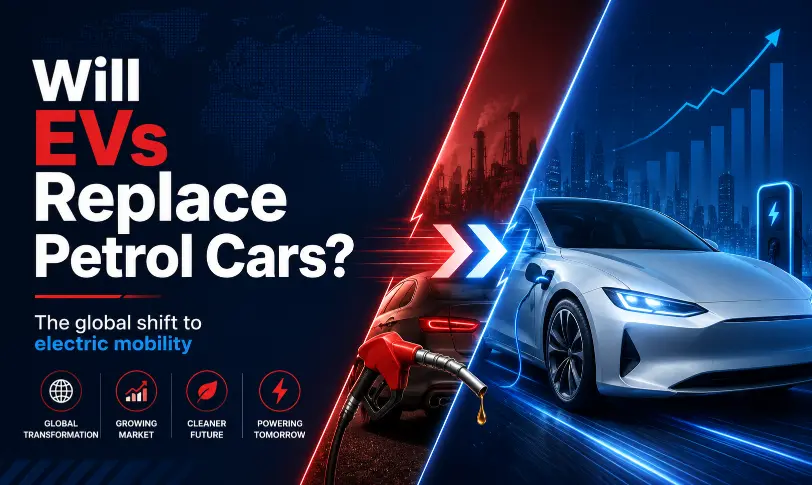

The EV transition is no longer a possible future scenario; rather, it has already become a reality and is affecting car sales globally. Moreover, about 1 in 4 new cars sold worldwide today is electric cars, and that is increasing in most major markets. The question is whether EVs will replace petrol cars, and are we preparing for that?
Where the Numbers Stand Today
In 2025, sales of electric vehicles globally reached 20 million, representing 20% more than the previous year, making one in four electric vehicles sold globally. Sales are expected to grow by a further 12% in 2026, to about 23 million units and 28% of the world’s new-car sales.
The regional variance in EV adoption is notable; the true story is:
- China is still by far the market leader with nearly a 55-60% market share of electric cars, a significant domestic supply chain, and strong price competition among manufacturers.
- EU is on a steep path for growth, with EVs accounting for around 28% of sales in new cars by 2025 and approaching 1 in 3 vehicles sold in 2026 with stricter EU emissions limits.
- The US is the clear outlier, accounting for around 10% of EV market share. Federal tax credits are ending, and affordable Chinese models were hard to find because of import taxes, as well as consumer preference for big cars.
Electric vs Fuel Future: The Case for Widespread EV Adoption
The market is continuing on its path toward EVs for several structural reasons:
- Falling battery costs: Cost of EVs fell by an average of about 8 percent last year, largely to lower raw-material costs and the increased availability of lithium iron phosphate (LFP) chemistry, which relies on non-pricy materials such as cobalt and nickel.
- In some major segments, BEV technology is now cost-competitive with gasoline-powered alternatives, such as the automaker’s battery electric SUV introduction in China.
- As long as oil prices are high, the benefits of EVs in terms of lowered fuel and maintenance costs become even larger than they are now.
- Compared to early luxury-focused offerings, the number of EV models under $40,000 has increased significantly in the market.
- The EV fleet is expected to be nearly seven times higher by 2035, and by some estimates, EVs may occupy more than half of all new-car sales globally by then, even without new policy support.
Electric Car vs Fuel Future: Why Petrol Isn’t Disappearing Overnight
However, several reasons will ensure petrol and hybrid cars stay relevant for years to come:
- Uneven policy support: Sales in the United States and Canada, where markets are less keen on EV incentives, have eased. Policy continues to be one of the most powerful tools influencing uptake rates at a regional level.
- Charging infrastructure gaps: Long-distance drivers are not feeling very confident in several key markets when it comes to public charging buildout, especially in rural areas.
- Vehicle mix mismatch: In the U.S., more than 85% of EV options available are in the SUV or large vehicle space, which has limited EV purchasing for these cost-sensitive customers.
- Uses plug-in hybrids as a transitional technology: As a stepping stone to full electric vehicle electrification, plug-in hybrid and range extender models have been growing in respectable numbers in many markets.
- Despite the pace for new cars turning electric, it will take decades to be able to replace the current global fleet of more than a billion petrol cars.
Conclusion
The direction is obvious, even if the dates differ by area. In China and much of Europe, EV sales are on track to take over one-third of all new car sales, and the market share will steadily increase. The pace of adoption in the U.S. is based on policy considerations and vehicle preferences rather than technology or consumer interest in other parts of the world.
By 2035, the global number of EVs is expected to reach as many as 510 million vehicles. That suggests that EVs will be on top of new car sales before petrol cars are finally phased out of car markets completely.