
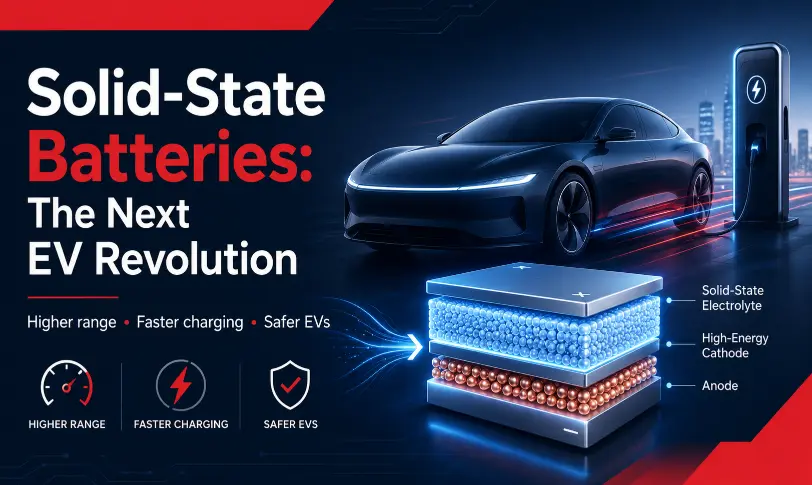

Solid-state EV batteries are making the transition out of labs into real prototype vehicles, and the auto industry is making it a turning point. The technology in the future can offer a higher range, quicker charging, and a decrease in fire risk over the current lithium-ion packs. Let us discuss the solid-state batteries and the next EV revolution that is coming up.
What Is a Solid-State Battery?
All existing EVs use a liquid electrolyte, which is a flammable solution that transports ions between the positive and negative. It certainly does the job, but it is also one of the major contributors to fire danger. In physical damage, overcharging, or in extreme heat, that liquid can catch fire and cause thermal runaway.
In a solid-state battery, a liquid is replaced by a solid substance, usually a ceramic, sulfide, or polymer compound. The solid-state cell can tolerate high temperatures of up to approximately 247°C, whereas for standard lithium-ion batteries, the value is in the low 90s.
In addition to safety, solid electrolytes offer three benefits that are important for the next generation of EV batteries:
- Greater range from a battery of similar size and weight
- Improved charging speed: The early prototypes have achieved 80% charging in less than 10 minutes
- Better products significantly reduced the risk of fire or thermal runaway
Lithium vs Solid State: A Direct Comparison
| Categories | Lithium-Ion (Current) | Solid-State (Emerging) |
| Range potential | Established, steadily improving | Higher energy density per unit of weight |
| Fire risk | Present, well-managed | Significantly lower |
| Charging speed | Roughly 20–40 minutes for a fast charge | Targeting under 10 minutes |
| Production readiness | Fully industrialized, global scale | Limited to pilot lines and prototypes |
| Cost | Declining steadily with scale | Currently high, expected to fall with volume |
Not far behind, lithium-ion technology is progressing also, with better LFP chemistry and silicon-anode cells increasing range and reducing costs. The challenge for solid-state manufacturers is to compete with an ever-shifting target.
Who Is Developing Technology?
Most of the major car makers and battery makers now have programs in progress, but dates are quite different:
- Toyota has one of the largest solid-state patent portfolios and will pursue small-scale production between 2027-28, with energy density targets between 450 and 500 Wh/kg.
- QuantumScape and Volkswagen’s PowerCo have sent out B-sample lithium metal batteries and achieved promising lab cycle-life performance.
- Chinese manufacturers such as CATL are developing “semi-solid” batteries, which have some liquid electrolyte. These cells are currently produced in small quantities and are used in high-end cars like NIOs.
- Solid Power, backed up by Ford and BMW, and Factorial Energy are developing alternative sulfide and quasi-solid chemistries.
Semi-solid batteries dominate the market for all-solid batteries, allowing manufacturers to improve safety and density without investing in new production lines.
Production Timeline
There are several crossovers on industry roadmaps that all largely see:
- 2027: pilot production lines and prototype cars for test and validation only, not built for consumers.
- 2027-2028: first debut of limited-run solid-state EVs, to be seen in higher-priced cars valued above $80,000.
- 2030 and beyond: more widespread implementation, increased scale, and cost reduction.
EV buyers looking for a purchase in the near future should find an EV with lithium-ion batteries, which are well-tested, proven, and advancing.
Conclusion
The key drawbacks of lithium-ion technology, namely range, charging rate, and fire risk, can all be overcome by solid batteries. Investment and development efforts continue in the industry, and the first production vehicles are closer than ever before. The shift will be phased in gradually, first for higher-priced cars and eventually through to the wider automotive market, much like previous battery transitions.
If you’re a buyer who needs to make your purchase today, lithium-ion electric vehicles are the sensible option. Monitoring of solid state technology in the coming few years will be worthwhile, as it approaches commercial scale.