
So, if you ever came across a question of why in Pakistan cars cost more than in other countries, a huge share of the burden is on duty. The government levies customs duty on car entry into the country. Moreover, another duty called Additional Customs Duty or Regulatory Duty is imposed on top of it. When piled up side by side, Pakistan has one of the highest import tax burdens in the entire region. The Ministry of Commerce has just released the National Tariff Policy 2025-30 to alter just that. Based on that, it calls for car buyers to understand what it really includes.
Why have the tariffs been high in Pakistan?
The current duty rate in Pakistan is 20% of the combined rate of customs duty, additional customs duty, and regulatory duty. For comparison, the average tariff across Southeast Asia stands at 6.5%, and in China at 7.5%. But not only are the taxes higher in Pakistan than in its neighbours, but it is also much higher.
This has left the car prices high for years. That is an incredibly high level of protection for local manufacturers, and it’s definitely not good for the individual purchasing a vehicle. With less competition, there is less pressure to keep costs competitive.
The previous tariff policy (2019-24) did make some headway. Duties were removed on over 2,000 product lines, and the effective tariff rate came down from 10.6% to 6.7% by 2024. Even in 2022, there was a record increase in exports worth USD 39.52 billion. That was still too high, too complex, and too steep in favor of big businesses over ordinary customers and small businesses.
What does the New Policy Plan do?
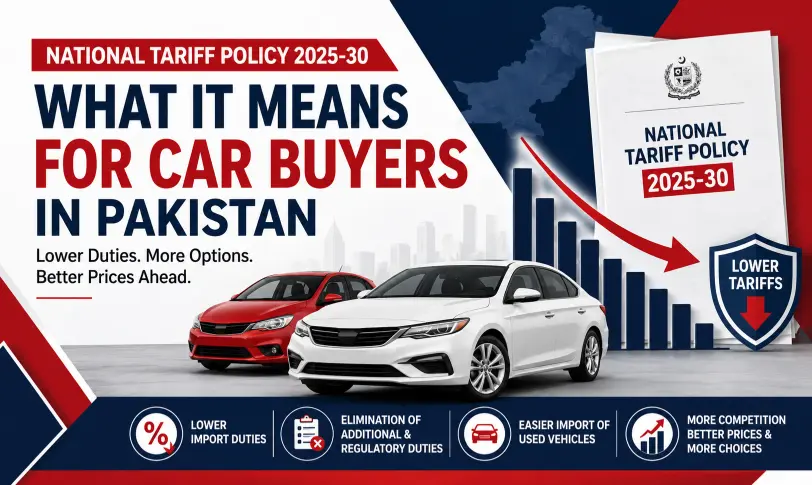
The overall average combined tariff rate has been dropped from more than 20% at present to 9.70% by 2029-30 (as per NTP 2025-30). That’s a drastic decrease, and it comes in four ways.
One of the first is the easing of the customs duty slab. There are currently five unequal rows. That drops to four clean tiers of 0%, 5%, 10%, and 15%, respectively, over five years under the new policy. The highest customs duty will be reduced to 15% by the end of the policy term.
Second, Additional Customs Duties get eliminated. Today, over 7,400 product lines are subject to these additional charges. They were intended to be temporary but became permanent, incrementally increasing the items’ price. They will be eliminated in four years.
Third, Regulatory Duties are also being phased out over 5 years. They were instituted to safeguard certain industries but actually resulted in an uneven and unfair tariff system where similar products have vastly different tariffs for unspecified reasons.
Fourth, a complex exemption system, the Fifth Schedule, which provided a low duty regime for large manufacturers but not for smaller ones, will shift over time toward the standard tariff.
What does this mean for the Auto Sector?
This policy has been carved out in its own section, with substantial modifications in the autos sector.
The outgoing auto-industry policy (AIDEP-2021-26) will end in June 2026. The new auto policy will be rolled out starting July 1, 2026. All extra customs and regulatory duties for automobile products will be removed, and customs duty levels will be lowered under the NTP 2025-30. Under the old regulations in force since 2006, a review of the rules and they will be updated.
Also, big news: the policy calls for the elimination of any limitations on the amount of old and used vehicles being imported. Pakistan has been traditionally stringent with the import of used cars. Relaxing those restrictions also increases supply to the used car market, which drives used car prices further down and broadens buyers’ selection.
For those assembled in local plants, this could mark the end of the days of being virtually blind to foreign competition. While this will put pressure on the industry in the short run, in the long run, the manufacturers will have to play fairer on price and quality for the benefit of the buyer.
Will Car Prices Actually Drop?
It will not be overnight or even right away. The cuts are spread over five years, which means that the impact of the policy is cumulative over time. However, the direction is clear.
However, when the import duty decreases, the prices of importing cars and car parts to Pakistan reduce. This contributes to the dealership-level prices in the long run. More options and reduced duties mean more competitiveness for the used and imported car segment.
The government estimates that these reforms will boost imports by 5 to 6% and exports by 10 to 14%. As tariff pressures ease, inflationary pressures on imported items such as cars and car parts will likely be reduced.
Conclusion
The car industry has been a heavily protected market in Pakistan for a long time. A National Tariff Policy is the most detailed attempt to open it up, reduce tariffs to regional levels, and provide better choice at more equitable cost. These changes won’t occur immediately, but the policy now exists, and the reforms in the auto industry will start in July 2026.